




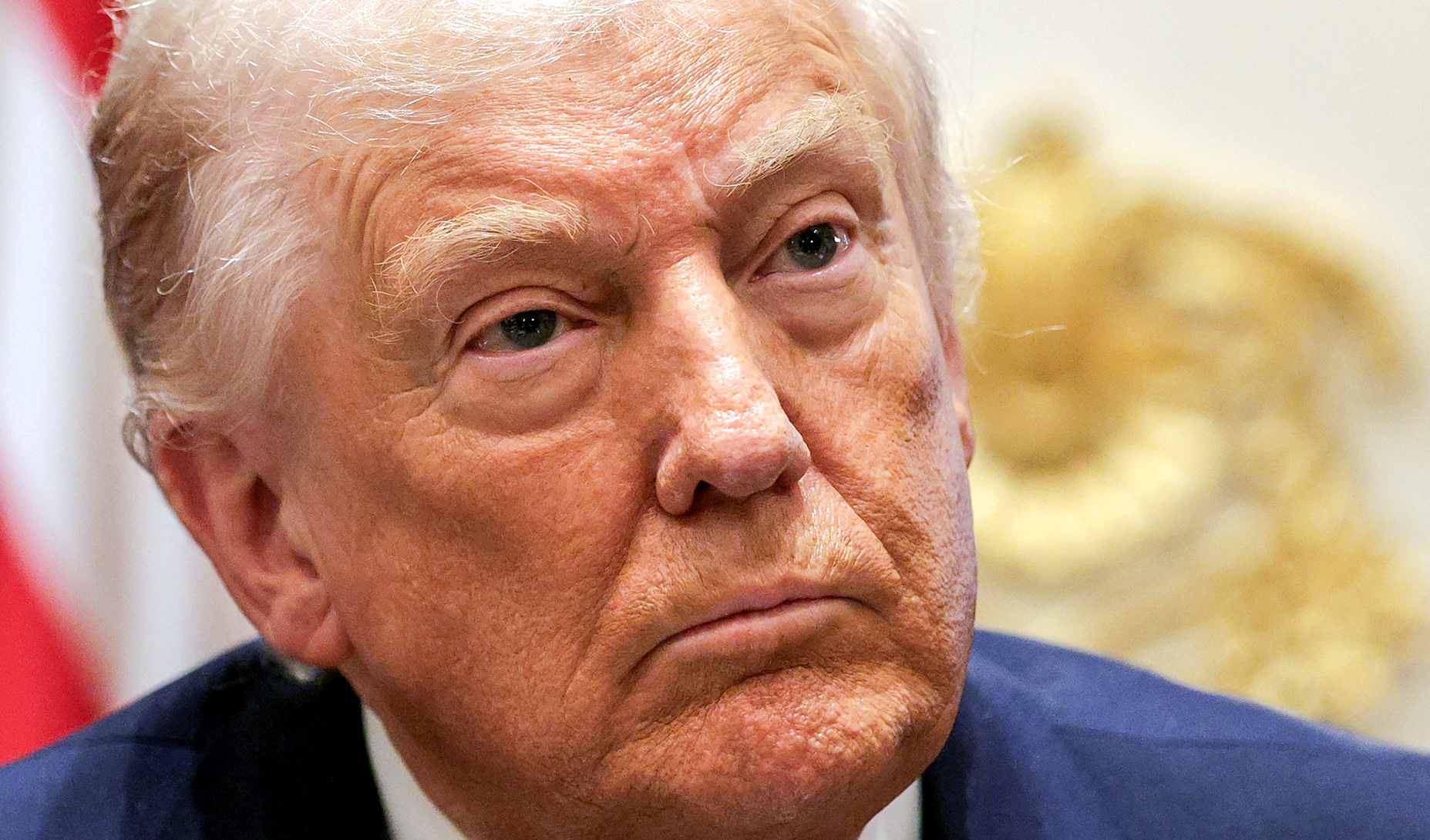
 US President Donald Trump has unveiled his new National Security Strategy, and its not good news for Africa. (Photo: Alex Wong / Getty Images)
 /file/dailymaverick/wp-content/uploads/2025/10/label-analysis-2.jpg)
“Dominate the Americas, respect China, undermine Europe, ignore India, retreat from the Middle East, don’t give a damn for Africa. These are the true headlines of the new US National Security Strategy released this week,” says former Norwegian peace negotiator and Minister of International Development, Erik Solheim.
And Solheim is largely on the mark. The National Security Strategy is certainly remarkable in its blunt and peculiar view of the world – and its unapologetic assessment of how President Donald Trump intends to shape it in America’s interests.
The candour is most apparent in dealing with the Americas and Europe. The Monroe Doctrine, dating back to 1823, proclaimed the Americas as an exclusive US sphere of influence. In recent years, though, it has been implied rather than explicitly invoked.
But Trump’s National Security Strategy spells it out unambiguously, stating that: “After years of neglect, the United States will reassert and enforce the Monroe Doctrine to restore American preeminence in the Western Hemisphere…”
/file/attachments/orphans/7930434_470460.jpg "Erik Solheim, former Norwegian peace negotiator and Minister of International Development. (Photo: EPA / Martial Trezzini)")
The US will prevent competitors positioning forces “or other threatening capabilities…in our Hemisphere”.
The National Security Strategy labels this strategy “the ‘Trump Corollary’ to the Monroe Doctrine”, a broad hint to the historians on how Trump would like it to be named.
Yet the National Security Strategy also departs from what it says has been America’s post-Cold War goal of “permanent American domination of the entire world” by stating that the US should not try to impose itself – and particularly its liberal order – on other regions like the Middle East, Asia or Africa.
Insulting Europe
The National Security Strategy is extremely direct, even insulting, to Europe, predicting that it is heading for “civilisational erasure” unless the US steps in to help it change course. It blames this on the European Union suffocating creative business with regulations, and undermining national sovereignty, European nations undermining political liberty, migration policies creating strife and changing the character of nations, plus “censorship of free speech and suppression of political opposition, cratering birthrates, and loss of national identities and self-confidence”.
The accusation of censoring free speech and suppressing political opposition – echoing Vice-President JD Vance’s speech to the Munich Security Conference in February this year that so outraged the Europeans – is clearly aimed at Germany and other nations for their restrictions on pro-Nazi and other hate speech. The Trump administration interprets this as an undemocratic attempt to counter far-right political parties such as the populist, pro-Russian Alternative for Germany (AfD) which is now the second-largest party in the Bundestag.
The National Security Strategy welcomes “the growing influence of patriotic European parties” and says the US will support them, “cultivating resistance to Europe’s current trajectory within European nations”.
That sounds a lot like the widespread interference by Russia in European internal politics, also in support of far-right parties.
The strategy document also strongly criticises Europe’s policy of helping Ukraine to continue fighting against Russia’s invasion instead of seeking to negotiate a ceasefire, as the US is doing. It criticises European officials “who hold unrealistic expectations for the war, perched in unstable minority governments, many of which trample on basic principles of democracy to suppress opposition”.
A large European majority wants peace, the National Security Strategy claims, but is ignored by governments that are subverting democratic processes.
Orthodox on Asia
On Asia, Trump’s National Security Strategy takes a more orthodox US approach, aimed basically at containing China. The strategy boasts that Trump “reversed more than three decades of mistaken American assumptions about China: namely, that by opening our markets to China, encouraging American business to invest in China, and outsourcing our manufacturing to China, we would facilitate China’s entry into the so-called ‘rules based international order’.
“This did not happen. China got rich and powerful…”
The National Security Strategy says the US should enlist nations like India to ensure they do not become subordinate to any other power (i.e. China) and to encourage India, especially, to contribute to Indo-Pacific security, including through the Quadrilateral alliance (“the Quad”) with Australia, Japan and the UA.
Having just insulted Europe, the National Security Strategy says that if Europe, Japan, South Korea and other allies mobilise their vast foreign assets, they could outdo China’s successful efforts to influence the Global South.
Read more: South Africa delivered at the G20, Trump delivered a tantrum
The strategy likewise proposes that America should “enlist our European and Asian allies and partners, including India, to cement and improve our joint positions in the Western Hemisphere and, with regard to critical minerals, in Africa”.
The National Security Strategy also maintains the historical US posture on Taiwan, saying that “deterring a conflict over Taiwan, ideally by preserving military overmatch, is a priority” and that “the US does not support any unilateral change to the status quo in the Taiwan Strait”.
The document highlights the strategic importance of supporting Taiwan, not only because of its dominance of semiconductor production, but mostly because of the island’s critical geographical position bridging the South China Sea and the East China Sea, through which so much global shipping passes.
“This could allow a potentially hostile power to impose a toll system over one of the world’s most vital lanes of commerce, or – worse – to close and reopen it at will,” it says.
But, as with Trump’s criticism of Nato allies for not doing their share, the National Security Strategy demands that America’s allies in the Western Pacific – specifically Japan and South Korea – must contribute more to the collective defence of that region.
On the Middle East, the strategy declares that the days when it dominated American foreign policy “are thankfully over”. This is because the US is no longer dependent on its oil, having become a net energy exporter itself and also because the region is no longer a “constant irritant, and potential source of imminent catastrophe… Instead it is emerging as a place of partnership, friendship, and investment.”
For this, the National Security Strategy duly gives Trump most of the credit, because of his Abraham Accords with several Gulf States and also his help to Israel in neutralising the threat of Iran – “the region’s chief destabilising force” – by bombing its nuclear facilities in June 2025. The strategy also credits Trump for helping to stabilise the region by negotiating a ceasefire in Gaza.
African an afterthought
Africa, as so often in such strategic thinking, is also something of an afterthought here. The National Security Strategy makes it clear that in Africa, as elsewhere, the Trump administration will depart from the longstanding US policy of “spreading, liberal ideology”.
Instead, the US should partner with select countries to ameliorate conflict, foster mutually beneficial trade relationships, and transition from a foreign aid approach to an investment and growth approach to harness Africa’s abundant natural resources and latent economic potential. This approach is, of course, consistent with the Trump administrating having scrapped the US Agency for International Development (USAid) soon after taking office.
The documents says the US should seek to settle conflicts such as between the Democratic Republic of Congo and Rwanda (which it is already doing) and the civil war in Sudan. It should also try to prevent new conflicts “(e.g. Ethiopia-Eritrea-Somalia)” and also “remain wary of resurgent Islamist terrorist activity… while avoiding any long-term American presence or commitments”.
The National Security Strategy is ambiguous about the Africa Growth and Opportunity Act (Agoa) that allowed duty-free access to the US market for most exports of eligible African countries until it expired in September this year. It greatly helped some South African exports, such as luxury automobiles, fruit and wine. Speculation continues about whether it might be resurrected.
Read more: Agoa has officially lapsed but US mulls one-year extension
The National Security Strategy rather cryptically proposes “action to amend our approach to aid and investment (e.g. the Africa Growth and Opportunity Act)” without hinting at what changes it envisages.
The document adds that the US should favour partnerships “with capable, reliable states committed to opening their markets to US goods and services”.
“The immediate focus for US investment in Africa should be the energy sector – particularly nuclear energy, liquid petroleum gas, and liquified natural gas – and critical mineral development.”
‘Allies do not threaten allies’
The reaction to the National Security Strategy has been varied. Unsurprisingly, the Europeans have been highly critical, with European Council president António Costa bluntly declaring that the EU would not tolerate “political interference”, saying “allies do not threaten to interfere in the political life or the internal democratic choices of other allies”.
/file/attachments/orphans/GettyImages-2237004273_184012.jpg "Antonio Costa, president of the European Council. (Photo: David Dee Delgado / Bloomberg via Getty Images)")
He was quoted by Euronews in remarks at a conference in Paris on Monday, 8 December 2025.
Torrey Taussig, a senior fellow at the Atlantic Council in the US, said the strategy had scored an own goal on Europe and undermined America’s own interests. She said the Trump administration had scored a win this year by pushing its Nato allies to agree to increase defence spending from 2% to 5% of their GDPs.
But by underplaying the threat that Russia posed to transatlantic security, “the National Security Strategy does not empower those nations that are working to take on greater defence responsibilities. Instead, the strategy seeks to embolden those nationalist and populist parties (such as the AfD in Germany) that would be the most likely to cut defence budgets and downplay the conventional threats that have traditionally fallen to a reliance on the United States.
“In this regard, the National Security Strategy is an own goal that undermines the administration’s stated objectives for what it seeks to achieve with European allies.”
Read more: G20 South Africa goes post-Trump as middle powers signal fresh path
/file/attachments/orphans/2740802_474399.jpg "Rama Yade, a senior director of the Atlantic Council’s Africa Center. (Photo: EPA / Yoan Valat)")
On Africa, Rama Yade, senior director of the Atlantic Council’s Africa Center, noted that the National Security Strategy’s themes were mostly familiar. But she added that the strategy had articulated a more interventionist security policy than had been apparent so far. She noted, though, that the administration started this shift in February with large strikes on Somalia against a leader from the local branch of the Islamic State of Iraq and al-Sham (Isis).
She also said the National Security Strategy hinted that after the peace agreement signed this week in Washington between DRC President Felix Tshisekedi and Rwandan President Paul Kagame, Trump would next turn to Sudan and the ongoing genocide in Darfur.
And she noted that the National Security Strategy was silent about Trump’s big fights with South Africa and Nigeria – the latter over its alleged failure to protect Christians from jihadists – which suggested these were more about domestic US politics than Africa policy.
Overall, Solheim – the Norwegian diplomat quoted at the top – saw the National Security Strategy as finally heralding the emergence of a long-anticipated multipolar world to succeed the unipolar world dominated by the US.
In his analysis posted on X, he called the National Security Strategy “the first official US acknowledgement that the US can no longer run the world. A US retreat from global dominance is welcome and overdue. The rest of us must rise to the occasion and shape the new world order.”
That is particularly true for Europe, for which he says the strategy shows “complete contempt… There’s no win-win here. It’s all about America first and America last.”
US National Security Strategy: The multipolar world has finally emerged.
— Erik Solheim (@ErikSolheim) December 7, 2025
Dominate the Americas, respect China, undermine Europe, ignore India, retreat from the Middle East, dont give a damn for Africa. These are the true headlines of the new US National Security Strategy… pic.twitter.com/LikV9GUSqx
Only by standing up for their own interests and showing self-confidence would nations be respected by the US. For Europe in particular, the National Security Strategy should be a catalyst to “stand up, unite, defend our values, integrate and achieve strategic autonomy from the US. The Trump flattery by European leaders brings only shame on Europe.”
And he notes: “Africa is of no interest to Trump, except as a source of raw materials. Africa will only develop by standing up for itself and seeking broad partnerships with China and others.
“The old US-dominated world is in tatters. The new world order is yet to be shaped. Let us shape it together!” DM