




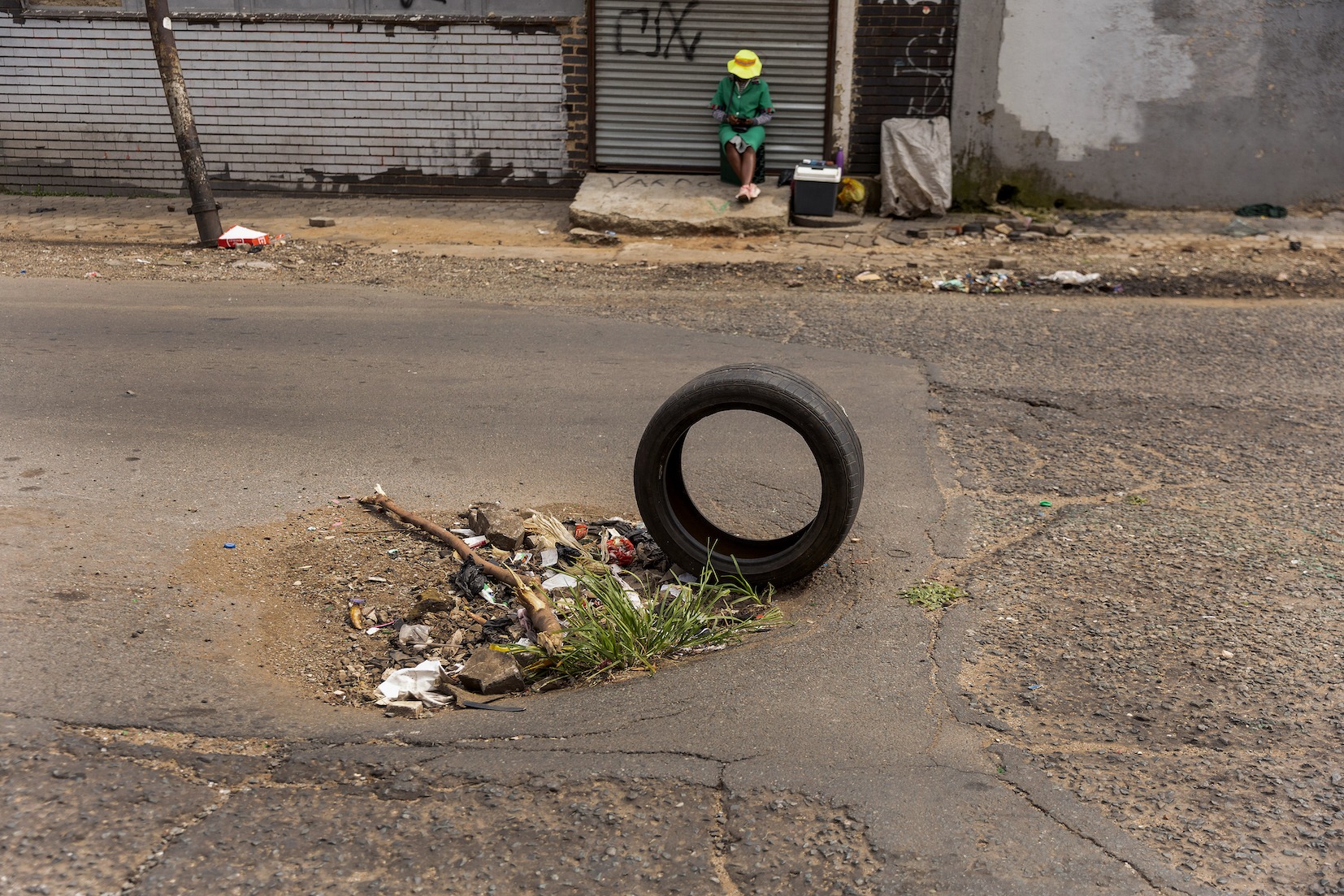
 An informal trader sits near a tyre placed as a warning for a pothole, in Newtown, Johannesburg, on 23 February 2023. (Photo: Our City News / James Oatway)
Every person in Johannesburg has a pothole story. A near miss, a Christmas tree planted in the pothole, a swimming hole. But not all holes on the roads are equal.
Some are potholes, while others are excavations carried out by entities such as Johannesburg Water or City Power when repairing infrastructure. Once this work is completed, the Johannesburg Roads Agency (JRA) is responsible for reinstating the road surface.
A pothole is generally defined as a hole in the road surface that is no more than one square metre. They form when water seeps beneath the road surface, erodes the underlying material and weakens the tarmac.
The Department of Transport estimates that it costs between R700 and R1,500 to fix a pothole. In Johannesburg the JRA says more than 980 potholes are reported per week through its various reporting channels.
The JRA is responsible for maintaining roads that are part of the City’s 13,599km road network, of which 12,431km are surfaced and 1,168km are gravel roads. The JRA says that in general South African roads have a 25-year lifespan, with regular intervals of maintenance required to reach that.
/file/attachments/orphans/Hillbrow_hole_01a_754304.jpeg "A massive pothole on Claim Street in Hillbrow, photographed on 11 November 2025. (Photo: Our City News / James Oatway)")
“Factors such as ageing infrastructure, uncontrolled excavations on the City’s road network for new services, high traffic volumes and the overloading of heavy vehicles and harsh weather conditions such as heavy rainfall and excessive heat from the sun contribute to the deterioration of the City’s roads and the formation of potholes,” says spokesperson Lucia Mhlanga.
She says the City conducts a Visual Road Condition Index (VCI) every three years to assess the state of roads and bridges and then allocates resources for the required work according to the outcomes of the VCIs.
Figures from July to December last year show that 23,572 potholes were reported to the JRA, with 20,302 fixed. These figures do not include the potholes reported on the Discovery app and fixed by the Pothole Patrol teams.
The JRA has allocated significant funding in the 2025/26 financial year towards maintaining and improving Johannesburg’s road infrastructure, including pothole repairs. The JRA has a budget of R912.8-million in the 2025/26 financial year for ageing road infrastructure, of which R149-million is dedicated to pothole repairs.
/file/attachments/orphans/Pothole1a_406965.jpeg "A pothole at the intersection of Langerman Drive and Queen Street in Kensington on 3 March 2026. (Photo: Our City News / James Oatway)")
Motorists who experience pothole-related vehicle damage in South Africa can submit a claim to the relevant road authority. Claims typically require proof of the incident, repair quotes and an affidavit submitted to the appropriate authority – Sanral for national roads or the relevant municipality for local roads.
Supporting documents usually include a certified copy of an ID, driver’s licence, vehicle registration, photographs of the pothole and damage, and a police affidavit. Additional documentation such as repair quotes and an assessor’s report may also be required.
Claims for national roads (N-roads) are handled by Sanral, while municipal road claims are processed by the relevant municipality, such as the JRA in Johannesburg.
It is crucial to initiate the claim as soon as possible, ideally within 15 working days of the incident. DM
This story is produced by Our City News, a nonprofit newsroom that serves the people of Johannesburg.
/file/attachments/2985/WhatsAppImage2025-11-21at1946001_346702_1cea9e715c05dc0a538fc79753ac3401.jpeg)
Comments
Scroll down to load comments...