




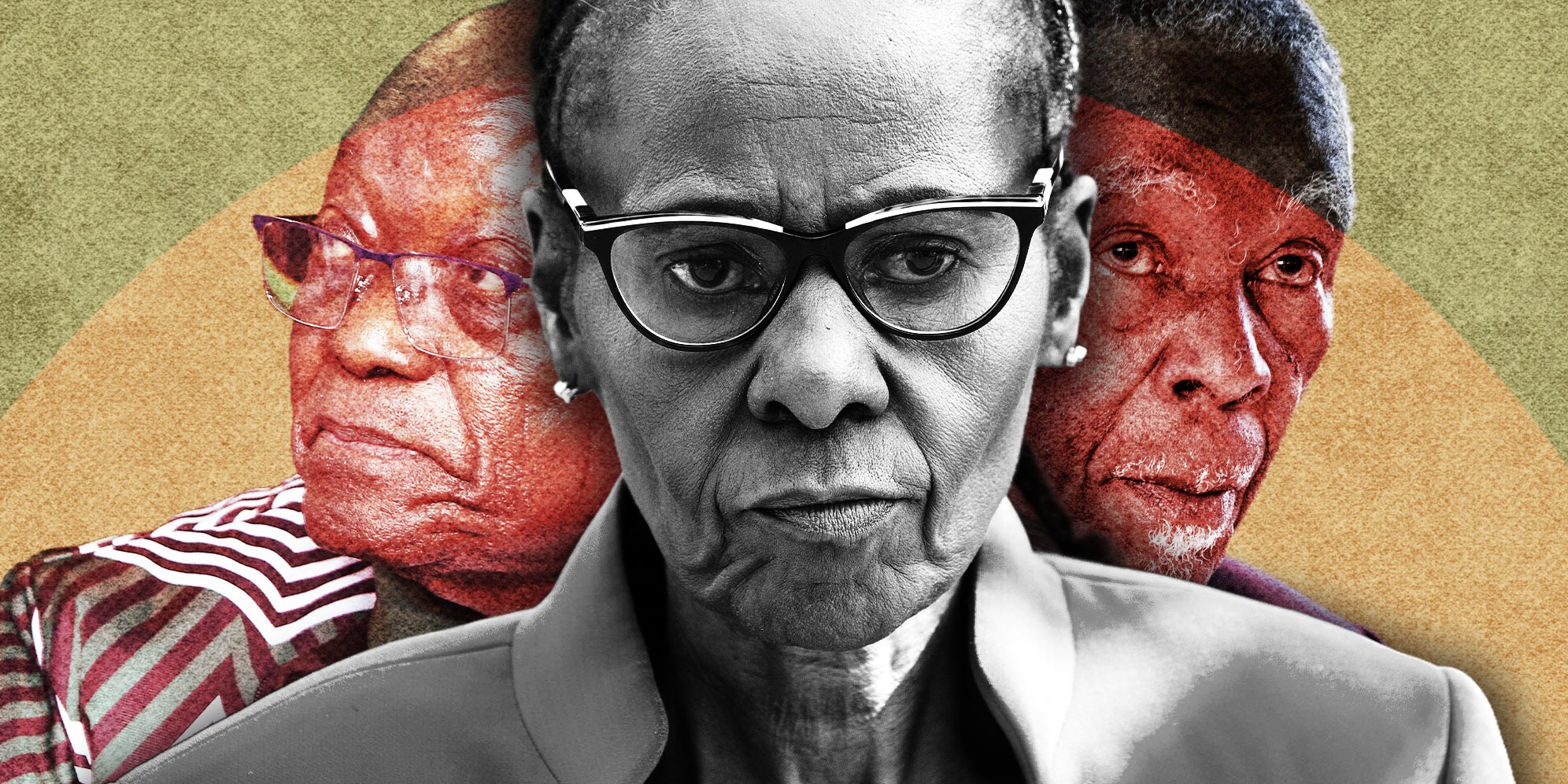
 Illustrative Image: Justice Sisi Khampepe (centre). (Photo: Gallo Images / Alet Pretorius) | Former president Jacob Zuma (left). (Photo: Gallo Images / Siyabonga Sokhela) | Former president Thabo Mbeki (right). (Photo: Gallo Images / Per-Anders Pettersson) | (By Daniella Lee Ming Yesca)
 Former presidents Thabo Mbeki and Jacob Zuma have taken the extraordinary step of challenging the very legitimacy of the Khampepe inquiry into allegations of political interference in Truth and Reconciliation Commission (TRC) cases.
Both former leaders have approached the Gauteng Division of the High Court in Johannesburg in an attempt to have retired Constitutional Court judge Sisi Khampepe removed as head of an inquiry into TRC prosecutions delays.
Incumbent president, Cyril Ramaphosa, indicated he would not oppose this bid by his predecessors, but “would abide by the decision of the court”. In his notice of motion, Mbeki requested that Ramaphosa terminate Khampepe’s appointment with “immediate effect”.
/file/attachments/orphans/13526697_401222.jpg "President Cyril Ramaphosa.(Photo: EPA / Thomas Mukoya)")
Ticking clock
Mbeki also sought a declaration that “all acts and decisions” undertaken by the commission and involving Khampepe were a “nullity”.
The commission, appointed by Ramaphosa and consisting of Khampepe, retired Northern Cape Judge President Frans Kgomo and advocate Andrea Gabriel, is mandated to complete its work by 29 May 2026 and to submit its final report by 31 July.
In a surprising twist, Ramaphosa, in his court papers, admitted that had he been aware of certain TRC-era decisions made by Khampepe, he might not have appointed “her, to avoid public criticism or review proceedings”.
/file/attachments/2988/yates-calataInterview_400430.jpg "Lukhanyo Calata, son of Fort Calata, one of the Cradock Four who were murdered in the apartheid era, has accused the ANC of betraying victims’ families by halting prosecutions due to a ‘secret agreement’ with apartheid-era leaders. (Photo: Supplied)")
High-stakes confrontation
This challenge is not merely a dispute over legal procedure; it is a high-stakes confrontation over public accountability, the independence of the judiciary and the elusive quest for justice for victims of apartheid-era atrocities.
The commission stands accused by Zuma and Mbeki of bias and unconstitutionality. These charges, the commission’s legal team argued, were a “dilatory and meritless stratagem” designed to evade the demands of the law.
The current litigation was sparked by Zuma’s application on 6 February, later joined by Mbeki, seeking to review and set aside Justice Khampepe’s decision to dismiss an application for her own recusal.
They argued that Khampepe’s past roles within the TRC and the National Prosecuting Authority (NPA) rendered her incapable of presiding over the inquiry with an “impartial mind”.
However, the commission’s chief evidence leader, advocate Ishmael Semenya, hit back, arguing that Mbeki and Zuma were engaging in an “abuse of court process”.
He noted that the review was being brought “midstream” – in the middle of incomplete proceedings, a move that South African case law suggested should be entertained only in “rare and exceptional circumstances”.
Semenya said there was no “manifest prejudice” to the former presidents that could not be remedied later and that their primary goal was to hinder the “efficient execution” of the commission’s mandate.
For the survivors of apartheid victims, who have waited decades for closure, this legal tug-of-war represents another agonising delay in a process meant to provide answers.
Shadow of the past
The core of the recusal argument lies in Justice Khampepe’s professional history.
Between 1996 and 2001, she served on the Amnesty Committee of the TRC, and from 1998 to 1999, she was the Deputy National Director of Public Prosecutions.
Zuma and Mbeki contend that these roles involved “institutional responsibility” for shaping the very policies that the commission must now investigate for political interference.
Mbeki, in particular, has expressed a “reasonable apprehension” that Khampepe’s prior vocational history made it impossible for her to approach the evidence with an “open mind open to persuasion”.
Zuma has gone even further, raising a “whistleblower” claim, suggesting that Khampepe allegedly coached and colluded with evidence leader Semenya to resist recusal applications.
This has been dismissed by the commission as “slanderous” and unsupported by a single “morsel of evidence”.
Acid test for bias
Semenya said the commission’s defence was anchored in the “acid test” for bias. He set out that the inquiry’s terms of reference were narrow and factual: investigating interference occurring from 2003 onwards.
Since Khampepe’s roles in the TRC and NPA ended in 2001 and 1999, respectively, he argued there was a clear “temporal boundary” that rendered her past involvement irrelevant to the current inquiry.
“It is too far-fetched,” Semenya declared, “to speak of prosecution policy to link the Chairperson as the one who ‘shaped’ it”.
/file/attachments/orphans/WFD_9283_700305.jpg "Former presidents Thabo Mbeki (left) and Kgalema Motlanthe. (Photo: Felix Dlangamandla)")
Mbeki’s overreach
Perhaps the most radical element of the litigation is the relief sought by Mbeki that Khampepe be removed with immediate effect. Semenya characterised this as an “unjustifiable overreach” and a violation of the separation of powers.
Under Section 84 of the Constitution, the power to appoint (and by extension, terminate) commissions of inquiry rests solely with the President of the Republic.
He argued it was “inconceivable” that a former head of state should ask the judiciary to encroach upon powers expressly reserved for the executive branch.
Zuma’s ‘illegal’ inside info
Jacob Zuma’s supplementary affidavit introduced a more conspiratorial tone to the proceedings, with claims that he had received information from an anonymous “whistleblower” alleging criminal conduct on the part of Khampepe.
Zuma alleges that Khampepe shared research and “tips” with Semenya to help him fight off his recusal applications.
Read more: Judge Sisi Khampepe allegedly being illegally monitored by Jacob Zuma, inquiry hears
Semenya noted that Zuma has refused to identify the source of this information or provide any factual foundation for the “objective illegality” he alleges.
Under the “Gijima principle”, Zuma argued that delay should not trump unconstitutionality, but Semenya maintained that the principle did not apply when allegations of unconstitutionality were founded on nothing more than “conjecture” and “slander”.
The Semenya factor
Adding another layer of complexity to the lawfare is the separate battle over Semenya himself.
The “Calata Group” – representing families such as the Cradock Four – originally raised concerns about Semenya as he had previously represented the NPA and the Minister of Justice in the Nkadimeng matter, which challenged the constitutionality of TRC-related prosecution policies.
While the Calata Group affirmed their “confidence in Semenya’s impartiality”, they suggested he step down for “efficiency and practicality” to avoid the perception of a conflict of interest.
The NPA and the DOJ filed formal applications for Semenya’s recusal, arguing he was privy to confidential legal strategies during his prior representation. Khampepe, however, dismissed these applications in December 2025, ruling that evidence leaders were not decision-makers and therefore should not be held to the same standard of recusal as judges.
Read more: Zuma’s recusal gambit – a plan to collapse the ‘slaughterhouse’ commission?
She found that the issues in the Nkadimeng case were res judicata (already decided) and did not overlap with the Commission’s factual inquiry into political interference.
Semenya used this prior ruling to bolster his argument that the present challenges against Khampepe were similarly misguided.
Accountability
At its heart, this case is about the “cornerstone of the Constitution”: accountability. The commission’s terms of reference seek to determine if and how holders of public power – including those who served during the Mbeki and Zuma administrations – interfered with the wheels of justice.
By challenging Justice Khampepe, the commission alleges that the former presidents are seeking to “evade accountability for their own role” in history.
For Jacob Zuma and Thabo Mbeki, the battle is about fairness and the “reasonable apprehension” that the person judging their legacy has already been a player in the system they are investigating. DM