




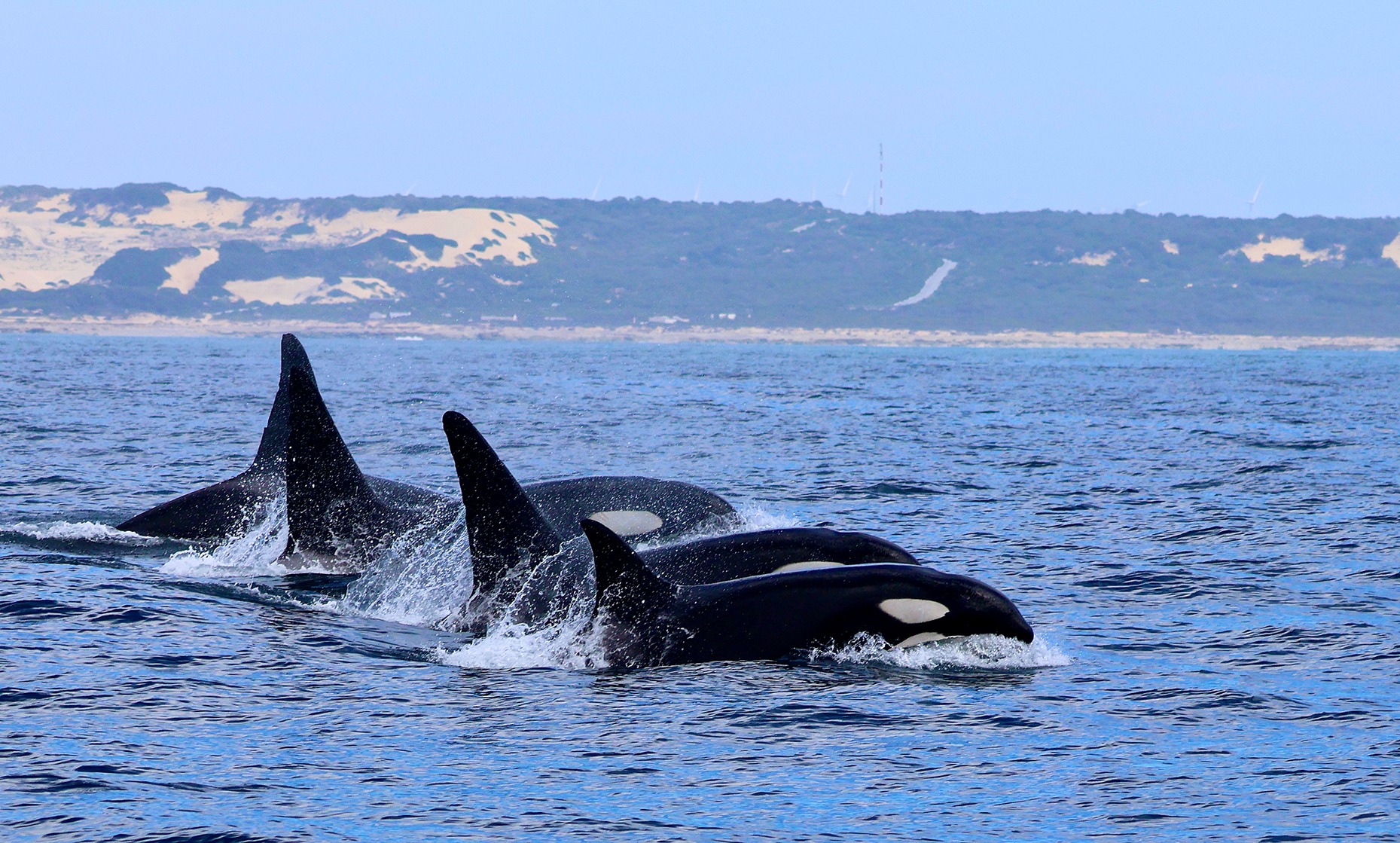
 A pod of seven killer whales was spotted in Algoa Bay on 18 February at about 10am and positively identified as returning visitors. (Photo: Libu Cyprien / Raggy Charters)
 For some sighting a great white shark is the pinnacle of marine drama. But last week in Algoa Bay, it was the ocean’s undisputed apex predator that grabbed attention: seven killer whales cruising through the shallow waters off Gqeberha.
For veteran skipper and conservationist Lloyd Edwards, the sighting was as significant as it was stirring.
“It was in fact, seven [killer whales] that we saw last week,” said Edwards, owner of Raggy Charters in Nelson Mandela Bay, who has more than three decades’ experience on the water. “[There were] three adult males. You know, identified by the very tall dorsal fins, which can measure up to like 1.9 metres.”
A known group on the south coast
Edwards explained that they are able to identify and differentiate the whales by the distinctive nicks and notches along the trailing edge of each dorsal fin.
These identifications and matches were carried out by Aaron Barnes, a doctoral student with Sea Search and Stellenbosch University. Barnes has done extensive work analysing these features and was responsible for identifying and matching the individual whales.
From those markers, the team confirmed three adult males, two adult females with shorter, curved fins, one juvenile of undetermined sex, and a seventh whale that could not be conclusively identified.
“It was the same lot that were here earlier in the year,” Edwards said. The group was also seen twice in 2024 and once in 2022. “So it’s a known group and they kind of seem to have made the South African south coast their home.”
That observation concurs with research led by Dr Simon Elwen, founding director of Sea Search Research and Conservation and a research associate at Stellenbosch University.
“We now know based on the preliminary photo [identification] and other work we’ve done so far, that we have a discrete population of killer whales that live around South Africa,” Elwen said.
/file/attachments/orphans/Photo_4_296696.jpeg "Marine experts have urged the public to photograph any killer whale sightings, saying clear images assist with ongoing research and identification efforts. (Photo: Libu Cyprien / Raggy Charters)")
Building the bigger picture
Elwen has spent the better part of two decades surveying whales and dolphins off South Africa and Namibia’s coasts. Even so, dedicated surveys rarely encounter killer whales. “We have only found killer whales three or four times by chance, and rely strongly on support from other water users to help increase the area we can effectively search,” he said.
To compensate and support its ongoing research into these apex predators, Sea Search has turned to collaboration, compiling sightings from operators such as Raggy Charters and the Simon’s Town Boat Company, as well as reports from Knysna, fishing vessels, other scientists and members of the public.
“We are trying to get every sighting and photograph we can get our hands on. That’s allowing us to build up a picture of time, date, where, when and how many killer whales are seen around South Africa,” Elwen said.
On average, the team logs about two sightings a month. Most are clustered between Cape Town and Gqeberha, although records stretch north to Namibia and east to Mozambique.
/file/attachments/orphans/Photo_3_633654.jpeg "According to Lloyd Edwards, owner of Raggy, Charters killer whales visited Algoa Bay once in 2022, twice in 2024 and twice again this year. (Photo: Libu Cyprien / Raggy Charters)")
“I think the sighting rates are staying fairly consistent. We’ve seen changes in when we see animals with more sightings inshore in the last few years,” Elwen said.
“We see more reports around this time of the year – February through to May – and that’s when the dolphin sightings also increase nearshore, especially common dolphins, and that also links to the start of sardine run on the east coast around Gqeberha. When there is more prey in the form of dolphins we tend to see more killer whales,” he said.
Following the food and family ties
For Barnes, the Algoa Bay sighting fits an emerging pattern.
“Killer whales can move wherever they want effectively. So they are usually drawn to an area by foraging,” Barnes said.
“The species is also known to be philopatric, which essentially means that they have a tendency to return to their ‘home’. Algoa Bay and its surrounds might be their home range where a combination of that instinct and food availability is likely what drove them there.”
Algoa Bay’s seasonal sardine run draws shoals of fish – and with them, dolphins.
“Killer whales have been observed eating dolphins primarily, but we don’t really get to see what goes on below the surface,” Barnes said, noting more investigative work is required to assess how broad these predators’ diets really are.
Responding to a question about killer whales’ movements, Barnes said their behaviour is also shaped by tight-knit social bonds.
“Killer whales are highly social animals. They also have a matriarchal society,” Barnes said. “So generally you’ll have an older female who’s sort of in charge and and the majority of the group [pod] is usually related to her in some way.”
/file/attachments/orphans/Photo_2_522436.jpeg "The killer whales were photographed near St Croix and Brenton islands in Algoa Bay. (Photo: Libu Cyprien / Raggy Charters)")
Apex predators, close to shore
In False Bay in the Western Cape, skipper Dave Hurwitz of the Simon’s Town Boat Company has watched similar dynamics play out over more than a decade. In 2009, he documented killer whales hunting a common dolphin for the first time there.

“In 2016, I encountered two killer whales with collapsed [dorsal fins], which is very unusual in the wild and named them Port and Starboard,” Hurwitz said. Port’s dorsal fin leans left and Starboard’s right – matching the nautical terms for port (left) and starboard (right).
The pair has since been observed hunting sharks close to shore.
“Killer whale sightings have grown exponentially over the years,” Hurwitz said. “Prior to 2009, killer whales were very seldom sighted inshore but from then it had grown to about 18 sightings per year by 2017 and now hardly week passes by without a sighting report.”
/file/attachments/orphans/Photo_5_723226.jpg "Edwards said it was a special moment to see these mammals in Algoa Bay. (Photo: Libu Cyprien / Raggy Charters)")
Back in Nelson Mandela Bay, Edwards described the recent encounter as unforgettable.
“It was absolutely [beautiful]. Seeing these guys, I mean, wow, they’re so powerful, they’re so strong. They are in communication with each other. It’s like this pack of roving wolves.”
“As cruel as they are, you know, you cannot help sort of just being in awe of how strong and smart they are. There’s just nothing quite like that.” DM