




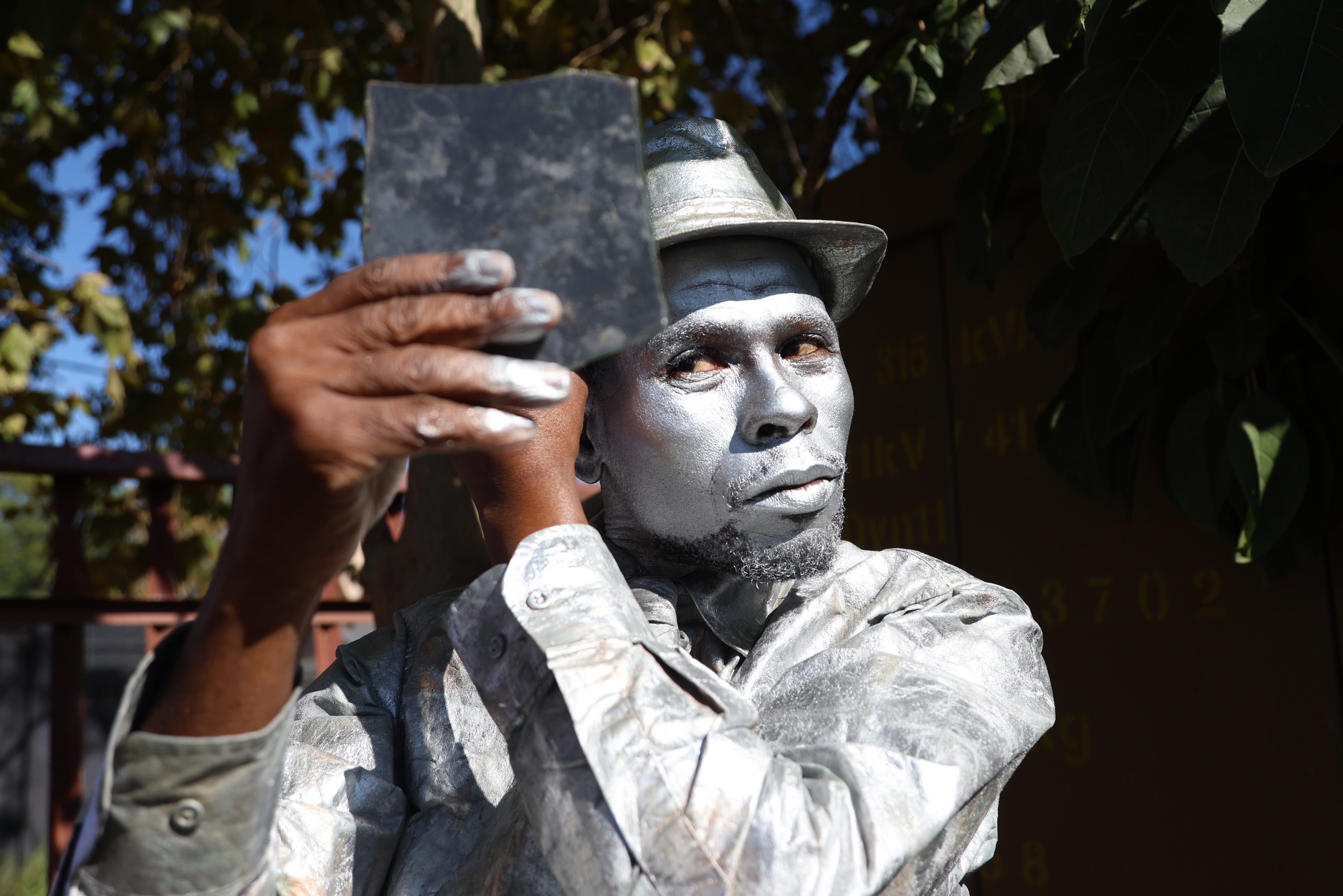
 Thabo Buyapi checks his reflection in the mirror, putting the finishing touches on his silver persona on 11 March 2026. (Photo: Felix Dlangamandla)
 They have become a striking fixture in some of Joburg’s public spaces, transforming ordinary malls and streets into vibrant stages. Covered head to toe in shimmering silver paint, they captivate motorists and passersby with their unique style of performance art.
Their presence blurs the line between sculpture and spectacle as they stand like living statues one moment, then break into playful movement the next. By turning everyday environments into arenas of creativity, the city’s “silver men” invite audiences to pause and smile.
/file/attachments/orphans/6I1A4977_278961.jpg "Thabo Buyapi, William Malatji and Russel Dube showcase vibrant poses along Jan Smuts Avenue, Rosebank on 11 March 2026. (Photo: Felix Dlangamandla)")
We caught up with a troupe in Rosebank. They normally have four performers but were reduced to three on our visit.
Thabo Buyapi, 43, is from Cofimvana, Eastern Cape. Once dreaming of a steady nine-to-five job, he was introduced to the silver art in Marlboro while job hunting, instantly captivated by its theatricality.
“I fell in love with the art,” he said, his body gleaming.
/file/attachments/orphans/6I1A4859_649756.jpg "Thabo Buyapi adjusts his tie, adding the final detail to his silver street performance on 11 March 2026. (Photo: Felix Dlangamandla)")
Paint as ‘therapy’
Beside him stood Mlamuli Dube, 34, from Alexandra, who admits the silver paint has become more than a costume and is now a kind of therapy.
“It has helped me deal with the frustration of not finding full-time work,” he explained.
Dube, newer to the craft, stumbled into it while searching for work in Rosebank earlier this year. The men insist their aim is not riches but to entertain, to be appreciated.
/file/attachments/orphans/6I1A4778_951397.jpg "Thabo Buyapi looks at his reflection in the mirror, adding the final touches before taking to the streets as a living silver statueon 11 March 2026. (Photo: Felix Dlangamandla)")
According to Buyapi, there’s politics and greed within the work, like any other. Their troupe broke away from a bigger group at Rosebank Mall, choosing instead the chaos of Jan Smuts Avenue.
At the mall, the group could rake in a few thousand rand a day, but they said that a self-appointed “manager” allegedly skimmed the lion’s share, leaving the performers with scraps.
While still working at the mall with the other silver men, Buyapi said the most he has ever made in one day was R450.
/file/attachments/orphans/6I1A4951_441831.jpg "Thabo Buyapi, William Malatji and Mlamuli Dube on their way to showcase poses along Jan Smuts Avenue, Rosebank on 11 March 2026. (Photo: Felix Dlangamandla)")
On the streets, the earnings are meagre. Sometimes as little as R140 is split between them, barely enough for transport and the day’s meals. Desperation occasionally drives them back to the mall for events, where the lure of higher pay outweighs the politics.
/file/attachments/orphans/6I1A4708_535137.jpg "The performers change into their attire, getting ready to bring streets to life on 11 March 2026. (Photo: Felix Dlangamandla)")
Previously, the group relied on silver spray paint, but health concerns pushed them toward a safer alternative – metallic craft paint mixed with water.
Their preparation happens wherever they can find space near Jan Smuts Avenue. The ritual is painstaking, layering paint across their bodies before stepping into traffic.
/file/attachments/orphans/6I1A4719_522283.jpg "Performers carefully pour silver paint. (Photo: Felix Dlangamandla)")
/file/attachments/orphans/6I1A4834_265171.jpg "Performers apply the final touches to their silver bodies, preparing to bring their street art to life on Jan Smuts Avenue on 11 March 2026. (Photo: Felix Dlangamandla)")
Meals are a practical interruption. They wash only their hands, slip their gloves back on, and return to performance.
A small tin of paint costs them R40, a recurring expense they shoulder to keep the spectacle alive.
“We are not sure about the effect of the metallic craft paint on our skin, but it is much better than the silver spray,” Buyapi admitted.
He added that the group should really be called the “silver-gold men”, since they alternate gold with silver when they can afford it.
/file/attachments/orphans/6I1A4862_584421.jpg "Performers apply the final touches to their silver bodies, on 11 March 2026. (Photo: Felix Dlangamandla)")
/file/attachments/orphans/6I1A4810_618100.jpg "Silver bodies in the making, on 11 March 2026. (Photo: Felix Dlangamandla)")
/file/attachments/orphans/6I1A4931_343452.jpg "Street artists William Malatji, Mlamuli Dube and Thabo Buyapi on their way to Jan Smuts Avenue on 11 March 2026. (Photo: Felix Dlangamandla)")
According to the men, there are many risks to working in the street. Jan Smuts is one of the busiest roads in Johannesburg, with grinding morning and rush hour traffic.
“Cars we can manage well and most drivers respect our art, but taxis have none such respect,” Dube said.
“Taxi drivers drive recklessly and they run over our stuff and we cannot do anything about it,” Buyapi added.
For the three men, the dream is simple: reunite the group, secure safe paint, and perform with dignity.
“What we need is for the group to get back together and find places to work from,” Dube said. “When we are together, we can make enough money to buy ourselves safe paint and proper silver and gold uniforms.”
“When we are together, we can make enough to sustain ourselves and keep the silver shining.”
/file/attachments/orphans/6I1A4939_776661.jpg "Thabo Buyapi, William Malatji and Russel Dube en route to Rosebank on 11 March 2026. (Photo: Felix Dlangamandla)")
/file/attachments/orphans/6I1A4916_809942.jpg "After transforming themselves into living silver statues, the performers strike a pose for a group photograph. 11 March 2026. (Photo: Felix Dlangamandla)")
Asked if the presence of the silver men on the road was in violation of any of the city’s by-laws and traffic laws, Johannesburg Metro Police Department spokesperson Xolani Fihla told Daily Maverick that the silver paint men were in violation, as there should be no loitering on the roadway.
“However, personally, what I have noticed with them is that, unlike other people, like the crate men and begging mothers with small children, is that they never really cause a nuisance on the road,” Fihla said.
“We have never had complaints about them, but in actual fact they are transgressing traffic regulations and by-laws as well.” DM