




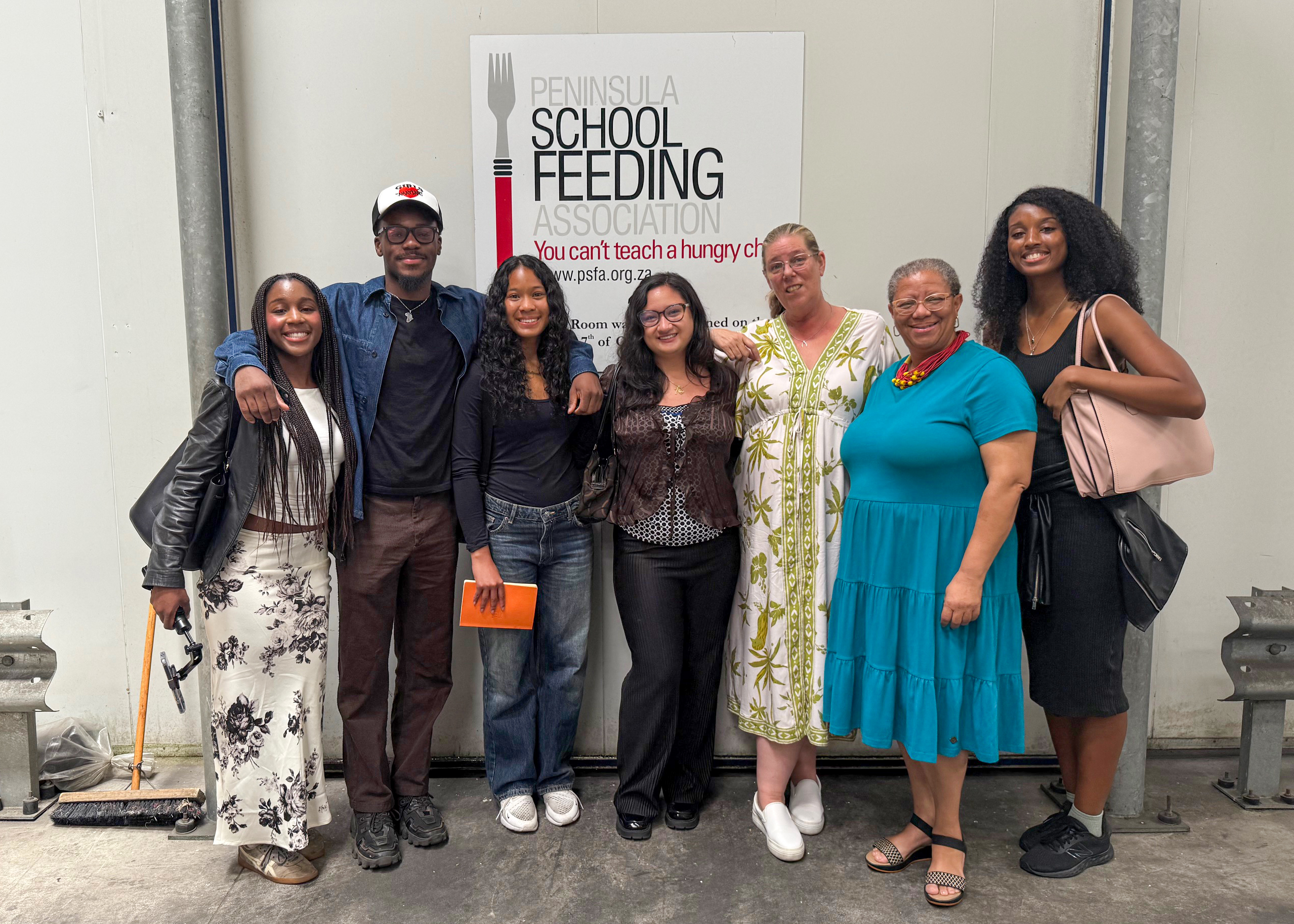
 From left, Laurenne Mvete, Walter Heiser, Tahirah Abdul-Qadir, Olivia Simons, Tanith Hamman, Petrina Pakoe and Naomi Campbell. (Photo: Naomi Campbell)
 A plate of food is more than a tourist’s Instagram reel or a chef’s cooked meal for a couple’s first anniversary – meals matter and are more than a basic necessity for at least 30,000 children in the Western Cape and nearly 400 schools being serviced with cooked meals.
According to The Peninsula School Feeding Association (PSFA), one in four households goes to bed hungry in South Africa.
The PSFA is a 67-year-old registered non-profit organisation that is committed to addressing the hunger needs of schoolchildren.
Prior to 1958, the Rotary Club of Paarden Eiland recognised a need for school feeding and called a public meeting to discuss the matter.
On 10 March of that year, the Feeding Association was born to support young learners with essential nutrients for their bodies and growth.
PSFA is accessible for students attending primary, secondary and special needs schools, including other educational and familial development services like Orphaned and Valuable Children Centres (OVCs), Early Childhood Development Centres (ECDs) and Technical and Vocational Education and Training Colleges (TVETS), specifically in the Western Cape.
While the association’s main goal is feeding children to combat starvation, there are additional priorities such as increasing school attendance, which often decreases due to inconsistent diets, as well as enhancing “children’s ability to learn through school feeding”.
The 10-day immersion experience couldn’t have been achieved without Founders Without Borders. In collaboration with iKapa – founded by South African Dee Moskoff – a personalised internship experience was curated for students and professionals to immerse themselves in South African culture while gaining networking experience. Laurenne Mvete, a Master’s student studying entrepreneurship at Syracuse University who is the founder of Founders Without Borders, an organisation committed to social entrepreneurship and innovations with impact, worked closely with Moskoff to create an intentional learning opportunity about social impact.
One of the first stops during the culturally enriched networking experience was the Peninsula School Feeding Association. Five student entrepreneurs – Walter Heiser, Tahirah Abdul-Qadir, Olivia Simons, Laurenne and myself – arrived at the site in Philippi last Tuesday.
The five of us were not the only ones in attendance for the food-focused day – TGIFood Editor Tony Jackman also joined the cohort for the food-centred programme.
Petrina Pakoe, the director of PSFA, greeted us upon arrival. We were welcomed with light refreshments and warm introductions. Before sharing her personal and professional journey with the group, Pakoe asked students to share their entrepreneurship ventures, which ranged from an organisation committed to uplifting girls and women through kickboxing and sports to a family-run ice-cream shop.
/file/attachments/2987/tannithpetrina_999195.jpg "PSFA director Petrina Pakoe, right, and Warehouse & Logistics Manager Tanith Hamman in Philippi. (Photo: Naomi Campbell)")
After the cohort shared their passions, Pakoe began to discuss more about the purpose of the Peninsula Feeding School Association and why it was initially created. For one, the government had stopped feeding in schools.
“School feeding was wasting,” said Pakoe.
Yet, the Rotary Club knew the importance of the mission. Pakoe said that the first 1,000 days of a child’s life were critical to their development. Lack of proper nutrition could lead to acute malnutrition and other potentially deadly illnesses.
The Peninsula School Feeding Association not only strives to solve food hunger in schools, but also break the stigma linked to receiving these meals.
During her overview of the PSFA, Pakoe shared a personal part of her life with the group — she too was a beneficiary of the feeding association.
“This is not a job, this is a calling. This is a passion for me,” said Pakoe.
The PSFA not only serves hot meals for students including breakfast and lunch, it is also dietitian approved based on the percentage of protein, vitamins, minerals and starch added to the nutritious foods that are prepared.
The association actively works to supply schools with proper cooking equipment such as gas stoves, essential ingredients and even utensils. Dry ingredients are delivered on a monthly basis and fresh fruit and vegetables are delivered weekly. In addition, at 135 schools ready-to-use kitchens are available for cooking staff to prepare nutritious meals for young learners.
“Everyone should have the right to eat, but not everyone has access to it,” said Pakoe.
/file/attachments/2987/WarehouselogisticsmanagerTanithHammangivingtheFoundersWithoutBorderscohortandTonyJackmanatourofthefacilitywithdirectorPetrinaPakoeinPhilippiPhotoNaomiCampbelljpg_654603.jpg "The Founders Without Borders group with PSFA director Petrina Pakoe, right, and Warehouse & Logistics Manager Tanith Hamman. (Photo: Tony Jackman)")
Schools interested in receiving support from the PSFA must apply in order to become part of the feeding system. The non-profit only works with unregistered and/or schools that are not qualified for the Government’s National School Nutrition Programme (NSNP) subsidy, a government initiative that provides one meal per day for all learners in Quintile 1-3 primary, secondary, and special public schools that targets learners in the 60% of poorest schools.
Students typically identified as at risk for hunger and in need of a feeding service might show a lack of concentration and may even faint in class.
While the feeding programme emphasises serving hot meals to reduce hunger pains and illness among youth, malnutrition is not the only concern that the association strives to address — it is committed to ensuring that students receive a well balanced meal that wallows them to focus during intense study hours and sustain their energy.
The educational experience didn’t end there. Tanith Hamman, the warehouse and logistics manager, escorted the seven of us to the warehouse to share her role at the association, which includes tracking and updating the inventory.
Hamman doesn’t just manage logistics and inventory, she also recognises her shared moral responsibility for the growth of the association.
“I come to work every day to feed the children. It is personal and it makes a difference somewhere. It is not just a job,” said Hamman.
Her role isn’t limited to the warehouse. She wears multiple hats in the organisation.
“I don’t just sit and manage, I don’t just sit and plan. I know if my warehouse team leader is off, I can jump in,” said Hamman.
/file/attachments/2987/PhotographofachildenjoyingamealprovidedbythePeninsulaSchoolFeedingAssociationinPhilippiPhotoNaomiCampbell_430485.jpg "A child enjoying a meal provided by the Peninsula School Feeding Association in Philippi. (Photo: Naomi Campbell)")
Hamman and Pakoe said that the employees weren’t the only driving forces behind the feeding system – donors played a crucial role too.
For just R950, donors can help PSF provide a child with nutritious breakfasts and lunches for an entire year.
The PSFA also provides economic opportunities for individuals seeking involvement in the feeding programme. Unemployed moms have the opportunity to receive a stipend for their efforts toward addressing childhood hunger in South Africa. The goal is not only to feed hungry children, but provide recruitment opportunities for women seeking income.
“We don’t feed just to fill a hungry stomach,” said Hamman.
The PSFA also prides itself in its confidentiality, to ensure the students benefitting from the programme are protected and do not feel isolated. Some efforts taken to foster a positive school feeding system include teachers eating with the students and even a food bucket process where teachers dish out the meals. According to Hamman, these are “meals served with dignity”.
/file/attachments/2987/PeninsulaSchoolFeedingAssociationposterratthePeninsulaSchoolFeedingAssociationinPhilippiPostPhotoNaomiCampbell_559136.jpg "A Peninsula School Feeding Association poster at its premises in Philippi. (Photo: Naomi Campbell)")
While the association has successfully grown the number of students being fed each year, it wasn’t without difficulty. It experienced hardship during the pandemic, which necessitated a change in its way of operating.
It had to decide on new distribution modes due to school closures, and even on employment and staffing.
However, that didn’t stop the feeding scheme from supporting children in need. The PSFA issued a “special appeal”. This included a donation request that would support and feed 4,200 children in the Western Cape for 16 days via 10 community kitchens.
The response? The PSFA exceeded its goal. At least 9,000 parcels were accounted for and essential ingredients were purchased for households in need. Since essential service permits were granted, the parcels were able to be successfully delivered door to door by the community centres.
Even during the global pandemic, the association actively served as a first responder for the communities entrusted to its care.
“Our goal is finding the best for the organisation and for the children that we serve,” said Hamman.
/file/attachments/2987/RiceinventoryatthePeninsulaSchoolFeedingAssociationinPhilippiPhotoNaomiCampbell_423178.jpg "Rice being stored at the association’s premises in Philippi. (Photo: Naomi Campbell)")
Since the association began feeding hungry children, it has served more than two billion meals across the Western Cape, contributing to 67 years worth of establishing support systems for students and addressing a hunger crisis for young learners through working with community kitchens, receiving donations and reframing delivery systems during the pandemic.
By the end of the tour, students learned that food is more than a meal and the dish that is on your plate; it provides individuals and communities the opportunity to uplift themselves and produce a positive impact.
“Impact doesn’t always happen instantly; sometimes it doesn’t happen during our lifetime, but you have to start the learning blocks,” said Pakoe. DM