




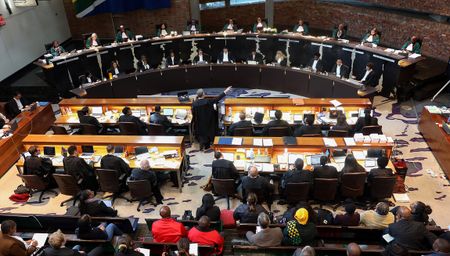
 Justice Steven Majiedt delivered the ruling in which the Constitutional Court dismissed two challenges to the National Health Insurance Act on Friday, 27 November. (Photo: Freddy Mavunda / Business Day)
The Constitutional Court has dismissed two challenges to the National Health Insurance (NHI) Act, with one decision going in favour of the government in a narrow 6-5 margin.
Justice Steven Majiedt delivered the judgment on Friday, 27 November, in a special sitting to mark his retirement after 26 years on the Bench. As the judgment was delivered, the court appeared to collectively be holding its breath for the outcome.
In the first case, which was brought by the Board of Healthcare Funders, the court unanimously dismissed the case. The board’s primary focus had been on the cost of the NHI scheme, which is set to become the main healthcare system in South Africa once the law fully comes into effect. Although it was signed into law in May 2024, the act has yet to be implemented, partly due to ongoing legal challenges.
The board had argued that the public deserved to know the details of how the NHI would be funded, considering it would require a large budget.
“The NHI Bill could not be assessed properly by the public without clear information on its projected costs and sources of funding. The cost and funding of the NHI scheme, would have informed whether the draft law was workable and sustainable within the country’s scarce resources. Yet, this issue received no attention during the legislative process,” the board said.
Unanimous decision
In a unanimous decision, the court found that there was no requirement from Parliament to provide information on funding.
“In our jurisprudence, there is no authority that Parliament’s obligation to facilitate public participation required the provision of cost estimates with the detail that the Board of Healthcare Funders contends here. Our case law does not extend that far. The information that has been provided complies with the requirement that there be a meaningful opportunity for Parliament to receive the public’s views,” Majiedt wrote.

The court also noted that the board’s case focused on a narrow legal issue, which did not preclude anyone else from challenging the law on other grounds.
“Self-evidently, this conclusion still leaves it open to a litigant to challenge the enacted law for irrationality, vagueness and impermissible delegations, as may yet happen in respect of the NHI, given the various pending cases. The conclusion reached here concerns only the public participation challenge, and no more,” he said.
The court also considered the board’s argument that there was insufficient information about the “basket of services”. The court found that there would probably be some flexibility over the basket of services as the scheme was rolled out.
“While Parliament has plainly gone to great lengths to afford the public opportunities to state their views on this groundbreaking, transformative legislation, there may well be valid concerns about key elements of the legislation. However, those are substantive law concerns that fall outside our present remit, namely the antecedent procedural constitutional challenge of allegedly fatal shortcomings in the public participation process,” he said.
5-6 split
In the second case involving a challenge brought by Western Cape Premier Alan Winde, the court appeared to have a difficult time reaching consensus and ultimately penned two judgments, with five justices agreeing with Winde’s arguments, and the other six agreeing with that of Parliament.
Justices Nambitha Dambuza, Owen Rogers and Kate Savage, and Chief Justice Mandisa Maya concurred with Majiedt in the minority judgment in the case, finding that there were flaws in the public participation process conducted by the National Council of Provinces (NCOP) in Parliament. The council is required to seek input from provincial legislatures on all legislation that will affect people directly at the provincial level.

Winde had argued that inputs from Gauteng province were not fully considered, and it challenged the “rigid” timeline given by the council. Justice Majiedt wrote that legislation like the NHI Act required a high level of “procedural care and reasonableness”.
“(The NHI) seeks to fundamentally restructure the system through which healthcare is funded, administered and accessed, and will affect virtually every person in the country in matters bearing directly on health, dignity and, at times, survival. The NHI Act’s consequences will extend beyond the present population to millions of people in future generations. In that context, the constitutional standard could not be satisfied by a process that is merely extensive in form. Moreover, the extensiveness of the process was limited to only one chamber of Parliament, the NA (National Assembly),” he said.
Majiedt noted that the report on Gauteng’s participation was completely missing from the record and agreed that the National Council of Provinces had an “inflexible timetable” that “resulted in the Western Cape’s public participation inputs being considered at a stage when they were no longer capable of influencing the ultimate legislative decision”.
“The most important shortcoming is that the Select Committee did not engage at all with the issues raised in the public participation reports, nor with amendments proposed in any of the nine provinces’ negotiating mandates,” Majiedt wrote.
Case dismissed
Despite these criticisms, the remaining six justices in the court held a different view, leading to the premier’s case being dismissed. The majority found that when considering the full process, all provinces had an opportunity to provide input. Justice Jody Kollapen penned the majority decision with Deputy Chief Justice Dunstan Mlambo, Justices Nonkosi Mhlantla and Zukisa Tshiqi, and Acting Justice Lister Nuku agreeing.
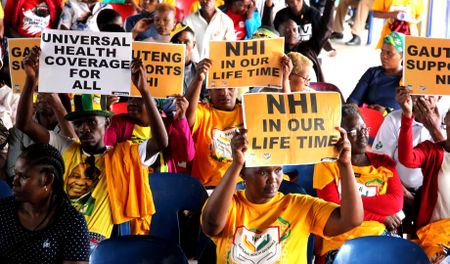
Kollapen noted that “universal healthcare remains a pressing and legitimate constitutional outcome, the realisation of which is beyond urgent”.
He added that in considering the outcome, the standard of reasonableness hinged on “whether the public had a real and meaningful opportunity to participate in and influence the law-making process”.
Kollapen said that when looking at the cumulative steps taken by Parliament, he could not find fault with the whole process.
“The conclusion that must follow is that the National Council of Provinces created the opportunity for the public to meaningfully engage with the bill, and the views of the public were properly considered by the NCOP in its final decision to adopt the bill,” he said.
Not the end of the road
Speaking to Daily Maverick after the judgment, Winde noted that the case was very narrow and that there would be more litigation to come.
“We are obviously disappointed, but we accept it and we now move to the next stage. There are a plethora of cases on the substance of the NHI Bill, and that is of course the next stage.
“We disagree with the centralisation of healthcare. We don’t believe that our Red Cross Children’s Hospital and Groote Schuur and Tygerberg will be better run by the national government,” he said.
The Board of Healthcare Funders said it noted the judgment and respected the court’s decision.
“The Board of Healthcare Funders also brought a separate application to review and set aside the president’s decision to assent to and sign the NHI Bill into law. The board will consult its legal counsel on the implications of today’s judgment for that application and the other outstanding NHI-related proceedings. There are also several separate legal challenges brought by other parties against provisions in the NHI Act.
“Each raises distinct legal questions that must be considered through the appropriate judicial processes,” the organisation said. DM
Comments
Scroll down to load comments...