



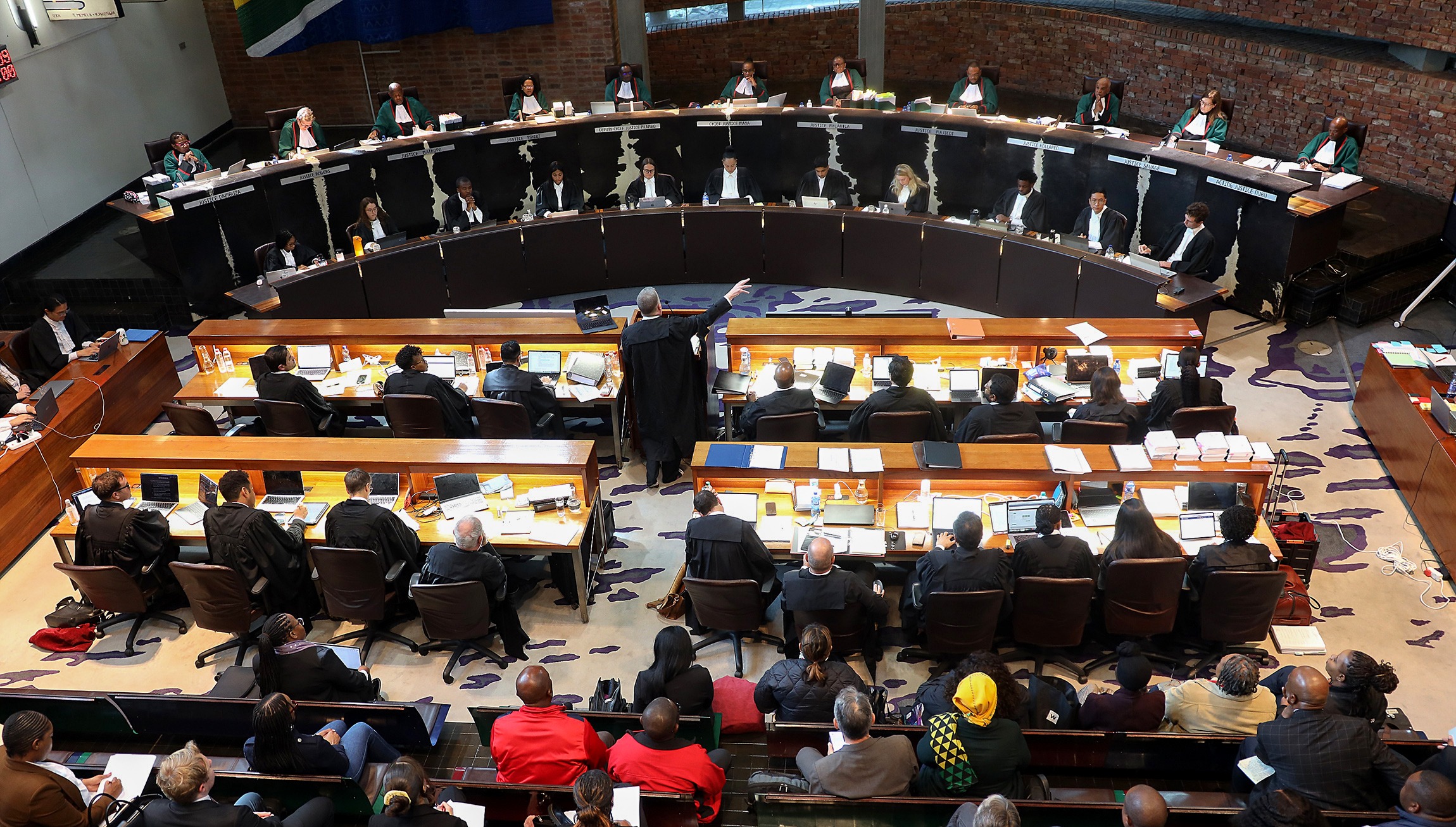
 A legal representative speaks at the hearing of the NHI Act challenges at the Constitutional Court in Johannesburg on 5 May 2026. (Photo: Gallo Images / Sharon Seretlo)
The Board of Healthcare Funders (BHF) has argued that Parliament failed to conduct a meaningful public participation process when it considered the National Health Insurance (NHI) Bill. The BHF has approached the Constitutional Court to challenge the signing of the NHI Bill into law.
President Cyril Ramaphosa signed the Bill into law in May 2023, and almost immediately, the decision faced legal challenges.
The BHF is a nonprofit organisation that represents 65 medical aid schemes, administrators and managed care organisations. The schemes represent 4.5 million beneficiaries.
The BHF’s case lists the Speaker of the National Assembly, Ramaphosa and Health Minister Dr Aaron Motsoaledi as respondents. The Constitutional Court has chosen to combine the hearing of this case with another NHI matter, brought by Western Cape Premier Alan Winde. The court set aside three days for the hearings.
Motsoaledi attended Tuesday’s hearing in person, sitting next to former presidential hopeful and former health minister Nkosazana Dlamini-Zuma. She served as health minister under Nelson Mandela, between 1994 and 1999.
When asked about the government’s chances in the case, Dlamini-Zuma said: “We have a strong case. I’m not sure about the judges, but we have a strong case.”

Motsoaledi agreed that the health department had a strong case: “We feel we have done what needs to be done. Because our actions are based on section 27 of the Constitution of the Republic, which says that everyone has got a right to healthcare.
“It goes on to say that the state must do everything within its available resources to make sure that this right is realised by the population. Subsection 3 says no one must be refused medical care. All those things are not happening now, and NHI is supposed to bring them into existence,” he said in an interview outside court.
He said that many people had been turned away from private hospitals because of a lack of funds.
“They check and find out you don’t have a medical aid, or a credit card or even cash. They leave you right there on the street and say you don’t belong here. That cannot be the way in which a country is run. It’s very wrong, and I am sure you do know that there have been several such examples where people were denied treatment.”
/file/attachments/orphans/20260505_093712_688627.jpg "Health Minister Dr Aaron Motsoaledi (left), beside Mandela-era health minister and ANC stalwart Nkosazana Dlamini-Zuma before arguments in two NHI-related cases at the Constitutional Court on 5 May 2026. (Photo: Dianne Hawker-Kalubi)")
‘The emperor has no clothes’
The NHI Act outlines a significant overhaul of South Africa’s health system by providing universal healthcare to citizens. It aims to pool the resources of private and public healthcare providers, an issue that has caused significant concern within the private healthcare community.
While the BHF says it is not opposed to the idea of universal healthcare, it argued in court that Parliament didn’t consider the many objections and concerns raised by stakeholders such as itself during the course of the public participation process.
In written submissions before the court, the BHF raised questions about the NHI funding model.
“The NHI Bill could not be assessed properly by the public without clear information on its projected costs and sources of funding. The cost and funding of the NHI scheme would have informed whether the draft law was workable and sustainable within the country’s scarce resources.
“Yet, this issue received no attention during the legislative process. Nor was the public provided with this information by Parliament or the department. The information couldn’t be provided – Parliament never had it; the department still doesn’t have an answer,” the BHF said.
/file/attachments/orphans/ED_607677_260325.jpg "Justice Steven Majiedt (left) and Justice Jody Kollapen during the hearing of the NHI Act challenges at the Constitutional Court on 5 May 2026 in Johannesburg. The Board of Healthcare Funders and the Western Cape government seek to have the NHI Act declared unlawful. (Photo: Gallo Images / Sharon Seretlo)")
In verbal arguments, the organisation reiterated these concerns, with advocate Bruce Leech SC, representing the BHF, saying the public participation process had not been “meaningful”.
“The right to speak and to be listened to is part of the right to be a citizen. This is a case about constitutional rights and dignity and the right to be heard,” he said.
Leech said that Parliament had admitted to receiving “thousands” of submissions from people and organisations raising concerns or requesting additional information. The concerns included how the NHI would be funded.
“We and other members of the public kept crying out to you. Everyone can see that the emperor has no clothes. And still, you go ahead and enact legislation that shows that the emperor has no clothes,” he said.
Members of the Bench engaged with Leech, questioning whether the case should have first been heard in a lower court before coming to the Constitutional Court. The court also questioned whether the absence of a record of deliberation on issues raised was enough to fault the entire process.
Leech held firm that there were “7,000 submissions calling for information, and that information was not provided” by Parliament.
‘Something is wrong with SA healthcare’
Advocate Ngwako Maenetje SC, representing Parliament, said more than 330,000 written comments were received by the National Assembly (NA); the National Council of Provinces (NCOP) received more than 23,400 comments.
“Both the NA and NCOP conducted extensive in-person hearings in each of the nine provinces. In the NA process alone, the hearings were attended by more than 11,000 members of the public and all of the hearings were streamed so that South Africans in all parts of the Republic could understand the issues arising from the Bill and the concerns expressed by members of the public,” said Maenetje.
He said members of Parliament engaged the BHF on some of its suggestions for the NHI.
Maenetje argued that one of the main issues raised by the BHF was the funding of the NHI model. The organisation had wanted clarity on how the model would work.
“What public participation requires is not that one’s views should prevail, but that the legislature should be informed of the views,” he said.

Justice Steven Majiedt noted that the NHI funding model was a “pertinent issue” and that several organisations had raised concerns, including The Alliance of Independent Practitioners Association, Discovery Health, Medscheme and the SA Clothing and Workers Union.
At the time, Parliament had said the funding model would be decided on later, with the assistance of the Treasury.
“How does any interested party, be it an individual user of medical care facilities or a large medical scheme, how do you assess what kind of redirecting of funds we’re talking about? How do you assess what new taxation is involved here?
“Because the one thing we can’t deny is that this is going to be a very expensive system. Because what you are basically doing is amalgamating private and public healthcare, and you are saying that 49% [of funding] that goes to private medical healthcare to cover on 16% of users, is now going to be spread all over, 100% or as close as possible to that. It is going to be frightfully expensive,” said Majiedt.

He said citizens should be able to engage with the proposal on an informed basis, “not groping around in the dark”, not knowing where the funds would come from.
“Is it enough to say to an interested party, like a group of medical schemes or an individual user, ‘We are going to have to direct funds from other parts of the budget. We are going to have to increase tax.’ You are basically saying you may have to redirect funds from other crucial fundamental rights, like a budget of education or a budget on social welfare. And redirect them to health. The point is, how much?”
Maenetje, for Parliament, responded by saying NHI was not simply about redirecting funds, but also about reforms in the system.
“NHI also changes the way in which healthcare is delivered to introduce efficiencies to deal with the escalating health costs in the private sector and the wastage that’s identified in the private sector,” he said.
Maenetje also noted that South Africa was spending 8.5% of GDP on healthcare, which the World Health Organisation noted was “at the top end of developing countries”.
“What they recommend is 5% of GDP. So there is something wrong with how we are delivering healthcare. We are spending 8.5%, but 85% don’t have access to quality healthcare. That is part of what NHI is intended to address.”
“If you want public healthcare that is going to work, you can’t start off by transposing the inefficiencies of both the private and the public sector into the new thing. That’s the purpose of the NHI, and the court can’t start from the premise that those efficiencies will never be achieved,” Maenetje argued.
Increasing premiums
Advocate Kameshni Pillay SC, representing the Minister of Health in the proceedings, said that in making its ruling, the court should consider the “uncontrolled commercialism of healthcare”. She pointed to inequalities in the “two-tier” health system and growing costs for private healthcare.
“The most reliable source of healthcare funding is medical schemes and hospital cash plans. However, to ensure their sustainability, many schemes resort to increasing premiums, making them more and more unaffordable to ordinary South Africans.
“They also resort to decreasing member benefits, leading to members exhausting their benefits by mid-year and then potentially becoming a burden on the public healthcare system,” she said.
Pillay added that the health department had an important role to play in the process of finalising the NHI Act, providing the necessary information to Parliament. She said that Parliament did not “follow the line” of the department and that the different parties held fierce debates on the issues.
The court will hear the argument in the Western Cape premier’s case on Wednesday. DM
Comments
Scroll down to load comments...