




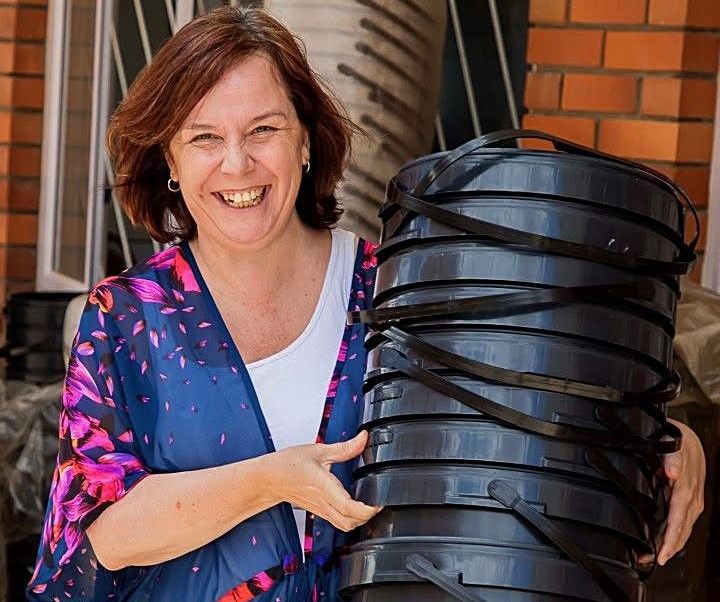
 With an infectious smile, Estelle Ellis — pictured last year at Missionvale Care Centre in Gqeberha — carries a stack of buckets as she helps prepare for the annual Buckets of Hope campaign. This year, the campaign will be renamed Estelle’s Buckets of Nutrition in her honour. (Photo: Donna van der Watt)
As a little girl, Estelle Ellis wrote “miracle worker” on a list of what she wanted to be when she grew up. Her sister, Tersia, says she spent much of her life pursuing that ambition, using her journalism and tapping into her social capital to expose systemic injustices and the inequalities that left so many people vulnerable.
Ellis, who died in August, aged 51, was the driving force behind Daily Maverick and SA Harvest’s Buckets of Hope campaign, which provides food to vulnerable children in the Eastern Cape.

This December, the campaign will continue in her name – Estelle’s Buckets of Nutrition – as friends, family, community partners and colleagues continue the work she cared so deeply about.
From hope to a fighting chance
For SA Harvest chief executive Ozzy Nel, it is an opportunity to carry forward the vision of a friend whose determination to make a difference was matched only by her ability to bring people together.
“It’s just an incredible privilege to be doing this in Estelle’s name,” said Nel. “She was a very, very important friend.”
Nel said the initiative had evolved from offering hope to providing children with something far more fundamental: a chance to survive and thrive at a time when many of the organisations that feed them are closed.
“We’ve realised that with so many of the smaller schools and ECDs [early childhood development centres] that we support, a lot of them actually rely on that nutrition because the only real meals they’re getting are at school. And now in the December period, they don’t have access to their schools.
“So it’s really gone from hope to just sustaining them and giving them a fighting chance through this period.”
The campaign comes as South Africa continues to grapple with a nutrition crisis, with the Eastern Cape particularly vulnerable.
“If I look at the Eastern Cape, we know that one in every three kids, children that are born, are going to most probably have serious signs of stunting, if you take the zero to five age group. And that is just because of the lack of nutrition,” said Nel. “That’s why it is so important for us to focus on that and give them a fighting chance. Because once stunting has occurred, you can’t change it.
“And that’s why I put it as a fighting chance. We literally have to give these kids a fighting chance. There’s so much that they have to deal with, so many challenges. But nutrition cannot be one of them.”
The SA Human Rights Commission has approached the Gauteng High Court in Pretoria, seeking to compel the government to reconsider the value of the child support grant, which remains well below the amount needed to meet children’s basic food needs.
In papers filed on 17 September, the commission challenges the government’s decision to increase the grant by just R20, from R560 to R580 per child a month from 1 April 2026.
In the papers, the commission’s Eastern Cape manager, Eileen Carter, pointed out that the food poverty line – the minimum amount needed to afford basic food – is R855 per person a month.

Carter said the latest figures from the National Department of Health reveal that 502 children under the age of five in SA died of severe acute malnutrition between April 2025 and March 2026, while 5.3% of children under five suffer from wasting, 28.8% are stunted and 7.7% are underweight.
She cited figures showing that 63.5% of households in South Africa are food insecure, with 17.5% experiencing severe food insecurity.

The little girl who wanted to be a miracle worker
Ellis’s sister, Tersia Ellis, says the decision to continue the campaign in her sister’s name has brought some comfort to a family still coming to terms with her loss.
She said the values that shaped her sister’s life were instilled in them by their parents, who raised them to believe that everyone had a responsibility to go out into the world and do good.
Going through Estelle’s old notebooks after her death, Tersia came across a childhood list of ambitions. Among the things the young Estelle had written she wanted to become was a “miracle worker”.
Looking back, Tersia believes her sister fulfilled that ambition – not through extraordinary individual acts, but by connecting people and persuading them to work towards a common purpose.
Nel recalled that Ellis was an exceptionally effective organiser who understood that tackling a complex problem such as malnutrition requires more than goodwill – it needs a network of people, organisations and resources working together.
“She was an absolute can-do person. She had faith like potatoes, but she also believed in building large ecosystems and creating massive collectives to solve a very complex problem. People could not say no to her.”
A journalist who refused to stand on the sidelines
Tersia described her sister as someone who embodied the Good Samaritan: she did not simply observe suffering from a distance but got involved and tried to change things.
“She didn’t just report. A lot of us know about all the misery that happens in the world, but we sort of keep it away from ourselves in a way,” said Tersia.
Daily Maverick editor-in-chief Jillian Green says the campaign also represents an important extension of the publication’s journalism: not merely reporting on problems or challenges, but using the craft to mobilise change.
“Often, as reporters, we go in, we report on a story, we leave, and we write our story, and that’s seemingly the end of it. What this particular campaign does is allow us to go back into some communities and to help support a campaign that is bringing actual direct help to communities.
“That is the extension of our journalism: not only to tell the story, but also to support programmes that drive change within those communities. Estelle’s Buckets of Nutrition, in combination with SA Harvest, is one of those campaigns that can actually bring real, tangible change to people’s lives and the lives of those they touch.”

Green said Ellis had an extraordinary ability to identify where people were falling through the cracks, often in places where public service failures had left them at their most vulnerable.
“This was Estelle’s superpower. She would identify where the need was and expose what that need was. But her super, superpower was that she didn’t just stop there. She used her craft and her connections generated through her craft to put people together that could actually drive an outcome.
“So, one, she highlighted the problem. Two, she put that problem in front of the people that needed to know about it. And three, she connected different people to make sure that that particular problem was addressed.”
Green said continuing the campaign was about preserving Ellis’s approach to journalism and social impact, ensuring vulnerable communities were not forgotten simply because they lacked the means to make their needs heard.
It also reflected how personally involved Ellis had been in making the campaign work: she was never someone who came up with an idea and left others to carry it through.
“She wasn’t like, ‘Oh, here’s a lovely idea. Can somebody run it?’ No, she was in there. She was making sure that the stories were written, that the connections were made, that the buckets were being packed, that they would be delivered, that the story of the delivery [was told] – et cetera. The full circle, she was in there from A to Z.”
A lasting fight against childhood malnutrition
Ellis had a much bigger ambition: to reduce, and ultimately eradicate, malnutrition among children in the Eastern Cape.
The importance of that ambition lies in recognising that food is not simply about relieving hunger for a day. Tersia, a doctor, says it is fundamental to children’s physical and cognitive development and, ultimately, to their future.
“Food, apart from the joy that it gives, also nourishes and sustains people,” said Tersia. “If we can make any headway into malnutrition in the Eastern Cape and even in the greater South Africa [that will be meaningful], because if we don’t get nutrition right we won’t get to see the full potential that our young nation and the people of the future are actually capable of.”
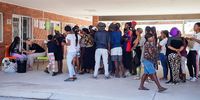
Nel said the challenge was too complex for any one organisation to tackle alone. The solution lay in strengthening the network of community organisations already doing the work and ensuring they had the resources to continue.
So how can you help?
These are the banking details for SA Harvest:
Please use your Name, Surname and Bucket as a reference. If you would prefer to remain anonymous, use only Bucket as a reference.
SA Harvest NPC
First National Bank
Account Number: 62693490478
Branch Code: 255955 (Randpark Ridge)
Swift: FIRNZAJJ
To donate online, please follow this link: Buckets of Nutrition.
What’s in one of Estelle’s buckets
10kg maize meal
5kg rice
1kg mabele
1kg pasta
2kg dried beans
1kg lentils
1.2kg soya mince
4 × 400g pilchards
4 × 410g baked beans
400g peanut butter
2L cooking oil
500g full-cream milk powder
500g dry soup mix
500g iodised salt
1 pack stock cubes
In addition, the buckets contain vegetables donated by One Farm Share Impact and dehydrated meals by Rise Against Hunger. DM
Comments
Scroll down to load comments...