


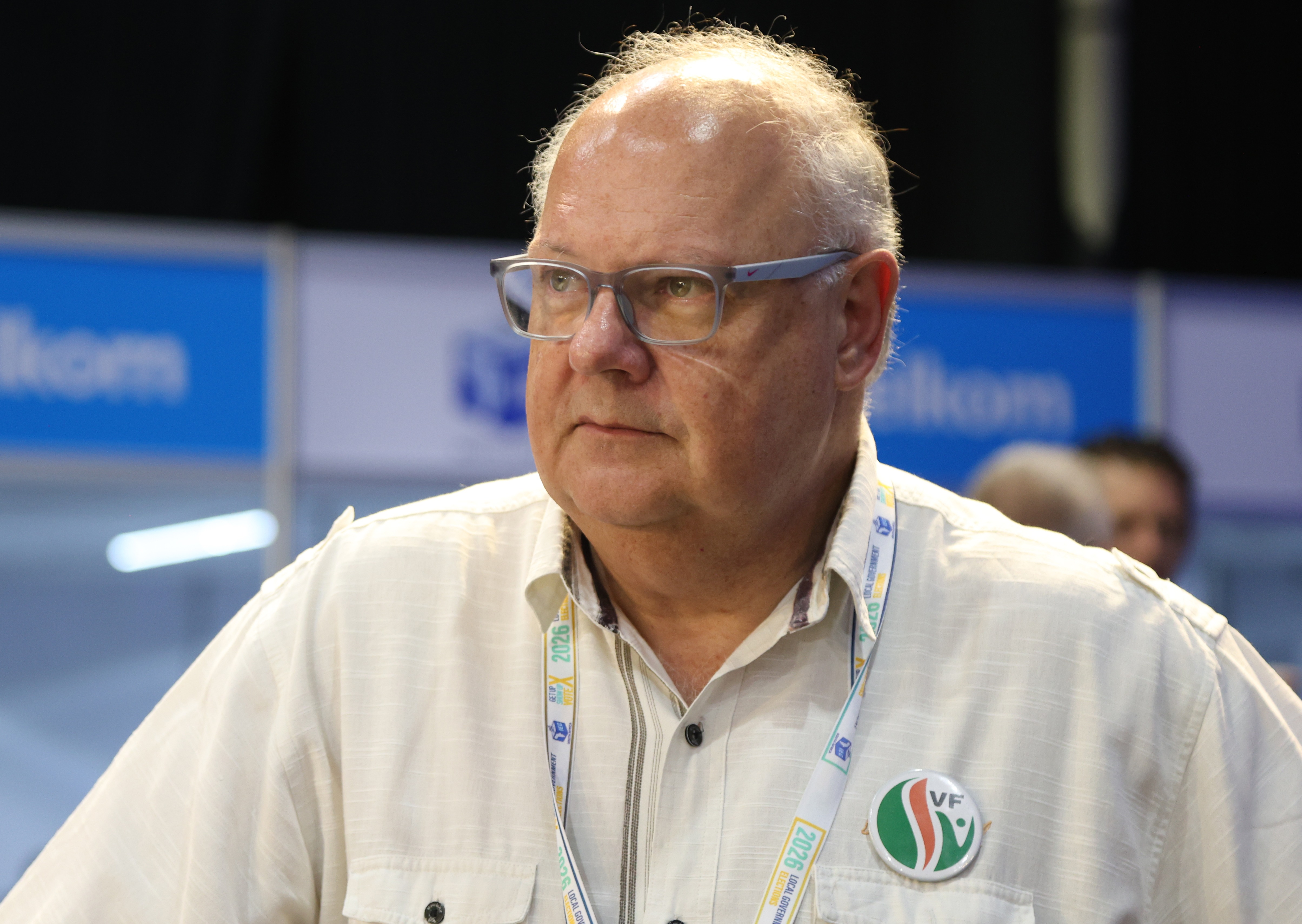
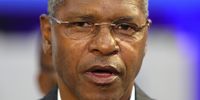
 Corné Mulder of the Freedom Front Plus at the election Results Operations Centre in Midrand, Johannesburg, on 7 November 2026. (Photo: Felix Dlangamandla)
The Freedom Front Plus’s Dr Corné Mulder attempted to broker an agreement between the Democratic Alliance (DA) and ActionSA to form a multiparty government in Gauteng’s hung municipalities, as disagreements over mayoral candidates and the allocation of posts complicated talks.
Daily Maverick understands that Mulder was approached to help ease tensions between DA federal chairperson Helen Zille and ActionSA leader Herman Mashaba, whose differences had become a key obstacle to establishing a multiparty coalition.
FF Plus head of elections Wouter Wessels confirmed to Daily Maverick that Mulder held one-on-one engagements with both parties to try to build a stable arrangement between the DA, ActionSA and the FF Plus.

“There were numerous one-on-one discussions (between Dr Mulder, the DA and ActionSA) to try to find a solution where a stable coalition could be formed between the DA, ActionSA and the FF Plus,” Wessels said.
Wessels added that the areas of disagreement between ActionSA and the DA were already well known.
The intervention came amid difficult negotiations in Gauteng, where the DA emerged as the largest party in Johannesburg, Tshwane and Ekurhuleni, but failed to secure outright majorities.
The FF Plus had previously been clear that it would not participate in a Government of Local Unity arrangement that brought the ANC back into municipal government. Mulder had instead expressed support for a Gauteng coalition involving the DA, ActionSA and the FF Plus.
Zille and Brink at the centre of the impasse
One of the primary sticking points has been the parties’ competing positions on mayoral candidates, particularly Zille in Johannesburg and Cilliers Brink in Tshwane, both of whom Mashaba urged the DA to replace.
In a proposal to DA federal leader Geordin Hill-Lewis, Mashaba suggested the DA nominate a different Johannesburg mayoral candidate supported by ActionSA in exchange for the deputy mayor post. In Tshwane, he proposed Brink step aside for ActionSA’s Dr Nasiphi Moya, while also offering support for a DA mayor in Ekurhuleni.
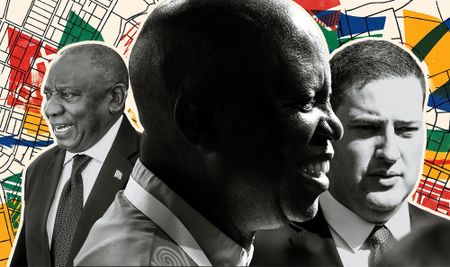
The DA, however, faced a difficult decision over whether to replace candidates it had put forward following the election campaign. Zille had campaigned for the Johannesburg mayoralty, while Brink was the party’s candidate in Tshwane.
A source close to the discussions said that personality clashes between the senior political figures had further complicated negotiations.
Competing demands for mayoral and executive positions had become a significant sticking point, said the source, adding that the DA and ActionSA were struggling to reconcile their positions, despite sharing an interest in reaching an agreement.
Speculation also grew that Hill-Lewis might move to Johannesburg to unlock an agreement, potentially creating an opening for Zille to step aside. However, Hill-Lewis clarified that he had not formally proposed such a swap.
On 19 November, Hill-Lewis was re-elected Cape Town mayor after the DA secured an outright majority, further narrowing the window for a Gauteng deal.
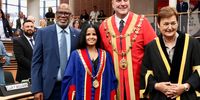
ANC-led alternative gathers momentum
Meanwhile, the ANC has pursued an alternative arrangement with ActionSA, the Economic Freedom Fighters and the uMkhonto Wesizwe (MK party) to form local governments across Johannesburg, Tshwane, Ekurhuleni and eThekwini.
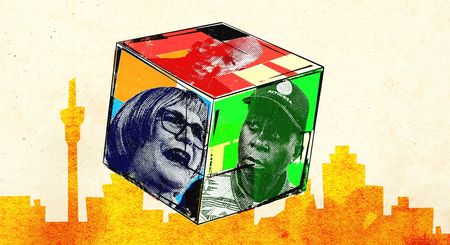
An emerging framework would see ActionSA take the mayoralties in Johannesburg and Tshwane, the ANC retain Ekurhuleni, and the MK party secure eThekwini.
However, negotiations remain unfinalised amid pushback from ANC structures in KwaZulu-Natal over eThekwini.
Parties begin securing municipal administrations
While negotiations continue in the major metros, several political parties have already begun constituting their new administrations, with parties securing mayoralties through outright victories and coalition arrangements.
The Electoral Commission of South Africa (IEC) had declared the election results on 8 November. Of the country’s 213 metropolitan and local municipalities, 72 produced outright majorities, while the remaining 127 councils were hung.
The Patriotic Alliance (PA), ANC, DA and MK party were among the formations that have won mayoral positions or announced coalition deals in councils across the country.
The PA managed to secure a coalition arrangement in Kannaland Municipality in the Western Cape, where it will govern alongside the Independent Civic Organisation of South Africa (Icosa) and the Kannaland Independent Party (KIP).
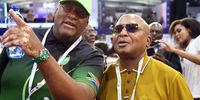
PA leader Gayton McKenzie announced that the parties had agreed to share political leadership in the 10-seat council, with the PA taking the mayoral position for the first two and a half years.
Under the arrangement, KIP will occupy the deputy mayor position, while Icosa will take the speaker position during the first half of the term. The mayoral position will subsequently rotate between the PA and Icosa.
The PA won two seats in the municipality, while Icosa and the DA secured three seats each. The ANC and KIP won one seat apiece.
The agreement gives the three coalition partners six seats, enough to secure a majority in the council.
The party has also secured the mayoralty in Prince Albert Municipality in the Central Karoo through an arrangement with the ANC.
Arnold MacKay was sworn in as mayor on 18 November after the PA secured five of the municipality’s 10 seats. The DA won four seats, while the ANC secured one, making its support decisive in the formation of the new administration.
In Dawid Kruiper Municipality, which includes Upington, the ANC and DA emerged tied as the largest parties, each securing 14 of the 33 council seats. The PA won four seats, while the FF Plus secured one.
Neither of the two largest parties has an outright majority, with 17 seats required to govern. The PA’s representation could therefore become important in determining the municipality’s political leadership.
MK party wins first mayoralty in Richmond
The MK party secured its first mayoralty following an outright victory in Richmond Local Municipality in KwaZulu-Natal.
Reginald Ngcobo was elected mayor during the municipality’s inaugural council sitting on 18 November.
The party won 10 of the municipality’s 17 council seats, giving it an outright majority without the need for a coalition partner.
Joyce Ndleleni was elected deputy mayor, while Derrick Thompson secured the position of speaker.
The party’s electoral performance has also positioned it as an important player in coalition negotiations elsewhere, particularly in KwaZulu-Natal and Mpumalanga.
In eThekwini, the MK party emerged as the largest party in the 221-seat council, securing 86 seats, while the ANC won 37. The two parties would have a combined 123 seats, above the 111 required for a majority.
Discussions between the parties over a possible governing arrangement have intensified, although an agreement has yet to be concluded.
In Mpumalanga, the MK party has reported progress in negotiations involving the ANC, South African Communist Party (SACP), EFF, Inkatha Freedom Party and Service Delivery Party.
The party emerged as the largest formation in Mkhondo Municipality, securing 16 of the 38 council seats, but fell short of the 20 required for a majority.
Its provincial spokesperson, Sakhile Mpofu, said discussions with several political formations were at an advanced stage, with the party seeking representation in municipal leadership structures, including the mayoral committee.
The MK party also has representation in Msukaligwa Municipality, where it is the second-largest party after the ANC.
ANC and DA form coalition in Limpopo
In Limpopo, the ANC and DA have already demonstrated that their cooperation in the national government of unity can extend to municipal administration.
The two parties formed a coalition in the hung Ba-Phalaborwa Municipality, where ANC councillor Petronella Mauwane was elected mayor on 18 November.
The ANC secured 17 seats in the 37-seat council, while the DA won six, giving the two parties a combined 23 seats.
Mauwane said her administration would prioritise basic services, including water, sanitation, electricity, roads and refuse removal, while addressing financial management and promoting local economic development.
The arrangement is among the clearest examples of the ANC and DA finding common ground at the municipal level despite political differences and competing strategies elsewhere.
DA retains control in Drakenstein
In the Western Cape, the DA has retained control of Drakenstein Municipality, where Stephen Korabie was re-elected mayor during the council’s inaugural sitting on 17 November.
Elna von Schlicht was elected deputy mayor, while Bertus Snyman secured the position of speaker. The DA retained its majority in the municipality, where it holds 26 of the 33 ward seats.
The party’s position in Drakenstein contrasts with the uncertainty in several other municipalities where it emerged as the largest party, but failed to secure outright majorities.
Major municipalities remain unresolved
Despite the agreements already announced, coalition negotiations remain unresolved in several major municipalities.
In Gauteng, Johannesburg, Tshwane and Ekurhuleni remain the most closely watched battlegrounds.
The ANC’s discussions with ActionSA, the EFF and the MK party have complicated the DA’s attempts to secure governing arrangements through its Government of Local Unity model.
In Tshwane, the inaugural council meeting has been postponed from 19 November to 26 November to give political parties additional time to negotiate coalition agreements.
In KwaZulu-Natal, eThekwini remains unresolved despite the ongoing ANC-MK discussions and the broader four-party negotiating framework.
Elsewhere, Buffalo City in the Eastern Cape and Mangaung in the Free State are among the major councils where coalition negotiations will determine the composition of the next administrations.
In Mogale City, Gauteng, the DA secured 27 seats against the ANC’s 23 in a 77-seat council, leaving both parties short of the 39 required for a majority.
Municipalities face deadline to elect leadership
With coalition negotiations continuing, political parties are under pressure to conclude arrangements before the deadline for inaugural council meetings.
Co-operative Governance and Traditional Affairs Minister Velenkosini Hlabisa has urged municipalities to convene their newly elected councils by 27 November, following the gazetting of councillors on 13 November.
The first council meetings are where municipalities formally elect their mayors, speakers and other political office-bearers, paving the way for the establishment of new administrations. DM
Comments
Scroll down to load comments...