



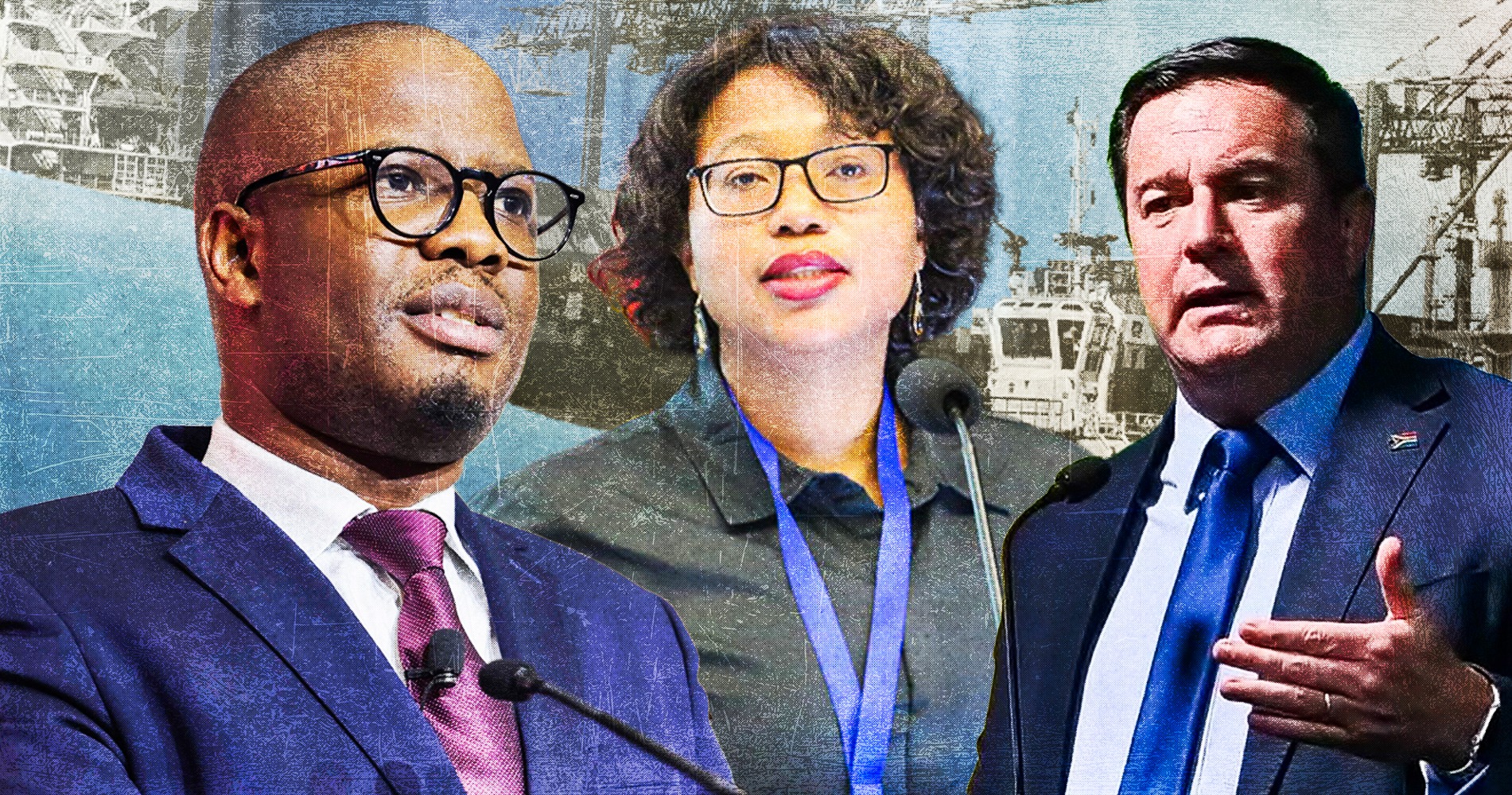
 Illustrative Image: Zuko Godlimpi Deputy Minister of Trade, Industry and Competition. (Photo: Gallo Images/OJ Koloti) | Deputy Director-General of the DTIC, Xolelwa Mlumbi-Peter. (Photo: DTIC) | Cranes. (Photo: Rawpixel) | (By Felix Dlangamandla)
Despite being rocked by aggressive US tariffs and a turbulent and increasingly protectionist markets elsewhere, South Africa is just managing to increase its exports, largely by diversifying away from traditional markets.
South Africa achieved an overall trade surplus of R202-billion last year, a slight increase on its 2024 surplus of R197-billion – with 2025 exports of R2.1-trillion and imports of R1.9-trillion, Xolelwa Mlumbi-Peter, Deputy Director-General of Trade, Industry and Competition, told Parliament’s committee on that portfolio this week.
South Africa’s strategic priorities were to diversify export markets, build value-added products and deepen African value-chain integration – while managing tariff increases, she said. Global trade was still expanding but was increasingly shaped by technology such as in semiconductors, ICT, batteries, EVs and critical mineral inputs, as well as climate policy and geopolitical alignment.
“Supply chains are shifting through friend-shoring, targeted tariffs and industrial policy. Trade on World Trade Organization most-favoured nation (MFN) terms fell from 80% to 72% by early 2026,” she said.
Mlumbi-Peter stressed the importance of Africa as the main buyer of South Africa’s goods, taking 26.7% of its total exports in 2025, followed by 19% to the EU; 11% to China; 7% to the US; and 5% each to Japan and the UK.
Meanwhile about 23% of South Africa’s imports in 2025 came from the EU, and the same percentage from China; 7% from India; 12% from the Middle East; 9% from the rest of Africa and 7% from the US.
Export diversification strategy
Mlumbi-Peter, who is also South Africa’s chief trade negotiator, underlined that in its export diversification strategy South Africa was benefiting significantly from China’s policy of allowing duty free access to its markets for most African countries, from 1 May this year,
From May to August 2026, after the zero tariff regime was introduced, South African exports to China rose nearly 25% to $5.3-billion, year on year. This included a 21% increase of non-mineral exports, including mechanical and electrical products, automobiles, chemical products and agricultural products.
Deputy Trade, Industry and Competition Minister Zuko Godlimpi said that without downplaying the importance of America’s decision this month to remove South Africa from the African Growth and Opportunity Act (Agoa), “it will not essentially spell the doomsday scenario that is sometimes hyperbolised”.
The products covered by Agoa could still enter the US “at a relatively competitive level” compared with US or other products.

Mlumbi-Peter noted that Agoa exempted already low Most Favoured Nation tariffs of between 0 and 3%. She said that despite all the Trump administration’s tariffs, trade with the US had increased in 2025 to $12.5-billion from $12.2-billion in 2024. South African exports in 2025 were $8.3-billion and imports $7.2-billion, giving it a trade surplus of $1.1-billion.
She noted that in 2024, 28% of South African exports to the US had been under Agoa, but this had declined to just 11% in 2025. This still contributed about R29.2-billion to the economy in value added, and 46,403 jobs.
Auto exports constituted 37% of total Agoa exports. Removing them would reduce estimated value added by R12.2-billion and jobs by 17,861.
But she said that the National Association of Automobiles Manufacturers of SA (Naamsa) had stated that the removal of South Africa from Agoa was likely to have limited impact as the prior US imposition of 25% Section 232 tariffs had already reduced auto exports by 83.2%.
On 2 November the US announced that it would remove South Africa from Agoa on 1 January 2027 if SA did not address its concerns. Mlumbi-Peter said these were evidently about issues such as South African import tariffs on poultry and pork as well as BBBEE, expropriation without compensation and South Africa’s “military entanglement with countries that the US has concerns with”.
Clarification from the US
She said South Africa expected clarification from the US about its concerns before the end of this week.
Mlumbi-Peter also noted there were many exemptions from the section 301 tariff of 12.5% that the US recently imposed on South Africa and many other countries for allegedly not doing enough to prevent the import of goods made with forced labour.
She added that the key development affecting South African trade had been the implementation of the temporary, two-year, zero-tariff access to its market that China had offered most African countries from 1 May this year.
After that, from May to August 2026, South African exports to China rose nearly 25%, year on year, to $5.3-billion, she said.

South African exports to China have been almost entirely minerals, but she said that since the tariffs were dropped, non-mineral exports had increased by 21%, including mechanical and electrical products by 36%; automobiles by 104% (though off a low base); chemicals by 63%; and agricultural products over 35% to nearly $500-million.
Meanwhile, imports from China grew 23% to $9,47-billion, which reduced but did not eliminate South Africa’s large trade deficit of R198-billion in 2025.
And she said negotiations with China had begun in October to agree on reciprocal access to each other’s markets after the two-year zero-tariff deal ended. She noted that China had agreed to exclude products that were sensitive to South Africa.
Mlumbi-Peter said South Africa was also pursuing increased trade with Africa to offset losses elsewhere. Key to this was the African Continental Free Trade Agreement (AfCFTA), which was gradually turning the continent into a free trade area.
But the agreement is taking time to implement. Mlumbi-Peter said that since South Africa began implementing the agreement in January 2024, its cumulative exports of goods under AfCFTA amounted to R3.5-billion by the end of July 2026. This was only a small part of South Africa’s total exports of R557-billion to the rest of Africa. Part of the reason was not all African countries were implementing their commitments. South Africa’s cumulative imports of goods through AfCFTA totalled R3-billion by February 2026.
New market access
She said South Africa now had new market access under AfCFTA to 14 countries beyond the Southern African Development Community (SADC), including Algeria, Egypt, Ghana, Kenya, Morocco, Nigeria and Ethiopia.
And she noted that negotiations were advanced for trade in services under AfCFTA which South Africa expected to do well in.
She also said negotiations were proceeding to implement the Tripartite Free Trade Agreement between the Common Market for Eastern and Southern Africa, the East African Community (EAC) and the Southern African Development Community which would create a market of 29 African states, representing more than 60% of continental GDP.
She said the SADC and the East African Community had completed their tariff negotiations under the Tripartite Free Trade Agreement, so they would now gain access to 60% of each other’s exports.
She also noted more widely that south-to-south trade offered opportunities as emerging economies became increasingly important markets, and South Africa and the rest of the Southern African Customs Union were negotiating with India for a Preferential Trade Agreement (PTA) and with the South American trading bloc Mercosur to expand the existing PTA.
With South Africa’s largest overall trade partner the European Union (EU), she said the main development had been that Brussels had implemented a 50% tariff on imports of steel.
South Africa had negotiated an interim suspension of the tariff. However negotiations to safeguard South Africa’s steel exports more permanently were still under way.
She noted that in 2021 and 2022 South Africa had enjoyed a trade surplus with the EU, but since 2023 this had swung into deficit. In 2025 South Africa had exported R404.43-billion in goods to the EU and imported R429.26-billion, so registering a R24.84-billion deficit.
But it was important that South Africa’s exports included value-added products. Autos were the main source of export growth, contributing 36% of total exports to the EU in 2025.
Future auto investments unlocked
She also noted that the EU had agreed to a derogation of the rules of the SADC-EU Economic Partnership Agreement to allow South African manufacturers of electric vehicles (EVs) and plug-in hybrids to use batteries made in South Africa or the EU, from 1 January next year for three years, with a possible extension for two years. She said this agreement “unlocks future auto investments in South Africa and preserves market access for auto exports to the EU” – which amounted to more than R36-billion in 2025.
However she also noted that South Africa and the EU had not found a solution to the issue of Sasol’s wish to export its green aviation fuel to the EU. And she said South Africa was still negotiating with the EU over issues such as EU health control measures on imports of South African citrus and amarula, and about the possible extension of the EU’s CBAM – the Carbon Border Adjustment Mechanism – to downstream industry in 2028 and the effect this could have on important South African exports such as autos.
Last year the EU announced it would invest about €12-billion in green, pharmaceutical and other projects in South Africa under its Global Gateway Initiative. Mlumbi-Peter told Parliament South Africa had identified 45 projects for such investment, of which 17 were “shovel ready”.
And Mlumbi-Peter said South Africa had submitted to the EU a list of 50 wine-related Geographical Indications to be registered in the EU, adding to the Karoo Lamb that the EU had already registered. Registration of Geographical Indications means that only South Africa can use these place names in its products.
South Africa had asked the EU for a review of the SADC-EU Economic Partnership Agreement so South Africa could add access for more of its agricultural products, but the EU said it did not have a mandate for review.
She also noted that the EU had on 30 October 2026 initiated a safeguard investigation on the imports of certain new hybrid vehicles to address an increase in the imports of such vehicles caused by a rapid rise in production by several third countries and the closing of several markets, diverting exports to the EU.
The EU investigation could lead to tariff-related quotas and higher tariffs from 1 December 2026. She added that South Africa was engaging the EU to try to avoid new tariffs, which she said would undermine South Africa’s preferential access to the EU market under the SADC-EU Economic Partnership Agreement.
Increase of vehicle imports from China
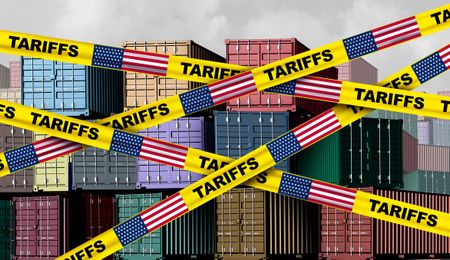
She noted this threat to South African automakers was coming on the back of America’s Section 232 tariff of 25% on autos, and the increase of vehicle imports from China.
Mlumbi-Peter noted that South Africa had some similar issues with the UK as with the EU. For instance the UK had introduced a new steel regime in July 2026 that would increase out-of-quota tariffs on 20 products by up to 50%. Negotiations to try to avoid this would start this month. South Africa had told the UK the tariffs could undermine its preferential access to the UK market under the SADC-UK Economic Partnership Agreement.

And South Africa is also discussing with the UK the potential impact of its Carbon Border Adjustment Mechanism on the market access under the Economic Partnership Agreement. South Africa was also asking the UK for the same sort of derogation of Rules of Origin for EV batteries as the EU had agreed to.
Nevertheless, in 2025 South Africa had exported R95.329-billion in goods to the UK and imported R27.782-billion, giving South Africa a large trade surplus of R67.547-billion .
Mlumbi-Peter said South Africa was also trying to improve market access for South African agricultural products to the European Free Trade Association (comprising Norway, Iceland, Lichenstein and Switzerland).

World Trade Organization
Mlumbi-Peter also said the World Trade Organization – which is supposed to regulate global trade – had been unable to respond to unilateral trade restrictions implemented by some WTO members. It had also made no progress in restoring its Dispute Resolution Mechanism, which had been effectively suspended since 2019. That was allowing countries to break the rules with impunity.
And she said the US and EU were revisiting WTO consensus decision-making in favour of plurilateral approaches, which SA opposed as it believed this harmed the interest of smaller states. As did the effort by bigger states to make the current “special and differential” treatment for developing countries apply only to least developed countries. Mlumbi-Peter said these powers were also re-examining the Most Favoured Nation principle of the WTO which, as she said, “is a cornerstone of the multilateral trading system”.

Deputy Trade and Industry Minister John Steenhuisen said “I don’t think we should over-catastrophise the loss of Agoa” even though it could do significant damage.
But he said South Africa now needed to “start moving seriously and more determinedly towards” a bilateral free trade agreement with the US. That would bring the certainty to the trading relationship that was required for agricultural and other producers to plan ahead.
It would be much better than Agoa which “can be withdrawn at moment’s notice… if the US president wakes up one day and is unhappy about something happening in South Africa”.
Need to diversity export markets
And he agreed fully that South Africa needed to diversify its export markets, including working with the EU on critical mineral beneficiation, green industry and pharmaceuticals, and also exporting more to the Middle East.
Steenhuisen said South Africa should be careful about imposing import tariffs to protect certain industries because these often harmed other South African industries that depended on the tariffed inputs.
And he said industries should only be protected to get off the ground, and not indefinitely. And South Africa should also focus on the things it could do itself, such as improving its infrastructure.
“Because no tariff can make up for a factory that can’t get power or a port that can’t move its goods… And so the biggest thing we can be doing locally is building a competitive economy.”
MP Toby Chance, Trade, Industry and Competition spokesperson for the Democratic Alliance, agreed with the focus on diversifying exports – along with decarbonisation and digitalisation.
But he added: “SA has always prided itself on playing by the rules when it comes to trade, but in the new world we live in, we need to be more muscular in defending our interests.” DM
Comments
Scroll down to load comments...