


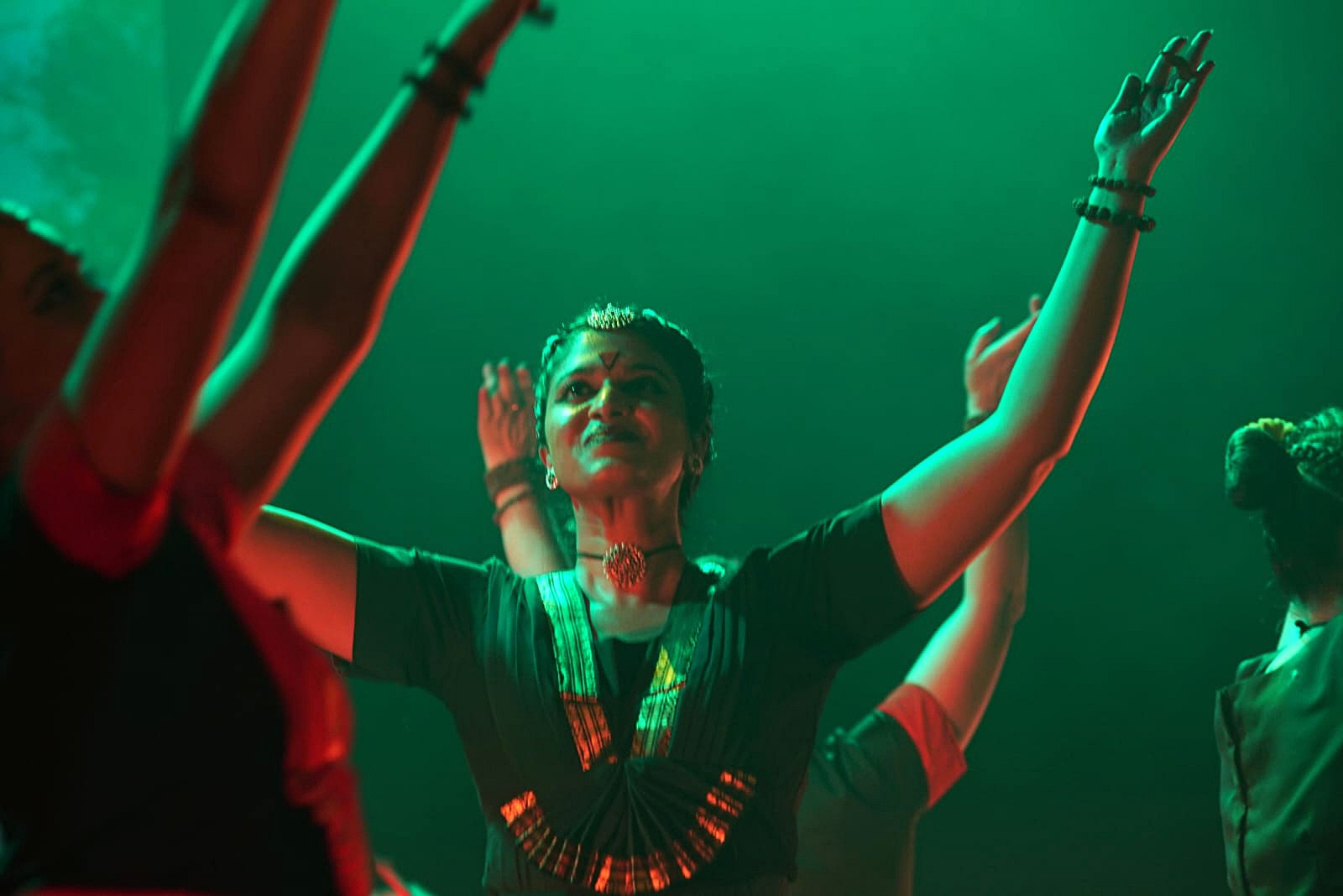
 The dance show Bhūmi 2 is being performed at the Lesedi Theatre, Johannesburg, on 13 and 14 November by the Sarvavidya Dance Ensemble. (Photo: Kavishna Pillay)
In early October I found myself in a primary school classroom of a public school in Lenasia, a still predominantly Indian community south of Johannesburg, watching a group of women from the Sarvavidya Dance Ensemble (SDE) rehearsing a new dance performance.
Outside, spring clouds mushroomed and slowly filled the sky, children played a volleyball match to raucous applause and shouts of other children. Inside the classroom six practitioners of the ancient Indian dance form of Bharatanatyam were dance-shopping Bhūmi, a word meaning Earth in Sanskrit. Together they were bringing a brand new dance into being. Only one, Anusha Pillay, is a full-time professional dancer. The other dancers, highly accomplished and practiced in Bharatanayam, include bankers, a pharmacist, an actuary and a social justice activist. All of them began learning Bharatanatyam as children and have undergone many years of practice.
Watching these women at work was a wonder. Even in the dance’s (then) raw, unfinished form, I felt a connection. The laughter; the learning; the movement; a choreography emerging from the chrysalis of imagination.
Humans at the work of creation.
Dance-makers.
On the last day of October I returned to Lenz to see how the performance had progressed. I sat in a corner and watched a run-through of the whole performance. The dance had matured.
The senior dancers are now joined by a chorus of younger dancers – cygnets being baptised into the world of public dance. In several “Interludes” poetry, rather than music, forms the background to a duet, a dialogue of motion, between Bhūmi (Kuvenshi Pather) and The Seeker, our torturing and tortured human conscience (Anusha Pillay).
The dance is intense. The movements are intricate. Each dancer’s concentration stretches from fingers to feet to face. Synchronicity in diversity. Unity in fragmentation. A bit like the Earth.
From light to dark, and (maybe) back to light again, narrative progression and tension builds up in a play where most of the speaking is through movement and music. Bharatanatyam – a name derived from a combination of Bha (bhava/emotion), Ra (raga/melody), Ta (tala/rhythm), and Natyam (dance) – is bent to critique the modern myth of prosperity theology.
Keep ancient culture modern
Bhūmi was first performed by SDE in 2023, winning a National Institute for the Humanities and Social Sciences award for Best Public Performance. Three years have passed. Bhūmi 2 springs from those roots but is an entirely new production, much of it scripted by activist Kavisha Pillay.
According to Pillay, “Part of SDE’s purpose is to ensure that classical forms are not simply preserved as heritage, but remain living traditions through which contemporary artists and audiences can explore the world around them.
“Bhūmi uses Bharatanatyam to engage with contemporary South African and global questions around climate change, inequality, technological power, conflict and our relationship with the Earth.”
The eclecticism of the production is self-evident: on the nights of the public performance the SDE dancers will also be joined by two guest artists, award-winning Kathak dancer Manesh Maharaj and veteran actor Jonathan Taylor who both dance and act pivotal parts in Bhūmi.
Bhūmi unleashes a roller-coaster of emotions.
How do you feel elated and deflated at the same time?
How do you celebrate wonder and simultaneously ponder at our capacity for hurt and harm?
In eliciting these questions (and not answering them) dance delves deeply into ancient ways humans have had of communicating with each other and the Earth, especially in Africa and India. Add to the dance the music, the poetry, the visual backdrop and you will feel an assault of a good kind on the senses. It’s in stark contrast to the everyday barrage we experience in our age of bastardised, digitised, one-dimensional communication and stunted connection.
The last time a dance grabbed me like this was when I was a fly on the wall (rather than the classroom) watching the evolution of the brilliant Vogue Opera, GLOW, the life and trials of Simon Nkoli.
Don’t miss it. DM
Bhūmi is being performed at the Lesedi Theatre, Johannesburg, on 13 and 14 November. Book tickets here.
The lead dancers are Anusha Pillay, Sarishka Aboo, Kuveshni Pather, Kavisha Pillay, Namita Kala and Mikara Rangasamy.
Mark Heywood will be hosting a post-performance discussion with the dance’s creators.

Comments
Scroll down to load comments...