



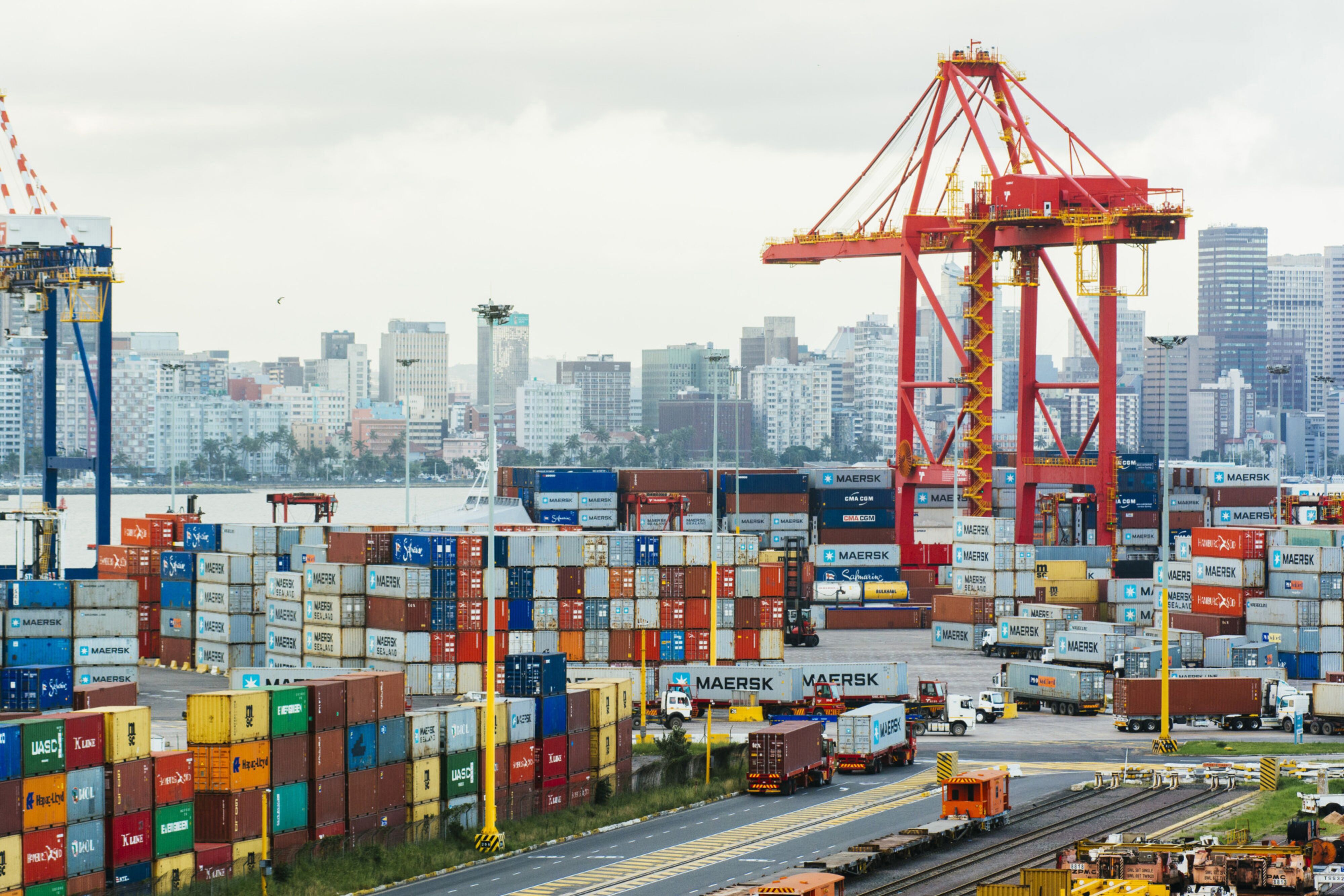
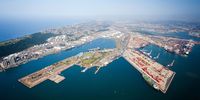
 A ship-to-shore crane stands above shipping containers on the dockside at the Port of Durban. (Photo: Waldo Swiegers / Bloomberg)
“This is not simply about ships waiting outside our ports. South African factories are standing still, employees are being sent home, and businesses are suffering serious financial losses.”
John Bowman, whose company makes refuse collection equipment, wrote to Daily Maverick last week out of frustration. He told us that things are looking up since his letter, but his business is just one of many that have taken a knock due to the slowdowns at SA’s ports – the prime example being Durban Gateway Terminal (DGT), or Pier 2.
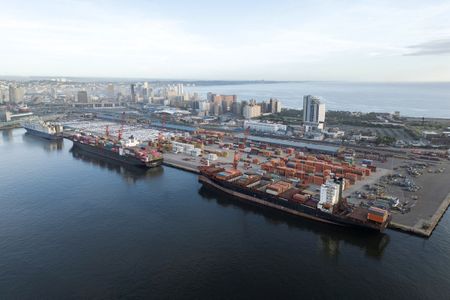
How did we get here?
Durban’s issues have had a lot of airtime, but are neither new nor isolated. And while they deserve our attention, it is also worth looking more closely at how turnaround times affect our economy and why they are receiving so much attention.
Year-end pressure
Dave Watts, a maritime consultant who has worked with the South African Freight and Logistics Association (Safla) and the Citrus Growers’ Association, explained that Durban has two peak shipping seasons.
There’s citrus season, from April to October, followed by a year-end spike in activity, linked to Black Friday, Christmas, and industrial firms looking to finish up for the year.
“Everybody wants their cargo desperately… So it’s not right to have 12 ships outside at any given time,” said Watts. “That’s a bit of a train smash, frankly.”
An ironic but apt description, considering “the share of freight carried in South Africa by rail has fallen from around 22% in the mid-2010s to under 15% in 2025, despite some recovery since 2023,” according to Trade & Industrial Policy Strategies data released earlier this year.
Watts laid it out nicely:
“The vessel that arrives today at anchorage won’t receive any kind of service for 12 days. Add on the four days to service. So that’s 16 days. And then it takes a couple of days to get them out, if we’re lucky, because the congestion on the land side is also quite drastic.”
Jacob van Rensburg, head of Research, Analytics and Industry Intelligence at the South African Association of Freight Forwarders, said: “The vessel backlog remains the principal concern … with current conditions adding around 20 days to affected supply chains.
“DGT has stabilised, but not recovered – the stronger weekly throughput has not yet produced sustained backlog reduction.”
Déjà vu and blind ambition
We’ve been in a similar position before: Transnet came under fire for delays at Durban harbour in 2023, when Watts said things were actually worse than they are right now, something we also heard from a separate source, who preferred not to be named.
The logistics sector understands that the Philippines-based port management company Ictsi bought into DGT without conducting full due diligence, as the court challenge brought by rival bidder AP Moller-Maersk prevented it from doing so.
“They [Ictsi] bought it blindfolded, basically,” said Watts.
Transnet told Daily Maverick that it had clearly communicated “all operational and financial statistics, along with investments made in the last three years, prior to handover”.
Watts suspects an ethos of “’n Boer maak ’n plan” prevailed before Ictsi’s arrival, and that the new entrant’s commercial instinct makes it reluctant to disclose the severity of the situation.
“Their communication was really poor… They’re jumping around a bit now because, as you probably know, the minister came around with a sjambok,” Watts added, referring to a visit from Transport Minister Barbara Creecy last month.
The current dynamic is one in which Transnet and Ictsi can each point to the other when complaints arise. It’s also one in which staff working at DGT lack clarity about who’s in charge.
Officially, this is a private-sector participation project, and Ictsi controls 49% and Transnet 51%.
“Both DGT and Transnet’s operating division, TPT [Transnet Port Terminals], are entities that operate independently and with autonomous operational authority. The overall Transnet strategy is aimed at developing complementary facilities over time,” Transnet explained when pressed for details.
By setting up DGT as its own entity, TPT created a competitor, but one in which it shares ownership. If you are confused, you are not alone.
“If you’re Transnet, or TPT, you’re having to cut off your leg. And then that’s going to grow into a competitor that’s going to beat you in 10 years,” a source revealed to Daily Maverick under condition of anonymity.
Long-running road issues
A 2023 report by the logistics consultancy Nick Porée & Associates (NP&A) highlights some of the structural issues at play.
Vehicles travelling from the harbour onto national freight routes are sharing the road with commuters and regular passenger vehicles.
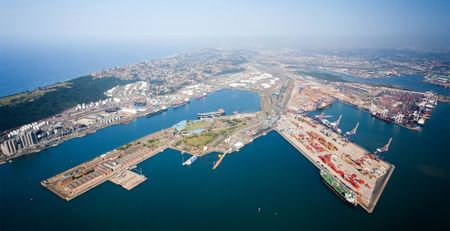
This becomes chaotic when you consider around half of South Africa’s containerised freight volumes move through DGT.
“The current problems have developed over a number of years due to the changing circumstances in the port, the country, and the region,” NP&A explained.
“These include containerised cargoes and the increasing size of container vessels, the switch to road transport, deindustrialisation and the increase in imported goods, the growth and increased mobility of the population, the spread of residential areas and the restriction of space for industrial development and logistics activities.”
Transnet’s “master plan” for Durban “fails to address the external issues of back-of-port spatial needs and road access and assumes that road transport can be ‘regulated’ (read restricted),” according to the consultancy.

Additionally, there are questions around Naval Base Durban, which some argue would be more useful as part of the port. Plans to move the naval base to Richards Bay have stalled, while the condition of the base itself continues to worsen.
According to DefenceWeb, the naval base has a 42% staff vacancy rate, and building work alone could cost tens of millions of rands, but no one is sure it’s worth making that leap with relocation on the cards.
Ailing equipment and the Covid curse
Peter Besnard, CEO of the South African Association of Ship Operators and Agents, traced current issues back to around 2014, “when things were starting to deteriorate, and there was a dire need to try and keep pace and upgrade equipment … but this didn’t materialise.”
Multiple sources pointed to State Capture-era funnelling of funds away from their intended uses and into bureaucrats’ pockets as an issue.
In 2019, President Cyril Ramaphosa dispatched then Public Enterprises Minister Pravin Gordhan to Durban to listen to the industry’s concerns. This intervention ultimately prompted Michelle Phillips – then head of Transnet Port Terminals and now CEO of Transnet – to scout for new equipment, an effort Besnard praised, saying, “She did a great job.”
Phillips managed to source straddle carriers and gantry cranes – used to offload cargo from ships – but then Covid arrived. The lockdowns delayed the delivery of equipment, which still required assembly.
At some point, the port shifted from truck-and-trailer operations to a full straddle carrier setup, which raised eyebrows among the freight sector, as straddle carriers are not intended to run for long distances. Eventually, the machines started to spill oil. Not great.
Besnard also cited a “tremendous battle with tugs” – you know, those cute little boats that help guide big ships in and out of the harbour. Basically, we need more of them.
Speaking to Daily Maverick last week, Besnard noted: “It’s only this weekend that I’ve seen six tugs available… This morning, there were 42 vessels at anchorage.”
Import-export dynamics
A shipping industry source who didn’t want to be named sees the current wave of panic, sparked around the introduction of a new IT system at DGT in August, as “primarily import-driven”.
Of course, solid port infrastructure is good for everyone, but those importing finished goods from Asia are hurting the most. The whole debacle certainly makes local sourcing more attractive.
There are things we must import, and the Durban drama has hurt exporters too – this is just an interesting shade of nuance to consider.
The source estimated that roughly 30% of the panic surrounding Durban’s delays is “by design” – pushed in front of the media’s beady eyes by stakeholders who need the appearance of a crisis to justify their role as crisis-solvers.
Still, that leaves about 70% of the panic as genuine, and no one is arguing that turnaround times need to improve.
Besnard said he left a stakeholder meeting with Ictsi “very optimistic”, but added that “Rome wasn’t built in a day … and they’ve got a long, long road ahead.”
According to Watts, new equipment is due to arrive at DGT “probably in the middle of next year”.
As consumers, we will need to keep an eye on our wallets. It’s a matter of time before companies pass on their higher transport costs, with inflation on the rise anyway.
Unable to wait for Durban to get its act together, companies are trucking goods from Gqeberha and elsewhere to Gauteng. Not something you want to do when the cost of diesel is spiking, and not good for customers.
Watts remained optimistic about Ictsi’s potential to turn things around: “I think we will, in a year, maybe 18 months, we will look back on this and say, ‘Geez, what a disaster. But now it’s running really well.’ That’s what I hope.” DM
Comments
Scroll down to load comments...