




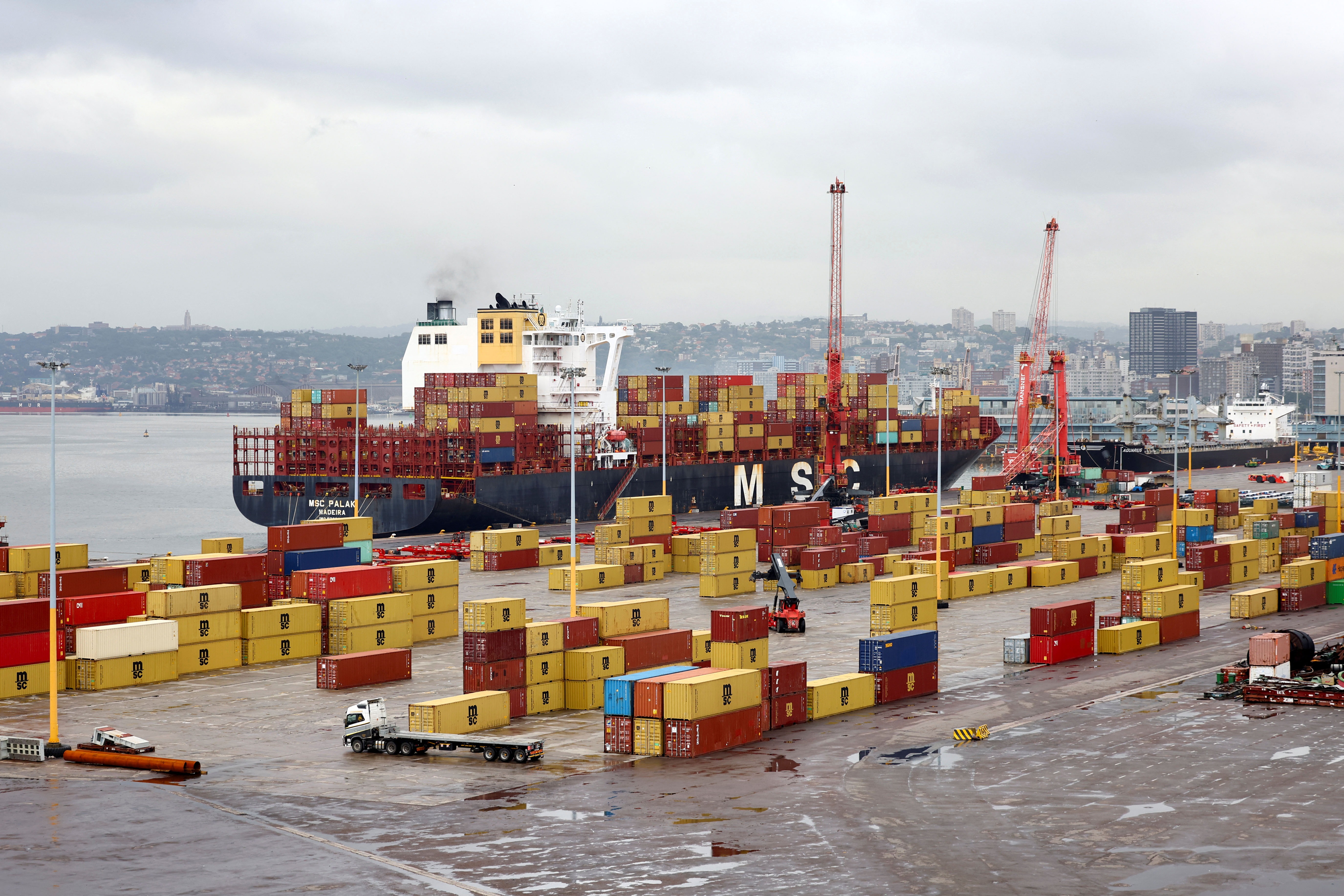
 An MSC container ship is docked in the Durban harbour, in Durban, KwaZulu-Natal, on 7 February 2025. (Photo: Siphiwe Sibeko / Reuters)
“Overall, there is a clear trend of gradual and ongoing improvement in both Durban and Cape Town,” said Juan Lombaard, local head of sales for DHL Global Forwarding. He was responding to Daily Maverick’s questions about South Africa’s primary container ports.
Durban and Cape Town have historically struggled with congestion, equipment breakdowns and severe external disruptions. This culminated in the World Bank and S&P Global’s 2025 Container Port Performance Index ranking the Port of Cape Town 400th out of 400 global ports – and Durban was at number 398.
It’s important to note that there are far more than 400 container ports in the world (anywhere between 1,100 and 1,200, depending on where the data is from). It’s just that the index list stops at 400. So, South Africa’s main container terminals are actually in the top third of the total number of ports.
Local stakeholders and maritime experts argue that this ranking is a misleading and unfair representation of Transnet’s operations. Though acknowledging systemic challenges, the index’s narrow methodology fails to account for whole-system logistics performance, external geopolitical shocks, adverse weather and the tangible operational turnaround that continues under Transnet’s management.
“We’ve seen an encouraging improvement in the performance of the Port of Durban over the past few years. Compared with previous conditions, operations have stabilised with much lower levels of delay,” Lombaard explained. “Investments in new equipment, including cranes, RTGs [rubber-tyre gantry cranes], tugboats and straddle carriers, have played an important role here.
“As a result, vessel turnaround times, ship working hours and truck turnaround times have all improved and waiting times for vessels have reduced significantly. Durban was also ranked among the most improved ports globally in 2025.”
Improvements in Cape Town have been more gradual, but investments in new equipment have played their part in better turnaround times. However, the weather is still the biggest limiting factor for outright success – one can’t load ships in high winds.
Even traditional critics of Cape Town’s port have come out in its defence since the negative press about the Container Port Performance Index. Megan Gobey, vice-chair of the Cape Chamber of Commerce’s portfolio committee for the transport and freight industry sector, said in a statement: “I really don’t think weather should be held against it, as putting in equipment to stop the wind is expensive. Already, the Cape Town Container Terminal wants to charge us a surcharge for new cranes, so I really think the World Bank needs to look at how it rates a port.”
Different headwinds
The underperformance of Mzansi’s sea ports cannot be attributed to a single factor, but rather a convergence of systemic infrastructure deficits and a healthy dose of external shocks.
/file/attachments/2994/17RC2QO5A15EFI_195687.jpg "Durban harbour, one of South Africa's busiest ports, on 31 January 2024. (Photo: Shiraaz Mohamed / Reuters)")
The 2024 Red Sea crisis forced a massive diversion of Asia-Europe shipping traffic, rerouting ships around the Cape of Good Hope. This disruption had a huge impact on global schedules, causing vessels to arrive out of sequence in bunches rather than a steady flow, which overwhelmed anchorage and berth capacities at both the Durban and Cape Town ports. South Africa went from being avoided since the Covid days because of poor performance to being overwhelmed when everyone rerouted to avoid the Horn of Africa.
Both ports have also suffered from legacy equipment failures and a lack of mid-life refurbishment for critical machinery like RTGs. In addition, the lack of reliable rail infrastructure has distorted the logistics network, forcing a heavy reliance on road freight, which congests port precincts. Minister of Transport Barbara Creecy is leading the much-needed rail reform to solve these issues.
When Daily Maverick visited the Port of Cape Town for a media briefing at the end of last year, Transnet said that, contrary to the index’s bleak picture, terminal volume at the Cape Town Container Terminal (CTCT) had actually increased 15.1% year-on-year in 2024, with average anchorage delays dropping drastically from 4.2 to 1.2 days and crane use efficiency rising 8%.
Riding the slow swell of progress
The national port operator has also implemented an eight-point plan to address inefficiencies. To combat the severe weather, Transnet has procured specialised shore tension units to stabilise ranging vessels and new RTGs with anti-sway technology capable of operating in higher wind speeds.
It also partnered with the Council for Scientific and Industrial Research to develop a predictive wind model, which reportedly will be ready later this year.
On the Durban side, the port recorded a massive year-on-year improvement in the Container Port Performance Index from 2024 to 2025. This is largely credited to Transnet’s shift towards private-sector participation, specifically a 25-year concession awarded to International Container Terminal Services (ICTSI) at Pier 2. This R11-billion investment has already increased crane moves from 18 to 28 per hour and is set to supercharge capacity.
/file/attachments/2994/17ED_388267_918165.jpg "The harbour in Cape Town, Western Cape, on 4 July 2022. (Photo: Misha Jordaan / Gallo Images)")
The index’s global data does South Africa a disservice by painting a static, overly negative picture that deters investment. The facts, when viewed through a wider lens than the strict time-in-port metric, reveal that terminal volume increased 15.1% year on year, and the CTCT managed to beat its own throughput forecasts by 62%, aided
by improved generator backups and reefer plug points.
What the index found was that container vessels spent just 56% of their total time at the port actively loading or unloading cargo at a berth. And nearly half – 44% – of all ship time was lost to waiting at anchorage outside the port limits.
This data fails to separate structural port inefficiencies from the external supply chain shocks and severe weather anomalies that South Africa has absorbed disproportionately. Acknowledging the index as a partial diagnostic tool rather than a definitive whole-system scorecard is essential if one wants to evaluate Transnet’s continuing turnaround efforts fairly.
Benedict Isaacs, infrastructure manager at the Port of Cape Town, told Daily Maverick about further plans for upgrades to the original gateway to southern Africa.
“The CTCT phase 2B project, which is made up of the packages where you’ve got the stack area within the container terminal, the truck staging area, as well as the rail aspect – we’re currently concluding the feasibility portion. And once that has been finalised, then we will be compiling the business case for execution,” he said.
This journalist’s spouse works with logistics partners in the wine industry and is one of the many CTCT detractors, but what Isaacs is outlining will solve most of the complaints. Ports are complex systems. DM
This story first appeared in our weekly DM168 newspaper, available countrywide for R35.
/file/attachments/2994/DM-260626_643039.jpg)
Comments
Scroll down to load comments...