


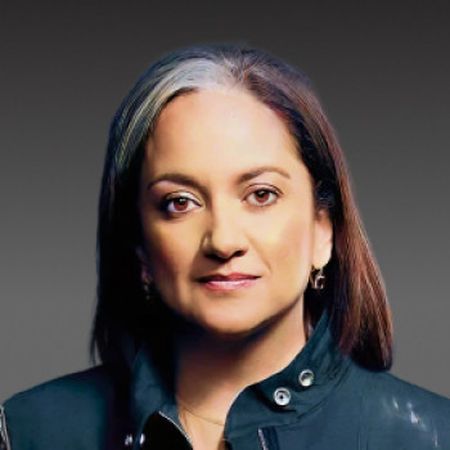
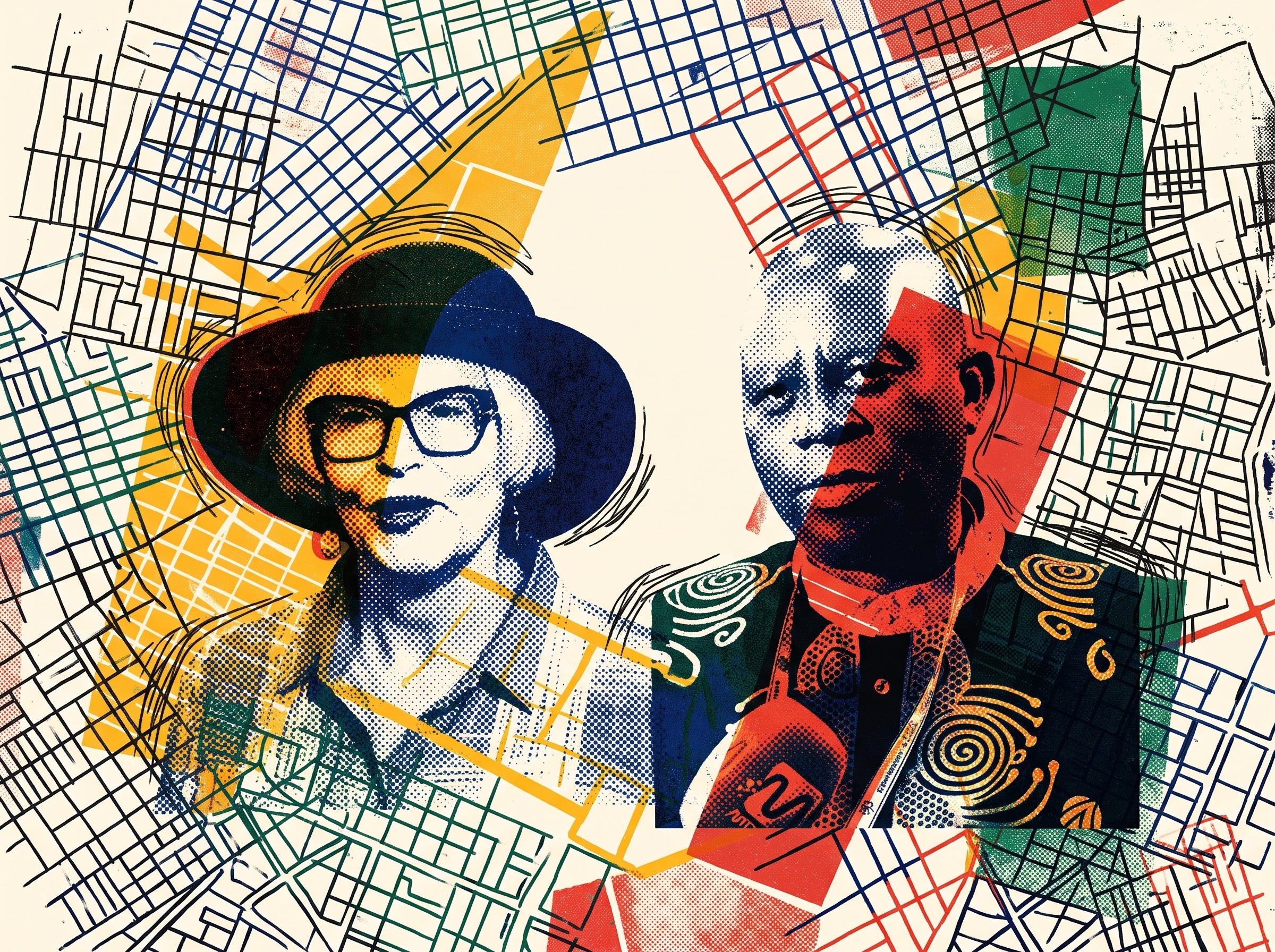
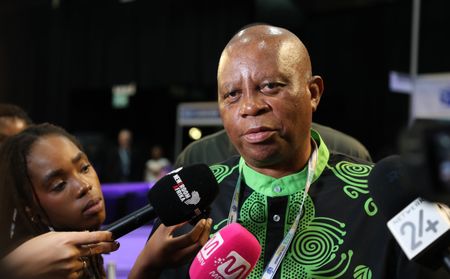
 Helen Zille and Herman Mashaba at the election results centre in Midrand, Johannesburg, on 6 and 7 November 2026, respectively. (Photo: Felix Dlangamandla)
It has been quite a week for Johannesburg. In the local government elections on 4 November, the DA’s mayoral candidate, Helen Zille, opened a crocodile-jaw-wide gap on the ANC, the first time this has happened in the city. But it was not enough to reach the party’s projected outcome of 40%.
After a spirited, 13-month-long campaign that took her from swimming in a pothole to spinning in a Gusheshe, Zille would have liked more but people in Johannesburg have fragmented the outcome. In the final results, seven parties have one seat each; three have two seats each; two have three seats each; and three have five seats each (Rise Mzansi, the Patriotic Alliance and the FF+).
This is going to make coalition building a nightmare and will call on the best negotiating and leadership abilities of the larger parties, which are the DA, the ANC and the kingmaker, ActionSA. For the state of our city, it would be best if the ANC and DA entered a two-party coalition, which they can do but are unlikely to.
Here’s what we have our eyes on:
Will the DA trade Tshwane for the Johannesburg mayoralty in talks with ActionSA?
ActionSA president Herman Mashaba said at the weekend that the chances of a coalition with the DA were “…slim, very slim”.
Will the DA go into opposition to avoid an unstable coalition?
In an interview before the election with our partner, Our City News, Zille said the party would rather go into opposition than enter an unstable coalition. Yvonne Grimbeek reported on the conversation.
Three types of coalition
By the weekend, it was clear that three types of coalition are on the table.
A government of local unity
The phrase, coined by DA leader and incoming Cape Town mayor Geordin Hill-Lewis, creates a broad front for unity of purpose. He signalled favouring this option. It mirrors the Government of National Unity, which South Africans, surveyed by Ipsos in an omnibus poll, in the main said they agree with and support.
A confidence and supply agreement
This is where one party negotiates for the Speaker position to hold the balance of power in the Council, while a second party gets the mayoral chains to run the City. One needs the other to pass budgets and key policy measures and they are forced to co-operate while also ensuring accountability.
A two-party pact for a City on the brink
A two-party pact between the reformist wing of the ANC and the DA would ensure the fastest path to dealing with the serial crises facing Johannesburg. Zille said in an interview with Sizwe Mpofu-Walsh on SMWX that she would only consider such an option if President Cyril Ramaphosa instituted a version of the Madlanga Commission of Inquiry into organised crime in the City administration.
Two research papers have found that patterns of corruption in Johannesburg can be characterised as organised crime. In a sampled study of municipalities across South Africa, Romi Sigsworth at the Institute for Security Studies identified patterns of organised crime. (You can read it here.) Mark Shaw of the Global Initiative Against Transnational Organized Crime, in the report Joburglary, identified a crime council ecosystem in the City. (You can read it here.)
Please send us your post-election questions here and also your thoughts about what kind of coalition will best serve our city.
Dada Morero loses his seat and the PA's Kenny Kunene may not be back
Because he is a PR member of the council, and given the ANC's steep losses in the City, outgoing mayor Dada Morero has lost his seat. If the ANC wants to put him back in the council, someone else will have to step aside. This is unlikely, as the ANC has haemorrhaged support and does not have sufficient patronage capital.
The Patriotic Alliance is down from eight seats to five and is less of a kingmaker now than it was in 2021. This means the party's deputy leader, Kenny Kunene, is unlikely to retain the transport portfolio, a "wet" portfolio rich in rents that will be coveted by one of the larger parties in negotiations. He may not return to a simple council seat, as he is a groot baas. DM
Have a question about the election results, or a view on what kind of coalition would best serve Johannesburg? Send it to us here.
Comments
Scroll down to load comments...