



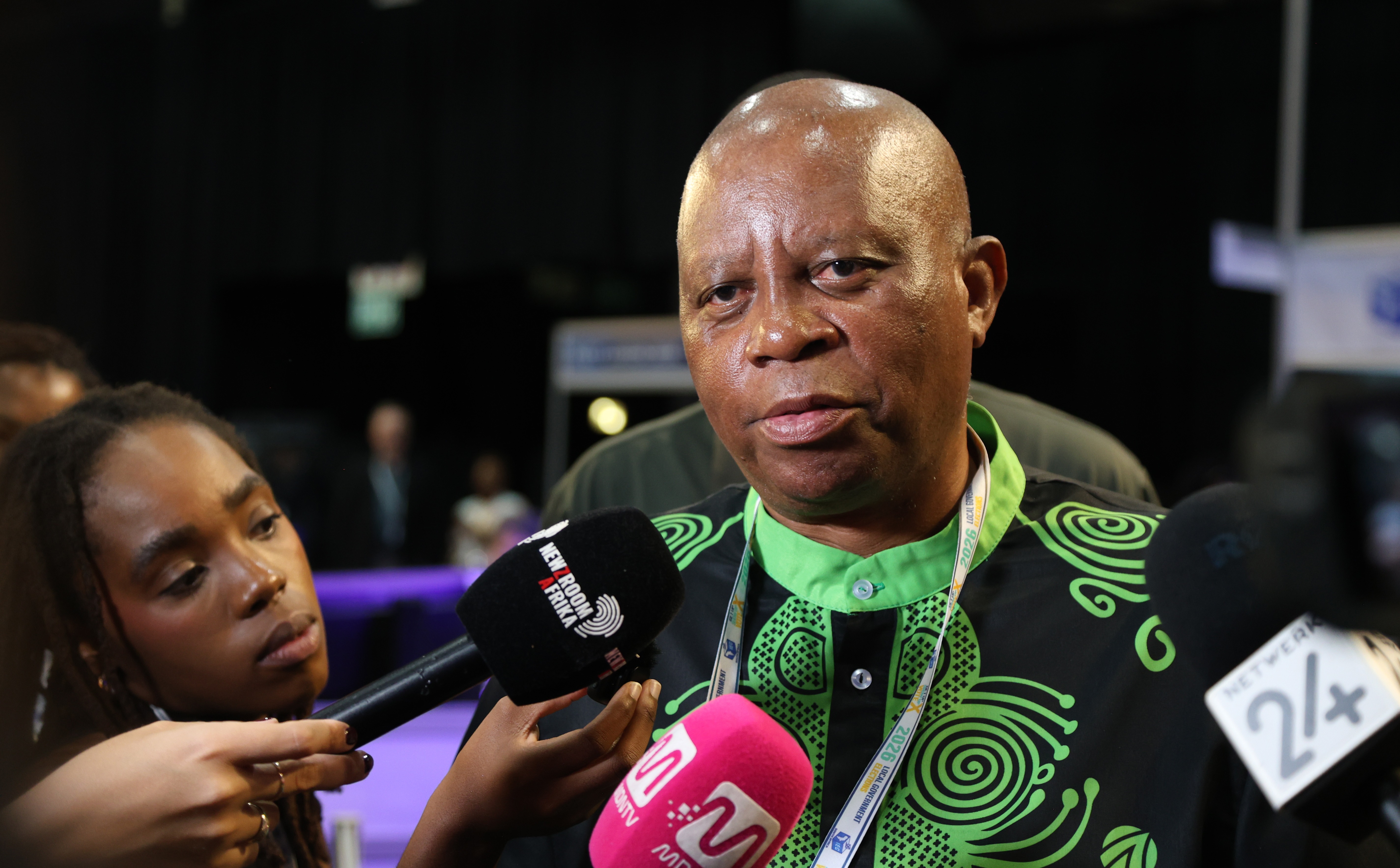
 Herman Mashaba of ActionSA at the election results centre in Midrand, Johannesburg on 7 November 2026. (Photo: Felix Dlangamandla)
In an interview in the Sunday Times, ActionSA leader Herman Mashaba said chances of coalitions with the DA are, “Very slim. Very, very slim,” suggesting the party will probably throw in its lot with the ANC and other smaller parties to cobble together coalitions.
Mashaba and the DA’s mayoral candidate for Johannesburg, Helen Zille, have bad blood. It goes back to 21 October 2019, when Mashaba quit the DA after a panel report which effectively pushed out leader Mmusi Maimane. Since then, the two can’t sit at the same table.
But it’s Day 1 of the 14 days parties have to form coalitions in hung councils, and positions shift to reveal the truism that in politics, there are no permanent enemies, only permanent interests.
ActionSA’s interest is in retaining Tshwane mayor Nasiphi Moya, who is popular and helped the party surge to achieve a 22.7% outcome in the capital city. The DA received the highest vote share of 34.4% after an all-in campaign by previous Tshwane mayor Cilliers Brink.
To install Zille as Johannesburg mayor, the DA may have to trade Tshwane. Zille received the highest share of votes at 34.81%; the ANC is at 20.27%, while Action SA is kingmaker here too with 16.29%. The DA will have to decide between Tshwane and Johannesburg, while Zille and Mashaba must find a peace pipe to smoke.
Action SA’s Michael Beaumont will lead coalition talks. He sets out the party’s strategy below.
The Kingmakers — Action SA’s coalition game plan
The 2026 local government elections have left most of South Africa’s councils without an outright governing majority. Political parties now face the difficult task of negotiating coalition governments, with just 14 calendar days between the declaration of election results and the inaugural council meetings.
ActionSA national chairperson Michael Beaumont will lead his party’s coalition negotiations. He speaks to Daily Maverick’s Ferial Haffajee about the tight deadlines, the importance of written coalition agreements, the dangers of narrow majorities and what happens behind the scenes when political parties negotiate power.
Question: Could you tell me how coalition negotiations work? I was really interested when you were explaining that calls start happening while voting is still continuing.
Answer: To some extent. Normally, when voting has stopped.
The problem in South Africa is you only have 14 days, provided for in legislation, between the announcement of the election result and the inaugural council meetings that elect mayors and effectively establish coalition governments.
Section 29(2) of the Local Government: Municipal Structures Act requires the municipal manager, or a person designated by the provincial MEC for local government in the manager’s absence, to convene the first meeting of a newly elected council within 14 calendar days of the council being declared elected. For district councils, the period begins after all representatives appointed by local councils have been appointed.
You know, in countries around the world, you have three to six months.
And that’s why we have coalitions that are largely negotiated around positions and not programmes of action.
And it’s very difficult to complete a negotiation that is programmatic in just 14 days when you’re doing it across 200-and-something municipalities simultaneously.
Q: I just want to go back to the 14 days to understand it. Is that 14 working days?
A: Calendar days is what I’m saying, 14 calendar days.
Q: So, say the results are declared on Sunday night, then it’s Monday two weeks thereafter. That’s a very short time.
A: Municipal managers are required to convene the inaugural council meetings within that 14-day period. The meetings can take place sooner.

Q: So, when you are negotiating in such a short period of time, with really urgent deadlines, are you able to strike tactical agreements that can go across councils?
A: Well, I suppose every party is different.
One of the things we did deliberately was develop our coalition negotiations framework in the weeks leading to the election, recognising that when you come out of an election, you haven’t slept in all that time. It’s not exactly the time to start thinking about these things.
As an organisation, like any other, you must ask yourself, strategically, what are we after?
How do we turn an election result into value for our residents from a coalition standpoint?
Q: And strategically, what are you after?
A: I think a couple of principles.
We have to have stable governments, so we want governments where there’s a programme of action that is negotiated, not just positions.
We want coalition agreements in writing, so that you can’t have a situation where you say that we agree on stability, and then they’re trying to remove your municipal manager with three months left to go in the term of office.
[Beaumont is referring to an attempt by coalition partners in Tshwane to remove the municipal manager before the end of the manager’s term.]
You need to have these agreements made public, so that you don’t undermine the democratic process by having, you know, 16 million people vote, and five unelected people sit in a smoke-filled room and do something else.

Q: I want to talk about the types of coalitions. There’s confidence and supply, minority government coalitions, large-party coalitions, and then the idea of a local version of the GNU. Have you thought about which of those are your preferred options?
A: We prefer stable coalitions, which means we must build a majority that’s not narrow.
I’ve been involved in a coalition in 2016 where we had a majority of, like, three seats, and I was having to chase people out of the bathroom to approve a budget, and it wasn’t a whole lot of fun.
Wheeling people in from hospitals, in beds. Not joking. This happened.
Those are the stakes. So, if you want to build really strong majorities, what you want to do is remove the ability of any one party to walk away, collapse things, and bring...
Q: What is a strong majority in your definition?
A: I think anything more than 60%, 65%, generally, is strong.
[Beaumont explains that a larger majority reduces the ability of individual parties to withdraw their support and collapse a coalition government.]
Q: ANC deputy secretary-general Nomvula Mokonyane was saying to me yesterday that she thinks the discourse can get pejorative about small parties. What’s your view of small parties?
A: I’ve been involved in coalitions where we passed a budget with one vote of an ANC councillor who wasn’t even part of our coalition. DM
Comments
Scroll down to load comments...