


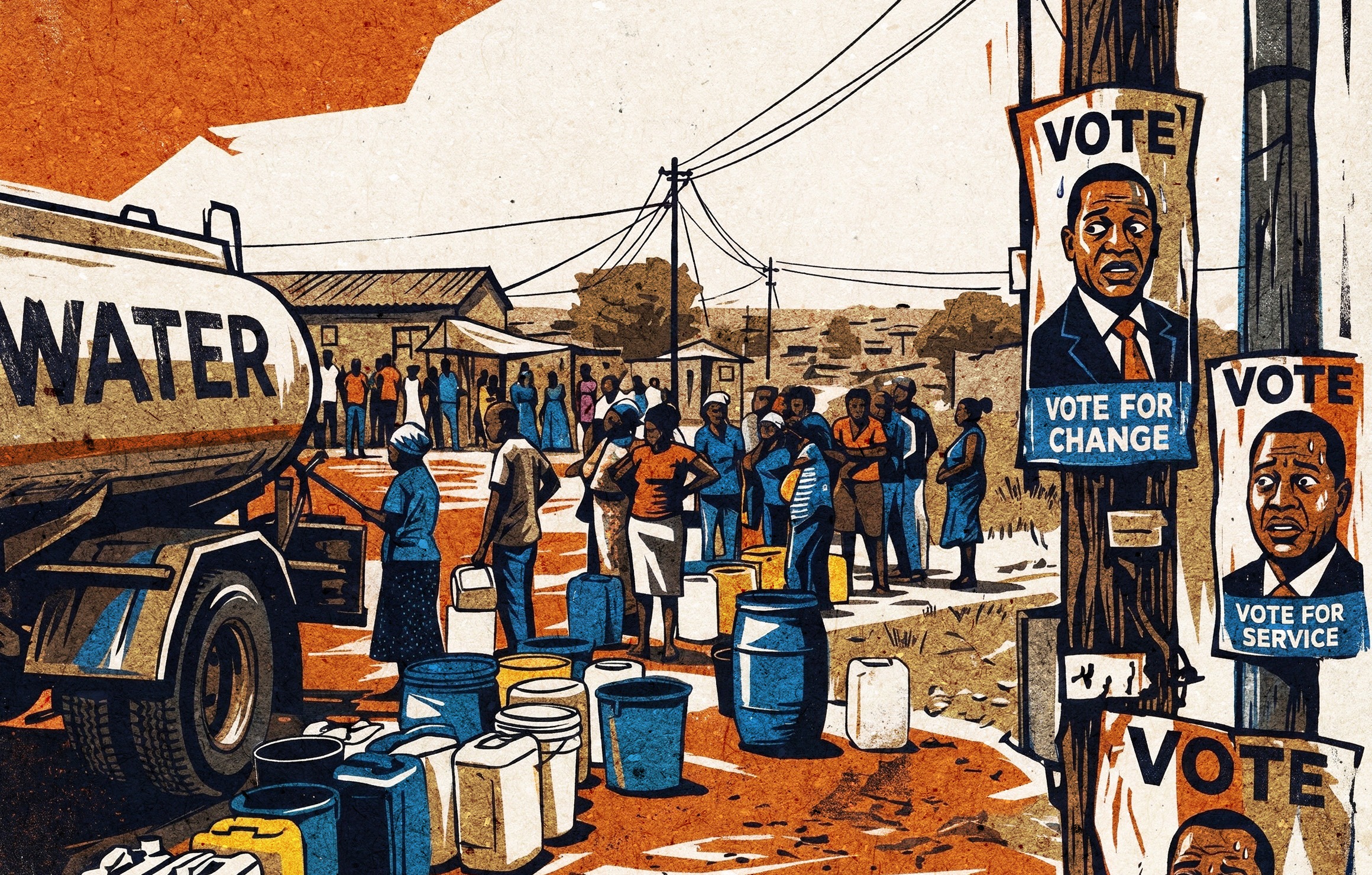
 Illustrative image: Sources generated with Google Gemini Flash Image 2.5
It was always going to be the case that service delivery issues would overtake any kind of narrative that parties were going to try to impose on this election.
Such is the scale of the problems in so many places no amount of discussion about anything else would really move the dial. Even discussions about race and our racialised inequality have not been able to direct the narrative yet.
This might be one of the reasons the various campaigns have been so dull, and why in particular election posters have been so boring.
The scale of our set of interlocking municipal crises now means that with just six days until the election headlines are dominated by two major long-running issues: the water crisis in Bronkhorstspruit and the Joburg protests by the South African Municipal Workers Union (Samwu).
Both have different impacts on different parties in different ways. But both are a warning to whoever takes over our councils, or who joins a coalition after next week.
Tshwane’s water crisis
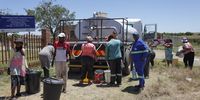
The reaction of the parties involved in the current coalition in Tshwane to the Bronkhorstspruit issue shows how worried they are about the problem. With more than 800 people now having been treated for a gastrointestinal illness, the scale is huge.
But the real bullet for the parties concerned is how it happened. That officials at the Bronkhorstspruit Water Treatment Plant knew they were putting water into people’s taps without adding chlorine to it.
And that their superiors in Tshwane were aware of a looming problem.
This explains why the mayor, ActionSA’s Nasiphi Moya, has been so front and centre. The only way to politically manage something of this scale is to be right in the centre of it.
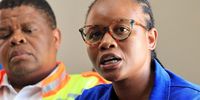
This might also explain why the ANC deployed Deputy President Paul Mashatile to Bronkhorstspruit earlier this week. He could not have been expected to provide any new insight on the problem.
The reason he was there was probably to occupy the media space, to make sure reporters and social media were talking about him, rather than allowing other parties to continue to explain how it was the fault of the coalition that includes the ANC.
For Mashatile it might also have served his narrower interest of reminding people that he is campaigning for the ANC after his as-yet-unexplained absence from public life for so long.
This is a classic case of many members of a coalition being caught up in a governance problem, and possibly suffering as a result.
When ActionSA leader Herman Mashaba celebrated joining the coalition with the ANC in Tshwane, and Moya’s ascension to the position of mayor two years ago, he might not have thought she would be the face of a major water crisis in the days before the next local election.
ActionSA has spent much time and effort in Tshwane campaigning directly for her. There are election posters calling for Moya to stay on as mayor, while part of their radio campaign also focuses primarily on her.
Joburg’s R10-billion headache
This is the risk that all parties now face when considering whether to join a coalition.
Whether you are the EFF, the IFP, the PA, the FF+ or any of the other parties, you have no idea what kind of governance issue could blow up while you are in a governing coalition.
Or when it could blow up.
The risk for the DA is perhaps greater than for many of the other parties, because they have staked their entire campaign on improving service delivery.
If they do have internal discussions about working with the ANC or other parties in Joburg or other councils, this is likely to be the biggest point of contestation.
The situation posed by this week’s Samwu protests is another example of the deep-seated problems that have no easy solution.
They say they are owed what would be a R10-billion increase that was agreed to 10 years ago. Joburg is broke and simply cannot afford it.
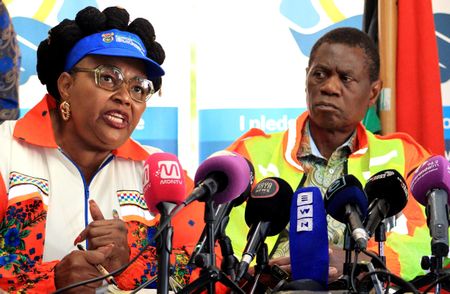
Samwu has traditionally supported the ANC. Now, as a member of Cosatu, its allegiance might be split between the ANC and the SACP.
It is worth repeating that in an election that will be determined by turnout, a major strike by Samwu might well drive up DA turnout. Especially if it results in the usual thickets of dustbins lining suburban roads.

But if the DA were to oppose a salary increase for Samwu members, it could drive up ANC turnout if it were claimed that Helen Zille was trying to stop black people from earning more money.
Despite that, Samwu’s leadership have probably assessed that they need to use this moment when the ANC-led coalition is vulnerable to extract what they can. This is because salaries are a core interest among their members, well above politics.
But, if the DA were to lead the next coalition in Joburg, Samwu might feel it has no allegiance to them at all, and might as well keep up the pressure before a new administration has a chance to find its feet.
These are by no means the only issues facing any incoming coalitions after next week.
The crisis at Joburg’s City Power alone probably requires an effort similar to the size made at Eskom to resolve it.
Water problems plague so many of our cities and towns, while electricity cuts don’t make news bulletins anymore.
And those who enter local government after Wednesday will be held publicly responsible for all of it. DM
Comments
Scroll down to load comments...