



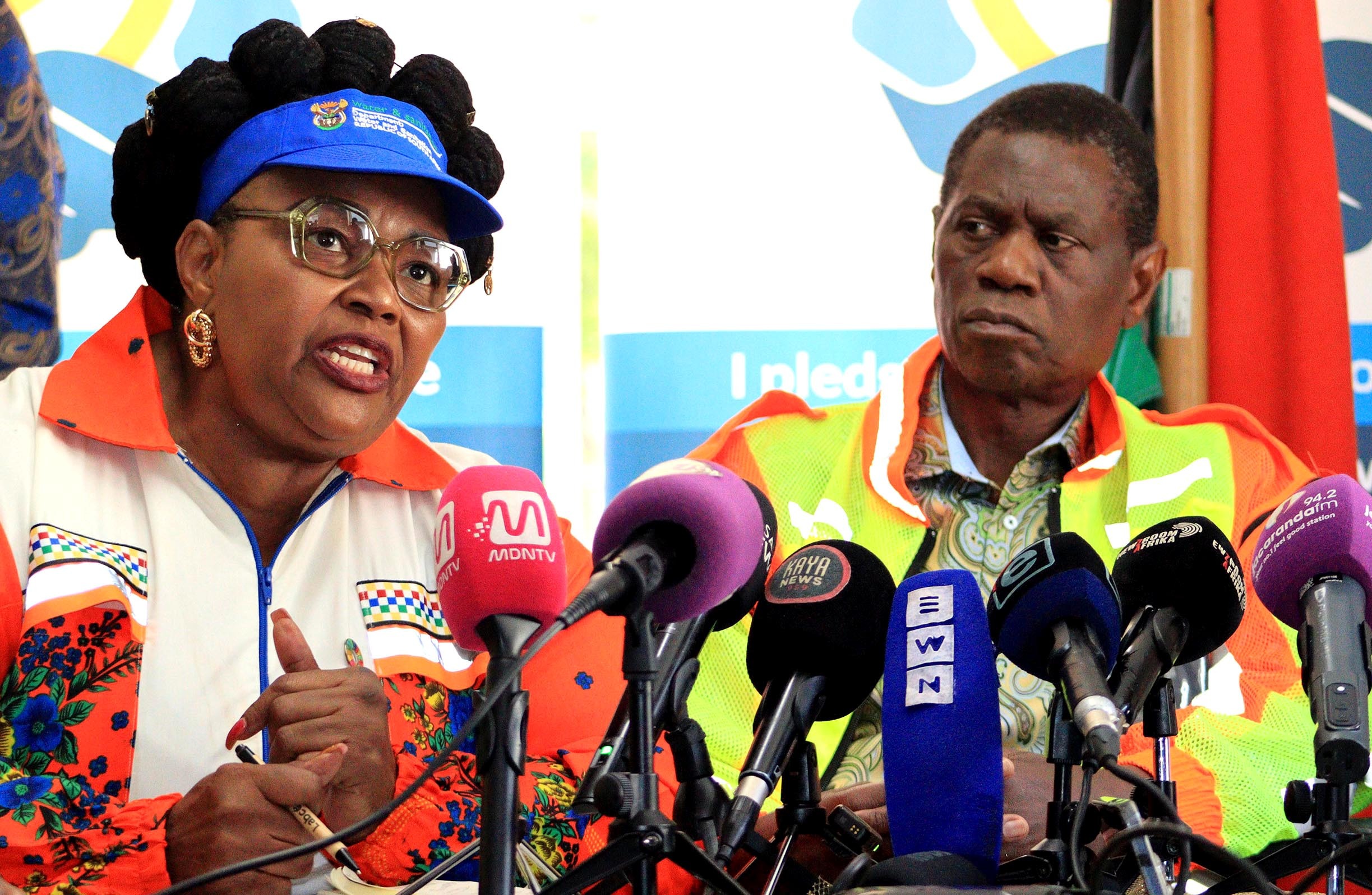
 Minister of Water and Sanitation Pemmy Majodina (left), alongside Deputy President Paul Mashatile, addresses the media at Bronkhorstspruit District Hospital on Monday, 26 October 2026. (Photo: Jamie Ho)
Water and Sanitation Minister Pemmy Majodina has denied that contaminated water in Bronkhorstspruit caused an illness outbreak, arguing that the situation cannot be classified as an outbreak without fatalities or critical cases.
On Monday, 26 October, Majodina, with Deputy President Paul Mashatile, visited Bronkhorstspruit District Hospital in Tshwane, after a rise in gastrointestinal illness linked to contaminated water in the area.
So far, 833 people have been affected by contaminated water and have sought medical assistance, with about 40% of patients aged up to four years old. Residents fell ill after drinking water from the Bronkhorstspruit Water Treatment Plant, which for weeks did not use chlorine to treat E. coli due to tender issues.
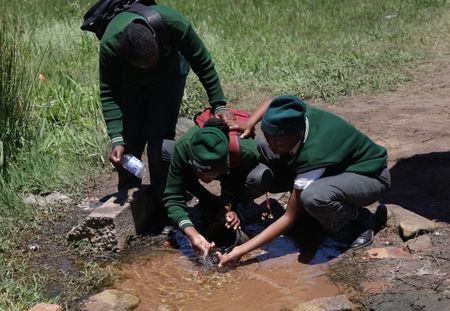
Majodina said three patients remained in hospital as a result of water contamination and that none had been hospitalised for more than three days.
“Admission, since the 7th of October to date, has not exceeded … three days, meaning that people have not been very critical,” said Majodina.
“They came to the hospital because they were dehydrated, and after they’ve been hydrated, they go back home.”
She continued, “I’m still firm that there’s no outbreak. There’s no death. There is no one that is critical.”
Majodina and Mashatile were also accompanied by officials including Deputy Water and Sanitation Minister David Mahlobo and Tshwane Mayor Nasiphi Moya, who briefed the media at the hospital.

Majodina said she was satisfied with the treatment of patients following the outbreak and that officials were working to prevent a recurrence of water contamination.
“There is no report that says they came back [to the hospital] for further treatment after they’d been released, meaning that the matter is under control,” she said.
Mahlobo said the government was coordinating its response.
In the interim, 36 water tankers are supplying affected residents with clean water. Majodina said this emergency measure should not continue for more than two or three months because it was expensive and inconvenient for residents.
Officials said the aim was to resolve the issue as soon as possible but did not provide a clear timeline for when affected residents could expect safe, clean water to return to their taps.
Infrastructure failures and residents’ water use
Majodina also attributed the rising number of gastrointestinal cases to residents continuing to use stored water. She said that, despite the City of Tshwane informing residents that the water was contaminated and advising them not to use or consume it, some had continued using stored water, contributing to the spread of the illness.
She said private water tankers had been supplying residents, but officials could not confirm whether the water they provided was safe for consumption.

“Some people kept water for the longest time. Other people are getting water from private tankers, using water that we don’t know where it was treated. However, this does not mean that there is an outbreak,” said Majodina.
She argued that most water-related issues across the country stemmed from ageing infrastructure and distribution challenges. She attributed some of the problems to water leaks, which contributed to significant water losses.
Mahlobo sought to distinguish between a water security crisis and what he described as a “municipal crisis”, arguing that municipalities across the country had been grappling with similar problems for some time.
Majodina said that some parts of Gauteng had excessive water consumption, particularly in Johannesburg and Tshwane, and argued that affluent neighbourhoods with swimming pools should face water cuts if lower-income areas were subject to them.
Majodina acknowledged that some areas could run out of water if the problems were not addressed. She said officials needed to monitor leaks and reservoirs closely and that the City of Johannesburg and Rand Water were due to meet to discuss solutions.
She called for audits to identify infrastructure that needed to be decommissioned and for other water treatment plants to be inspected for faults. She said illegal connections had put some metros under severe strain.
Questions remain over accountability, safe water
With local government elections just over a week away, Moya was asked whether the water contamination crisis could undermine her term as executive mayor. She said her focus was less on the election campaign and more on protecting residents’ health and resolving the water supply problem.
During a briefing on the matter last Monday, Moya said that the City’s performance was “indefensible” and admitted to municipal negligence after senior leadership was not informed in time about chlorine supply chain issues.

At Monday’s briefing, she said a plant manager had already been suspended, adding that “anyone found to have been negligent in managing chlorine levels or communicating the contamination” would be held accountable, while internal and external investigations continued to establish responsibility and ensure the issue was resolved.
Majodina urged residents to take precautions, including washing their hands regularly and maintaining good hygiene.
She urged residents not to use tap water until the plant had been disinfected. For residents, however, the warnings have raised questions about how they are expected to manage their daily needs.
Water tankers offer temporary relief
Moya outlined short-term relief measures, saying water tankers were operating from 8am to 8pm to supply residents. She said there were no restrictions on the amount of water residents could collect.
Despite promises to supply water from tankers until the treatment plant is disinfected, some residents say the reality on the ground has been different.
While officials outlined measures to ensure an emergency water supply, residents described irregular deliveries, insufficient tankers and uncertainty about when they would next have access to water.
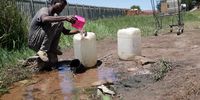
“These water tankers, if they come, maybe they come after two or three days,” said mother of three, Nomsa Mashele, 60. “We don’t know until when.”
“Now, this tap water, when it comes, they tell us we must not wash our hands with it, right?” Mashele says. “We shouldn’t drink it, we shouldn’t brush our teeth with it, we shouldn’t wash clothes with it. What are we going to do with it? Flush only?”
Joseph Mthimunye, 29, said tankers often arrived only briefly, with some residents left without water even when they managed to find a truck.
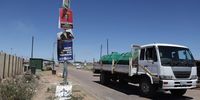
“The trucks, they just come in and out only, that’s it,” he said.
“Sometimes you find the truck, and they say water is finished. You cannot stop the truck because you can’t see what’s inside the tank. It’s just saying the water is finished and it just [drives off] and leaves you alone, standing there.”
A resident who wished to remain anonymous said a municipal tanker regularly parked outside a nearby community facility, but residents living in the surrounding area were not allowed to draw water from it.
“That truck, it’s for the multipurpose centre,” said the resident. “Not for us as a community. It’s for the centre. We don’t get water. Nothing.” DM
Comments
Scroll down to load comments...