



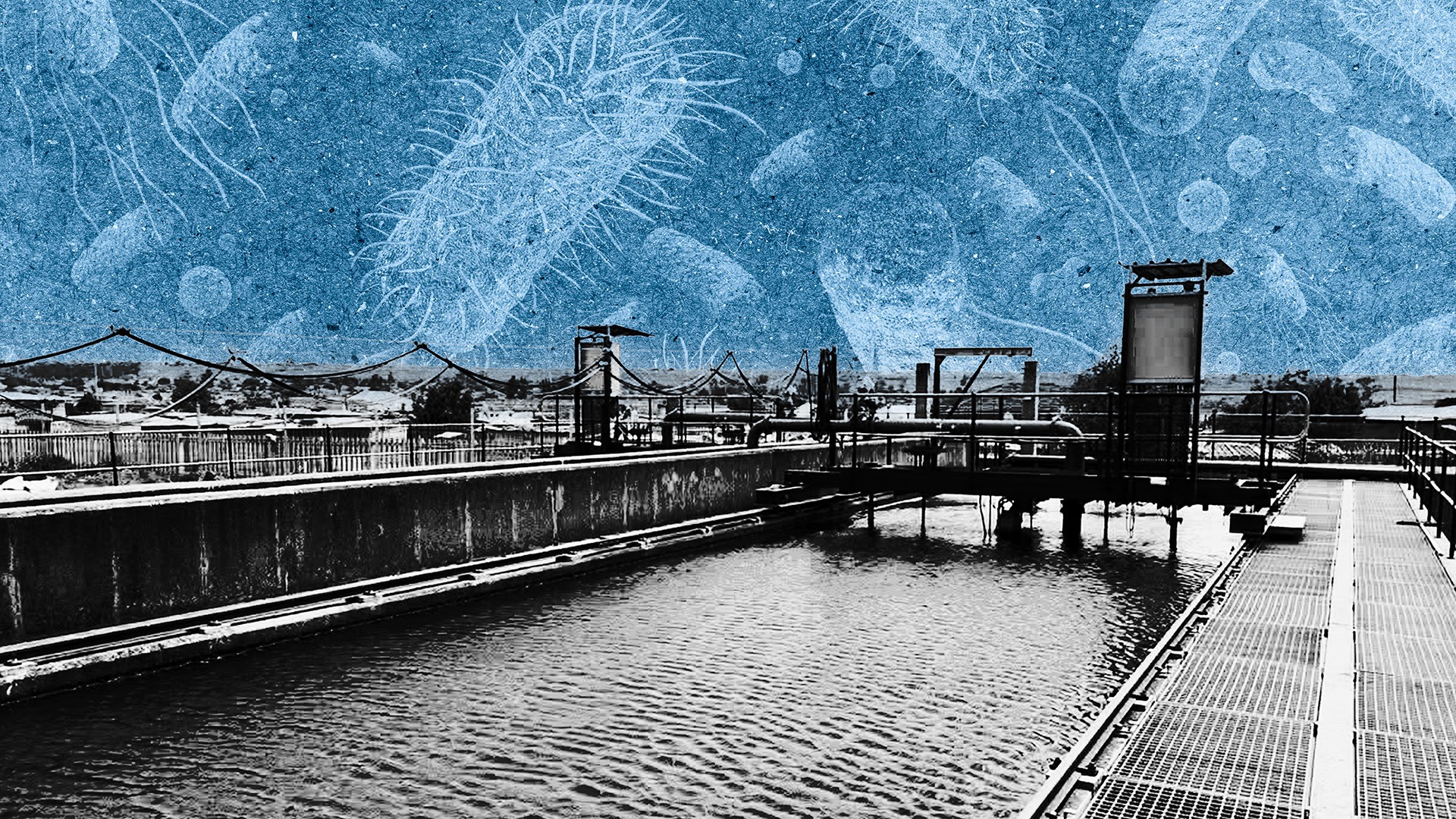
 Illustrative image: Bronkhorstspruit Water Treatment Plant. (Photo: Facebook / Dr Nasiphi Moya | E. Coli and Norovirus bacteria. (Graphic: iStock)
“I’m still firm that there’s no outbreak. There’s no death. There is no one that is critical.”
That is Water and Sanitation Minister Pemmy Majodina, speaking on 26 October 2026, after the number of people who had sought medical help for gastrointestinal illness linked directly to Bronkhorstspruit’s water supply reached 833.

The failure to maintain a safe water supply in Bronkhorstspruit, within the City of Tshwane, raises specific questions about procurement, operational management and oversight. How was an essential treatment process allowed to be paused for weeks without escalation, and why were residents not warned that their water might be unsafe?
Tshwane’s record is particularly troubling. The Rooiwal wastewater treatment plant was allowed to deteriorate for more than two decades. By 2011, it had effectively broken down. The subsequent failure to effectively repair the facility, compounded by a botched tender process in 2019, prolonged the crisis, thus contributing to the contamination of water systems serving thousands of homes, schools, hospitals and other facilities.

In May 2023, the consequences became devastatingly clear when a cholera outbreak in Hammanskraal led to the loss of lives. Only after months of political promises and mounting public pressure did authorities establish a system of water tankers to provide residents with safe drinking water.
Three years later, residents elsewhere in Tshwane have again become ill in circumstances linked to an unsafe municipal water supply. The question is, what changed after Hammanskraal – and why those changes were insufficient to prevent the failures in Bronkhorstspruit.

The June 2023 Blue Drop Watch Report found that 50% of sampled municipalities had bad or poor microbiological water quality, against 10% in 2012. The full 2023 Blue Drop Report found that only 26 of 958 water supply systems qualified for certification and that 46% did not comply with microbiological standards; acute health microbiological compliance carried a 30% sub-weighting within the drinking water compliance key performance area. Sixty-three water services authorities with systems in a critical state were issued non-compliance letters requiring corrective action plans.
When the most basic safeguards fail
In Bronkhorstspruit, failure by local government authorities to maintain chlorine supplies resulted in the water treatment works going without chlorination for weeks.
Water treatment protects entire communities from infection through the water they drink and use to prepare food; its failure can expose thousands of people before the first patients reach a clinic. Maintaining that protection requires reliable procurement, functioning equipment and operational oversight.
Residents were reportedly neither afforded that protection nor warned promptly that their water might be unsafe.

By 26 October, 833 people had reportedly sought medical assistance for gastrointestinal illness linked to contaminated drinking water, including 328 children aged four years and younger. Yet Water and Sanitation Minister Pemmy Majodina irresponsibly disputed whether this constituted an outbreak, citing the absence of deaths or critically ill patients.
An outbreak does not require deaths
This argument is scientifically indefensible. An outbreak is an occurrence of disease above the expected level in a particular population, place and period; it does not require deaths or critical illness.
A water minister need not be an epidemiologist, but should understand the public health risks her department is responsible for regulating.

Recognising when a water supply may be making people ill, understanding the advice of health officials and communicating accurately with the public are basic requirements of the job. Dismissing an outbreak because nobody has died raises questions about the minister’s understanding of those responsibilities, at precisely the moment residents need competent leadership. South Africa’s regulations reflect this distinction.
The absence of reported fatalities in the outbreak does not diminish the seriousness of hundreds of people becoming ill following exposure to contaminated drinking water. The absence of deaths should not be used to deny the existence or seriousness of a public health crisis. This is an outbreak, by any scientific measure.
The reported number of illnesses, the water-quality concerns and the failure to maintain chlorination demand urgent investigation, legal consequence management for those who were responsible and a transparent public response.
Minimising the crisis by misleading the community about what constitutes an outbreak merely deflects responsibility. It does nothing to explain why hundreds of people have become ill.
A failure of government
Safe water is one of the most important foundations of public health. It prevents infection across entire communities and makes food preparation, hygiene and healthcare safer.
Maintaining that protection is among government’s most fundamental responsibilities. The burden of failure falls hardest on communities with the fewest alternatives: households unable to afford bottled water, transport to collect it or the costs of illness and missed work.
Young children face risks, including repeated diarrhoeal illness that can worsen malnutrition. A reliable municipal supply protects people regardless of their ability to pay for alternatives. Allowing that protection to fail compounds the disadvantage of those who depend on it most.
A basic test of fitness to govern
Arguing over whether this constitutes an outbreak shifts attention away from the questions that demand answers: Why was chlorination interrupted? Why were adequate contingency arrangements not in place? Why were residents not warned sooner? And who was responsible for ensuring that the water supply remained safe?
These questions require a thorough, independent and transparent investigation. The findings must be made public, with consequences for those responsible, not simply another set of recommendations. Residents need a clear timetable for restoring a safe and reliable supply, supported by independent water-quality monitoring and regular public updates.
The implications extend beyond the treatment plant. A government that cannot reliably provide safe drinking water has failed at one of its most essential functions. Seeking to minimise that failure compounds it with a failure of leadership and accountability. The absence of deaths does not lessen the responsibility of those entrusted with protecting the public.
Bronkhorstspruit is a basic test of fitness to govern. Those responsible must demonstrate that they can fulfil their duties or face removal where the findings warrant it.
Restoring the water supply must not become an excuse to move on without consequences. Otherwise, residents are being asked to entrust their health to the same people and systems that failed to protect them. DM
Collectively authored by: Prof Shabir A Madhi (Professor of Vaccinology, Faculty of Health Sciences, University of the Witwatersrand), Dr Aslam Dasoo (Convenor: Progressive Health Forum; Chair: Universal Health Access Coalition), Prof Francois Venter (Professor, Faculty of Health Sciences, University of the Witwatersrand), Dr Jeremy Nel (Senior Lecturer, Faculty of Health Sciences, University of the Witwatersrand), Prof Guy Richards (Emeritus Professor, Faculty of Health Sciences, University of the Witwatersrand), Prof Glenda Gray (Distinguished Professor, Faculty of Health Sciences, University of the Witwatersrand), Prof Lucille Blumberg (Honorary Assoc. Professor, Dept of Medical Microbiology University of Stellenbosch), Prof Bavesh Kana (Professor, Faculty of Health Sciences, University of the Witwatersrand), Prof Fareed Abdullah (Honorary Professor, University of Pretoria), Prof Ian Sanne (Assoc. Professor, Faculty of Health Sciences, University of the Witwatersrand), Prof Wendy Stevens (Professor, Faculty of Health Sciences, University of the Witwatersrand), Prof James McIntyre (Honorary Professor, University of Cape Town.
Comments
Scroll down to load comments...