


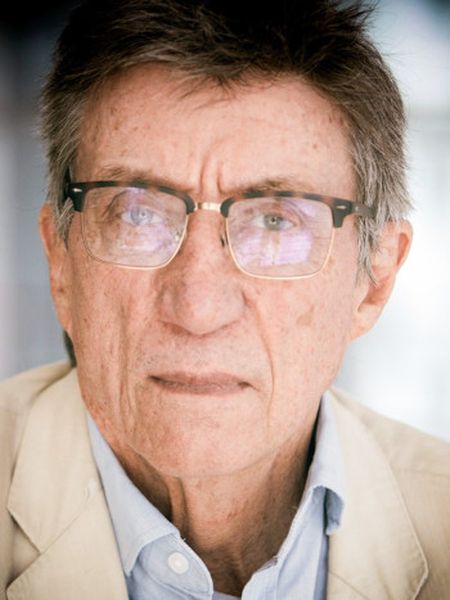
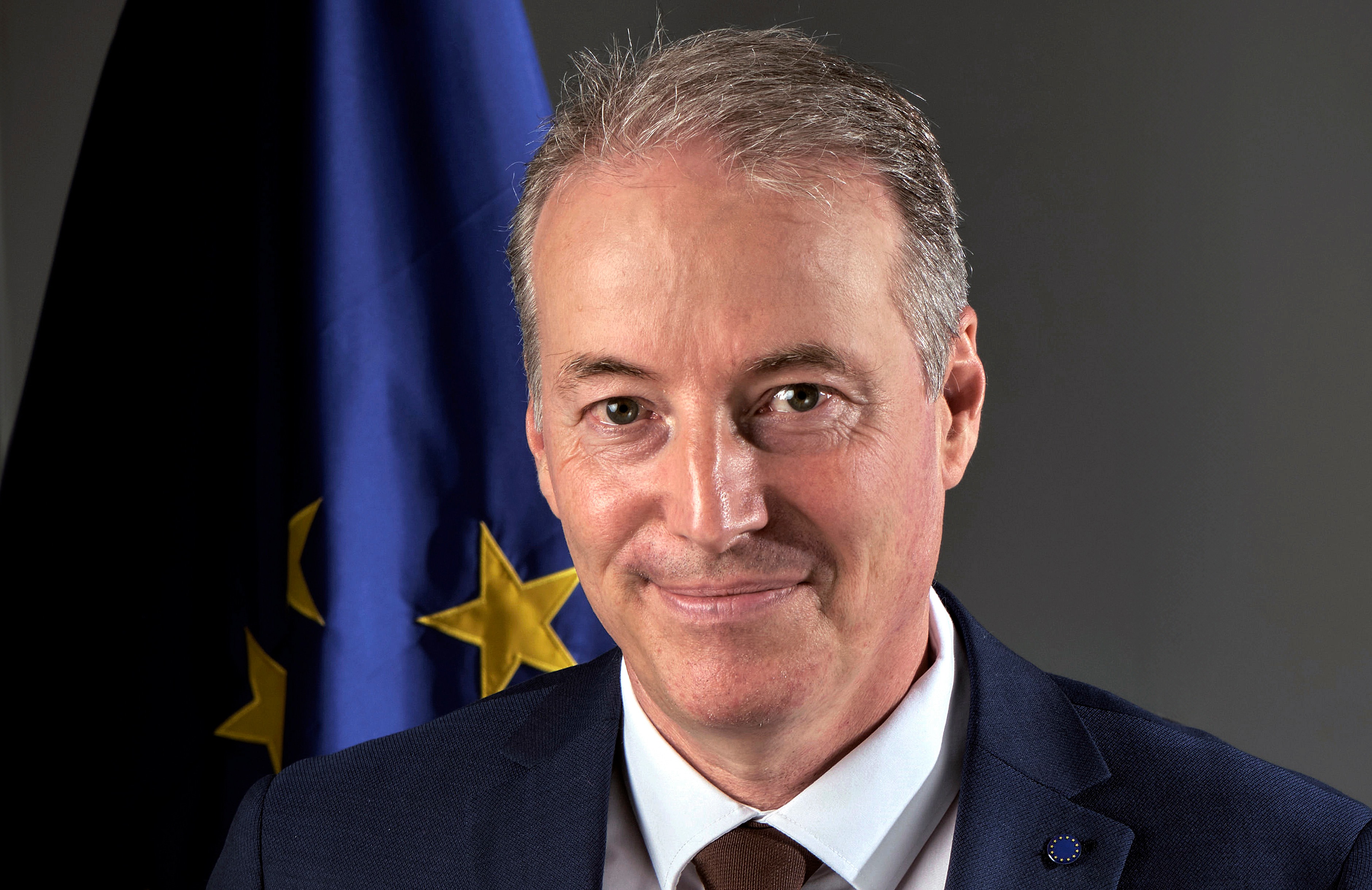
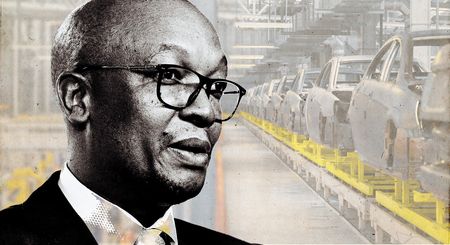
 Kristian Schmidt, the new EU ambassador to South Africa. (Photo: EU embassy / Pretoria)
While the US is aggressively demanding that South Africa abandon black economic empowerment (BEE) and other such domestic policies, the European Union (EU) is taking a much subtler approach.
It accepts the principle of BEE but has a formal negotiation platform with Pretoria to tweak implementation of the policy.
“You’ll never hear me complain” about BEE, says the new European Union ambassador to South Africa, Kristian Schmidt, a Dane.
“We Europeans, first of all, have a share, if not responsibility, in South Africa’s history. There is a historical injustice that needs to be addressed. And Europe will not be pushing for change on that legislation.”
Nevertheless, Schmidt noted that South Africa had been open to discussion about the implementation of BEE in the Clean Trade and Investment Partnership negotiation platform with the EU. So, for example, the policies might require a company to use local content or a local recruit if “it is simply not available”.

“So, either we agree on some flexibility, pragmatically, or the investment doesn’t happen.”
And Pretoria was also open to discussing “equity equivalence” – for example, foreign companies investing in transformation funds rather than ceding 30% of the ownership of their companies to local individuals.
But Schmidt added that EU investors also wanted to invest in a stable country and “stability comes from improving equality”.
Ukraine, Gaza and shared values
At the core of the relationship between the EU and South Africa are shared values, Schmidt said. These also helped shape the EU’s nuanced view on South Africa’s controversial failure to condemn Russia for its invasion of Ukraine.
“We would be making a mistake if we were telling South Africa to choose sides,” Schmidt said. Nevertheless, he adds that the ANC fought “imperialism, oppression, the rule of force not of law, and the total disrespect for human rights”.
“And these crimes against humanity are now being perpetrated by Russia in Ukraine. South Africa is extremely and rightly clear that if we talk about consistency in foreign policy, then in Sudan, Gaza, all these crises in the Middle East in general, and Ukraine, there cannot be double standards.
“So, if you condemn what is happening in Gaza, you should also condemn what is happening in Ukraine.”
However, he says that Europe is closer to the war and so expresses its objection to Russia’s violation of Ukraine’s national sovereignty and the UN Charter “with greater urgency” and acknowledges that South Africa has taken initiatives, such as the African Peace Initiative and, more recently, made a call at the international Pathways to Peace conference in Toronto for “the return of all civilians and especially children that have been abducted, deported and captured or imprisoned” to their families in Ukraine.
And he adds that “I don’t see a big difference of opinion with South Africa on Gaza”, noting that EU foreign minister Kaja Kallas had recently described what was happening in Gaza as apartheid.
He subsequently said that this year’s Nobel Peace Prize, awarded to the eminent South African human rights defender Judge Navi Pillay, clearly underscores the importance of protecting the vulnerable everywhere and the universality of human rights.
Trade and investment
Economically, the engine of the South Africa-EU relationship has been the 2016 EU-SADC Economic Partnership Agreement, which allows duty-free access for about 97% of South African exports into the EU and about 86% of EU goods into South Africa.
This has helped the EU to become South Africa’s largest trade partner. About one-third of South Africa’s exports to the EU are manufactured goods.
For years South Africa has enjoyed a trade surplus, but for the past few years it has had a slight deficit. In 2025, total trade amounted to about €46-billion (about $50-billion), of which EU exports to South Africa totalled about $26.51-billion and South African exports to the EU about $23.82-billion.
But Schmidt notes that trade “is not a zero-sum game and unlike some others we don’t believe a trade deficit means you are being ripped off”.
“It means that consumers on either side are benefiting.”
The EU is also the largest foreign investor in South Africa, making cumulative investments of about €40.4-billion by 2024, with more since.
Last year, for instance, “Team Europe” – the EU, the European Investment Bank and member states – pledged almost €12-billion to South Africa under its Global Gateway programme.
This was mainly to advance South Africa’s Just Energy Transition, its connectivity, green logistics and infrastructure, and its vaccine production.

Under this initiative, in September 2026 the EU committed R1-billion in credit guarantees to de-risk EU investment in green hydrogen production and critical minerals and metal chains in South Africa.
Schmidt explains that green hydrogen “will go to meet very important decarbonisation targets of our transport sector” where carbon emissions are still growing because it’s very hard to decarbonise aviation and shipping.
They both need green hydrogen, which would be too expensive to produce in Europe so “South Africa can be a world champion”.
“Europe’s own objectives on decarbonising, on energy sovereignty, on escaping the influence of aggressive bullies, whether they are to the west or to the east – so, energy independence – requires a diversification and working with partners who, like us, also would not like to be bullied or depend on either autocracies, on fossil fuel, or allies who may not be allies.”

Schmidt said South Africa should not be viewed as “a resource colony”. European companies were not dumping surplus production here. They were investing in South Africa because of its comparative advantages: the land, the sun, the expertise and the South African government’s own decarbonisation policy.
South Africa has, though, faced some hurdles in meeting strict EU environmental standards. For instance, Sasol, which mainly produces liquid fuel from coal, has been struggling to get EU approval to export its green aviation fuel.
Because Sasol produces the fuel in the same Secunda plant as it produces its normal fuel, the aviation fuel does not meet EU green standards. Recently, Bernd Lange, chair of the European Parliament’s trade committee, suggested that Sasol should be given more time to adapt to the strict EU requirements.
He also suggested South African car manufacturers should be given more time to switch to electric vehicles. The EU has set 2035 as the deadline beyond which it will not allow sales of internal combustion-driven vehicles.
And he appealed for South African exporters to be given more time to adapt to the EU’s Carbon Border Adjustment Mechanism (CBAM), a decarbonisation measure which imposes a levy on the carbon content of exports into the EU.
Schmidt’s response was much the same to all these suggestions: that many companies were making decisions to invest in greenfield green hydrogen plants or in EV production, to meet the EU deadlines
“Our producers deserve certainty,” he said.
“If you say this is the deadline, go green before, and then companies make investments, and then you move the goalpost, you’re penalising the early movers for doing the right thing.”
Instead, Schmidt applauded Minister of Electricity and Energy Kgosientsho Ramokgopa for saying at the recent African green hydrogen conference in Cape Town that EU policies on decarbonisation, including CBAM, were opportunities for South Africa because they were creating “an entire market for renewable energy and fuel and hydrogen”.
“He is visionary to say [that] we can moan about it or we can be the first mover and be the winner.”
One suggestion of Lange’s that Schmidt underlined was that South Africa should emulate the EU in imposing tariffs on imports of Chinese EVs because of the large subsidies Beijing pays its EV manufacturers to help them increase international market share.
The subsidies in many strategic sectors including autos and steel – where South Africa also competes – had created unfair competition, leading to large over-capacity, “flooding the world with cheap products that are not competing on equal standards”.
Schmidt said China was coming to South Africa not, as the EU was, to invest and create jobs, but to export surplus capacity.
Deepening the relationship
In an increasingly uncertain world, the hostility of Donald Trump’s America to both South Africa and the EU has brought South Africa and the EU closer together, he said.
And so, while the US boycotted South Africa’s G20 last year and barred South Africa from its G20 this year, “Europe bought into the South African [G20] agenda totally”, including South Africa’s call for greater equality and inclusivity in global bodies like the UN and more diversity and equality in society.
However, he added that the standoff with the US was no reason for glee, because “the world needs united advocates for democracy and freedom” and this very much included the US.
“But we will not allow ourselves to depend on the goodwill of any superpower. And I think that’s where South Africa and Europe are on the same page.”
He said he had arrived in South Africa with a mandate from Brussels to continue the “great positive momentum” of his predecessors by deepening and widening the relationship.
“South Africa should not see Europe as a market only,” he insisted. And so the EU and South Africa held a first-ever peace and security dialogue last week.
“Our leaders have agreed to explore cooperation well beyond the economic sphere.
“Because we believe in the rule of law and we think multilateral cooperation on cyber security, maritime safety, anti-terrorism, intelligence gathering and exchange; all these kinds of things between democracies exposed to the same transnational crimes and risks, is the way to go.”
“And I would see it as my task to explain that Europe is a political actor on top of being, of course, a market.
“So, a market, your first partner, your first investment source of origin.
“And exactly because we want to make that sustainable, we should be more demanding of our relationship and work on these other issues.”
This should include greater agreement on peace and security resolutions at the UN. If not “then there is a weakness in the relationship”.
Diplomatic path
Schmidt began his career as a Danish diplomat and his first posting was to the UN in New York, “which really for diplomats is the ultimate kindergarten. Because you get exposed immediately to the entire world. And you deal with everything from disarmament to economic and social rights.”
From 1999 until 2009 he worked in Brussels in the cabinets of the Danish European Commissioner Poul Nielsen in 1999 and the Estonian European Commissioner Siim Kallas.
Schmidt recalls the excitement of the “Big Bang” of EU enlargement in 2004 when 10 countries joined together, including several former Soviet Union and Warsaw Pact countries.
“And this was like an ultra-shock to complacent Western Europe,” he says, as countries came into the EU still exhilarated by their newfound freedom after the fear or experience of living with an aggressive neighbour, Russia. They warned the Western members to “wake up and get ready, because they knew Russia was revising history and preparing to rewrite borders”.
In 2011 he joined the EU’s new foreign service, becoming EU ambassador to Uganda in 2013 and then to Myanmar.
“Both very challenging postings,” he says. In Uganda, President Yoweri Museveni had just signed a bill mandating the death penalty for homosexuality, “so I spent the first year managing the crisis”.
And just as he arrived in Myanmar the genocide/crimes against humanity against the Rohingya minority began and so within a few months he was preparing sanctions against the military.
Navi Pillay is now handling this issue at the International Court of Justice.
“I know this third posting is completely different because I’m now in a country where we share the values.
“Democracy is stable, institutions are working.
“There are of course domestic issues in South Africa, but they are not my business.
“As partners, of course, we care, but it’s a different ball game than the two previous postings.” DM
Comments
Scroll down to load comments...