



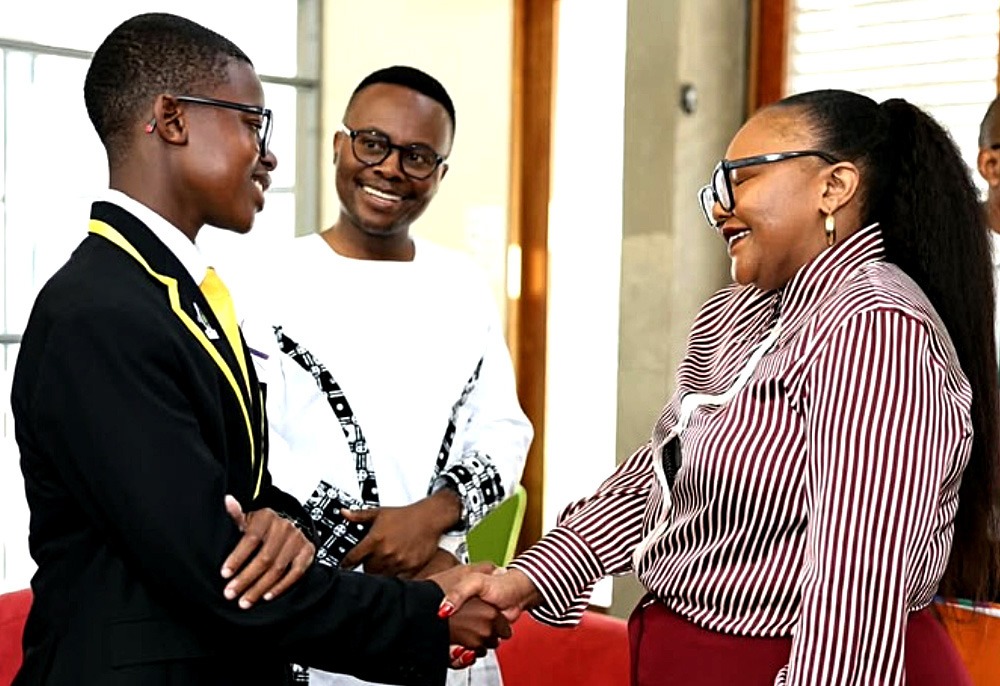
 Ndivhuho Nthangeni (far left) attending an event at Constitutional Hill in Johannesburg. (Photo: @Ndivhu_for_Jozi on Instagram)
Local government elections in South Africa are less than a month away. If you’ve been following the campaigns at all, you might have seen that in Johannesburg, South Africa’s most populous city, things have been… interesting.
Some political parties are reeling in voters by swimming in potholes, while others haven’t even announced candidates yet. It’s hard to know where young Joburgers will put their trust.
But while the fight for mayor of Joburg continues, another race has already ended in Johannesburg’s Student Council.
Starting in March this year, 16-year-olds Ronewa Mulaudzi and Ndivhuho Nthangeni began their campaigns for junior mayor. Mulaudzi put youth mental health at the forefront of his campaign, but the night before the big mayoral debate, his own mental health took the lead and panic set in. Mulaudzi says: “I sat down, and I just was like, ‘is this truly for me?’”
In a moment where young people are understandably disillusioned about the politics in South Africa, listening to two 16-year-olds navigate panic attacks, privilege and civic duty to fight for what’s right is incredibly moving.
In Radio Workshop’s latest podcast episode, In the Running, they bring up youth issues that we don’t often hear about in the political conversation, such as mental health and menstrual dignity. So it makes us perk up at the new conversations they are bringing to the fore, and applaud their efforts at choosing to care at a time when many young South Africans feel despondent.
Mulaudzi’s campaign is called RISE. It stands for Resilience, Inspire, Support, Empower. His own mental health struggles made him want to use his story to empower other young people in Johannesburg. He added: “I think mental health being important to me is because it has affected everyone.”
As part of RISE, Mulaudzi gathered a group of students from his high school to volunteer at a local orphanage. Kiara, a RISE volunteer, says: “To be able to help little people when I couldn’t get help [as a child], it’s a beautiful opportunity.” Part of what they do is cook lunch for the kids. On the afternoons they are there, four of them squeeze into a small kitchen and get to work.
Other volunteers spend time playing with the kids outside. And in the kitchen, the four talk about life and their own mental health struggles to pass the time. Mulaudzi and one of the ambassadors remembered when they both had panic attacks on the same day.
According to the South African Depression and Anxiety Group, one in five South African teens experience a mental health condition. Anxiety is among the most common and 60% of affected teens don’t seek help. Earlier in his campaign, Mulaudzi handed out mental health flyers at his school and hosted an event for parents and kids to talk about their mental health with each other after the visit to the orphanage.
The Junior City Council mimics a local government council: there’s a mayor, a chief whip and a speaker, along with a few deputies. Every year, schools nominate pupils to join the council. Then, the council members select candidates to run for junior mayor and the winner ends up with a direct line to the city mayor who becomes their mentor. Both Mulaudzi and Nthangeni were nominated to run.
Mulaudzi and Nthangeni happen to know each other from before, since becoming councillors in the Johannesburg Student Council. For three months they ran their campaigns side by side. All while balancing school and trying to have a normal teenage life.
Nthangeni’s campaign is about access and opportunity. For him, it’s important that those who didn’t grow up with the same privilege that he had have a fair chance to succeed. “All I want to do is even the playing field for those who were dealt bad cards by life,” he says.
When Nthangeni was preparing his campaign he visited Diepkloof, a township in a different part of Johannesburg from where he grew up. He says he saw rubbish piled high along the side of the road. And when he pulled out his phone to take a photo, some kids walking by warned him to put it away to avoid getting mugged by nyaope addicts in the neighbourhood. Nyaope is a mixture of heroin and cannabis and other chemicals including rat poison, detergents and sometimes even antiretrovirals.
It shocked Nthangeni that kids so young were talking about it. Reflecting on the moment, he said it made him realise the time to make a difference is now adding, “It is our turn to be the change that we want to see in our city.”
Nthangeni’s visit inspired him to call his campaign SOW. It stands for Safety, Opportunity and Wellness. He might be too young to vote himself, but he believes political education needs to start early. South Africa is a young country, with almost a third of the population under 35 years old – and not registered to vote. Nthangeni wants this to change.
After three months of campaigning, the candidates had a debate – the final obstacle before the Junior Mayor elections were held in August 2026.
Tune in to In the Running to find out which of the two candidates becomes the next Junior Mayor of Johannesburg. As South Africa’s local government elections draw nearer, the new junior mayor is watching closely to see who their new mentor will be. DM
Comments
Scroll down to load comments...