



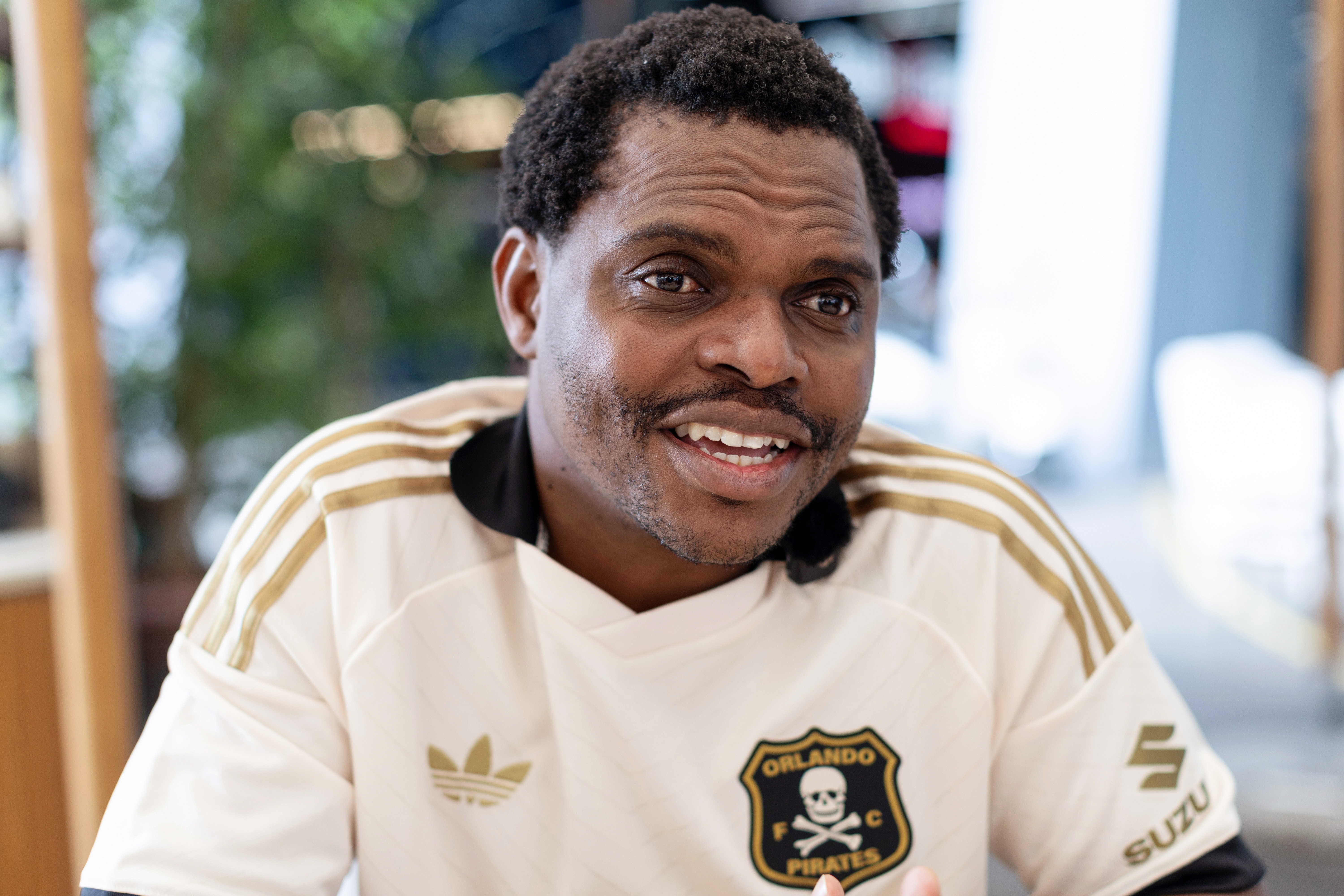
 Lukhona Mnguni, Rise Mzansi mayoral candidate for Johannesburg, in Sandton on 1 October 2026. (Photo: Our City News / James Oatway)
/file/attachments/orphans/Election2026LogoInarticle_260133.jpg "LGE-2026-logo-signpost")
There are probably worse ways to make a case for serendipity in Johannesburg’s politics than having Fikile Mbalula walk into a restaurant just as you are discussing the coalitions that could determine who becomes the city’s next mayor.
Lukhona Mnguni was explaining who Rise Mzansi could and could not work with after the election when the ANC secretary-general appeared at Tashas at The Marc in Sandton. The two greeted each other warmly before Mnguni asked when the ANC was finally going to give Johannesburg its mayoral candidate. Mbalula smiled, gestured towards him and joked that the mayor was already there.
“What are the odds of talking about coalitions, and then the people we might be negotiating with actually pitch up?” Mnguni laughed after the encounter. “Maybe a coalition has just been sealed in Tashas at The Marc.”
Mnguni describes himself as a spiritual person who believes serendipitous moments happen for a reason. He also calls himself “a villager caught in urban trappings”, a phrase that fits neatly with the Johannesburg he is campaigning to lead: a city of very different worlds pressed up against one another, sometimes uneasily, but still dependent on one another.
He had originally wanted to meet at Kwa Mai Mai. Instead, sitting in Sandton, in what is commonly called Africa’s richest square mile, he spoke fondly about the traditional market opposite Maboneng, where people buy food, traditional goods and muti and where, he insisted, some of Joburg’s best scones are baked.
“It holds a lot of nostalgia for Joburgers. You get a sense of home, a bit of home,” he said, before pointing to the contrast between the development on one side of the road and neglect on the other. “It’s a pity that when Maboneng was being developed, Kwa Mai Mai was left behind because it’s literally right opposite.”
That contrast offers a useful way into Mnguni’s politics, which repeatedly come back to whether Johannesburg can function as one city rather than a collection of neighbourhoods whose access to safety, opportunity and basic services depends on geography and income.
/file/attachments/orphans/OCN-Lukhona-Joburg3_782065.jpg "Lukhona Mnguni, RISE Mzansi mayoral candidate for Johannesburg. Sandton. October 1, 2026. (Photo: OUR CITY NEWS/James Oatway)")
It also shapes his view of migration, with Mnguni describing Johannesburg as a city “built by migrants from all over the continent” and arguing that tensions between South Africans and migrants were tied to competition over jobs and failing public services.
He supports immigration enforcement and documentation requirements for traders, but said the Johannesburg Metro Police Department (JMPD) should not be “criminalising poor people” or pushing informal businesses to places where they cannot survive.
His position became more radical when discussing hostels, saying that the apartheid-era model had failed and should ultimately be replaced with better housing, and that many hostels had become spaces with poor living conditions, violence and political control.
Rebuilding Joburg’s systems
Serendipity may make for good political theatre, but Mnguni knows Johannesburg cannot be repaired through spiritual conviction and fortunate encounters alone. His campaign ultimately rests on a more practical argument. It revolves around the idea that fixing the city means rebuilding the systems that determine how safely people live, how reliably services work, and how easily residents can reach jobs and opportunity.
That thinking also runs through Rise Mzansi’s broader plan for Johannesburg. Its Spatial Justice proposals focus on bringing people closer to jobs and economic opportunity through better-located housing. At the same time, A Living City aims to make streets safer, cleaner and more workable for the residents and informal traders who use them every day.
For Mnguni, these are symptoms of a city so accustomed to failure that residents and institutions increasingly work around broken systems rather than expecting them to be repaired.
“It’s almost like we have now planned for the collapse, and we are accommodating the collapse,” he said.
The remaining campaign pillars try to address that failure more directly. Dignity in Every Ward promises a minimum standard of municipal services regardless of neighbourhood, while Infrastructure Reliability focuses on water, electricity and the maintenance of ageing networks. Jozi On the Move centres on integrated, safer and more affordable public transport that connects residents more easily to work and opportunity.
Mnguni said a government led by him would prove its case in 70 days rather than the conventional first 100 days benchmark. That is because his administration would immediately have to deal with Johannesburg’s adjusted budget. He wants bid evaluation and adjudication meetings recorded and eventually made public, along with a water master plan, accelerated pipe replacement and a more intensive approach to waste management.
“You cannot develop the city if you don’t invest meaningfully in the water infrastructure,” he said. “We need to reduce the leaks. A lot of water is running on the streets and not running in the taps.”
‘A 10 to 15-year plan’
Mnguni is also unusually willing, for a candidate asking voters to hand him the City, to acknowledge that Johannesburg’s decline is too deep to reverse within a single term.
“Definitely, the turnaround of Joburg is a 10- to 15-year plan. So much has deteriorated,” he said. “You won’t get to every neighbourhood within five years. But I think you could, in five years time, tell a different story about the City of Joburg.”
That story, in his telling, is not only about pipes, roads or municipal finances. Mnguni argues that residents have not abandoned Johannesburg even if many have lost faith in those governing it, pointing to residents’ associations, neighbourhood WhatsApp groups and businesses increasingly filling the gaps left by the municipality.
“If people were not involved, this city would probably have collapsed by now... What I think people have lost is confidence in electoral politics,” he said.
The Orlando Pirates shirt he wore to the interview offered a lighter expression of the same attachment to the city. Asked whether it risked alienating Kaizer Chiefs supporters, Mnguni joked that “you can’t alienate your own children”, before recalling how he fell for Pirates during their 1995 African Champions League triumph. Kaizer Chiefs broke away from Pirates.
For him, clubs such as Pirates, Chiefs and Moroka Swallows are part of Johannesburg’s civic memory, institutions rooted in communities and in the stories people tell about the city. That is why he talks about sport not simply as recreation, but as part of rebuilding social life and creating opportunities for young people whose talent could otherwise be lost.
Mnguni linked that erosion of community directly to Johannesburg’s crime problem, arguing that safer neighbourhoods would require both a better-resourced JMPD and a city where residents felt comfortable occupying public spaces again.
“When we are unsafe, we go to our private spaces. But when we retreat to our private spaces, we deplete the community,” he said, adding that: “When we deplete a community, we open up much more space for criminality.”
Whether Mnguni gets the opportunity to put any of these ideas into practice will depend heavily on the coalition negotiations that follow the election. He has ruled out the Patriotic Alliance, but not the ANC or DA, and says coalition partners should be bound by a public programme and anti-corruption agreement rather than negotiations over positions. (See the current polling numbers below.)
“We cannot create a coalition where we are trying to parcel out who becomes the board chairperson of which entity, who becomes the CEO of which entity.
“We’re not going to be in the business of deal-making. We are going to be in the business of governing the City of Johannesburg in the best interests of the residents,” he said. DM
This interview is part of an ongoing series by Our City News featuring key mayoral candidates contesting the City of Johannesburg in the upcoming local government elections.
/file/attachments/2985/WhatsAppImage2025-11-21at1946001_346702_1cea9e715c05dc0a538fc79753ac3401.jpeg "Our City News logo")
Comments
Scroll down to load comments...