




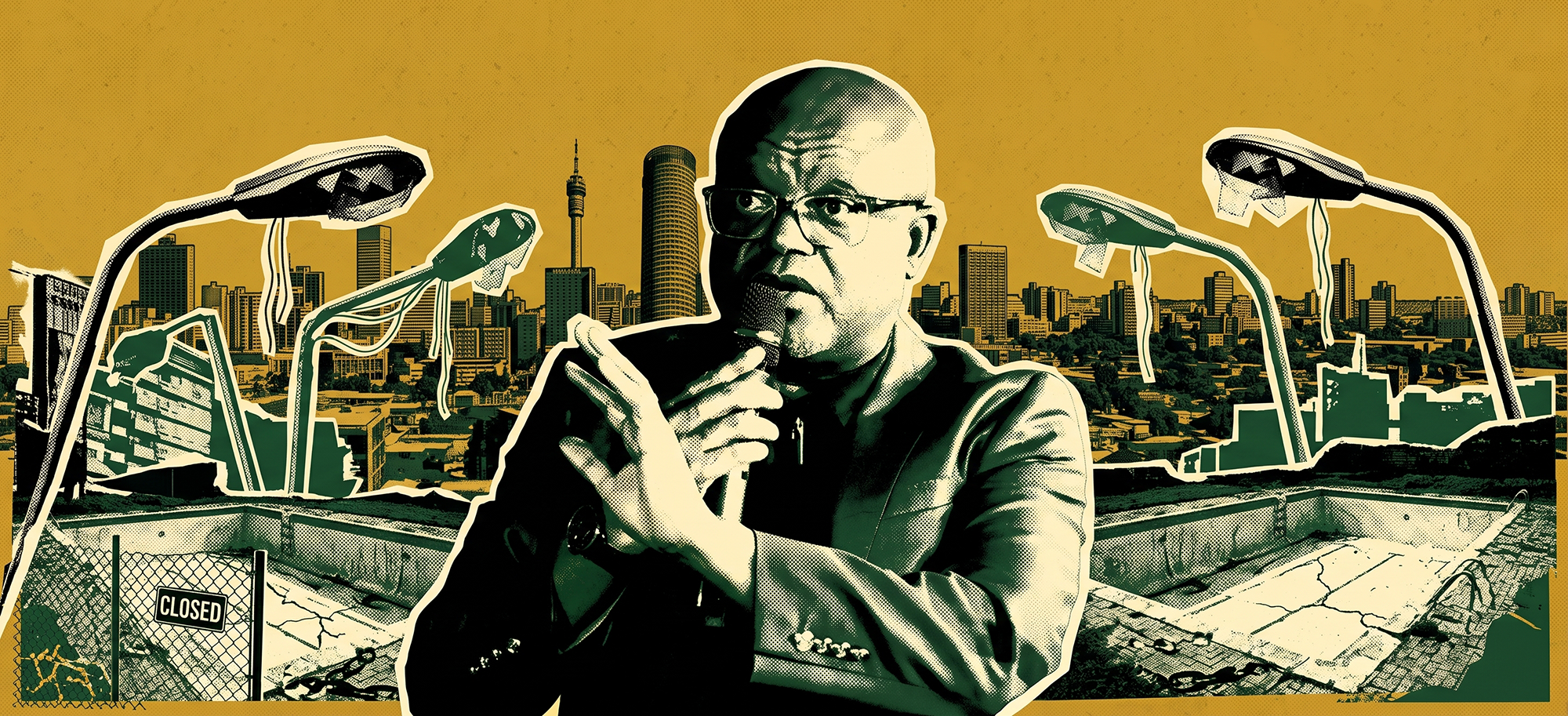
 Johannesburg Mayor and possible ANC 2026 mayoral candidate Dada Morero. (Photo: Felix Dlangamandla | Graphic: Kevin Momberg)
In the past four days, Johannesburg executive mayor Dada Morero swore at residents angered by days-long, ongoing power cuts in Soweto; and he failed to open public pools today – a rare form of recreation in many townships. The pools are not ready and may be opened on 1 October, said the MMC for Community Development Thapelo Amad, a short-lived Al Jama-ah mayor in the city, let go for off-book meetings with unknown financiers.
Johannesburg is governed by a populist coalition led by the ANC with the EFF, PA, IFP and other micro-parties like Al Jama-ah. The coalition has run the city into the ground, and the ANC has given up, even on a last-mile race.
Here are five proof points.
1. There is no mayoral candidate and no strategy
Johannesburg is the key battleground of the 4 November election. Yet the ANC has not identified a mayoral candidate to rally its troops behind and to carry the mantle of an electoral battle.
It is running the race as a primary with three candidates: veteran leader Reverend Frank Chikane, the regional chairperson Loyiso Masuku and the incumbent Morero. In these images released by the party’s region, only Masuku and Chikane pitched for what was meant to be a show of unity.
/file/attachments/orphans/Ferial2_735404.jpg "Loyiso Masuku and Rev Frank Chikane. (Photo: )")
/file/attachments/orphans/Ferial1_761454.jpg "ANC deligates with Loyiso Masuku and Rev Frank Chikane.(Photo: )")
Morero was in the dog box for telling Tshepisong, Soweto residents, “O bua masepa” (You’re talking shit), when they suggested corruption may be to blame for at least some of their chronic power issues.
The party has no strategy to win back support in Johannesburg, and its campaign photos suggest it is doing house visits and handing out T-shirts. This may have worked in the past, but won’t work this time around.
2. ANC voters have already voted by not registering
There are 2.418 million registered voters in Joburg who make up 35.8% of total registered voters in Gauteng – this is the city where the ANC’s outcome in the province will be measured.
In Gauteng, there are 6.751 million registered voters out of a total possible eligible voting pool of 11 million. Even at a high turnout of 58%, you can see that most voters have already chosen to stay home. These are, in the main, possible ANC voters. Opposition voters are more motivated to both register and vote.
Gareth van Onselen’s blog, Inside Politics, shows that there is a strong correlation between registration, turnout and results for both the ANC and opposition DA.
“In blunt terms: DA voters generally turn out in local elections, ANC voters generally do not. As a result, the DA vote inflates, and the ANC vote deflates, compared with national elections.
“The ANC’s decline in Johannesburg has been catastrophic. From the dizzying heights of 68.6% in 2004, it has systematically lost support, falling below 50% for the first time in 2016, and then, all the way down to 31.9% in 2024. A decline of 36.7 percentage points. Put another way: The ANC has lost more support in Johannesburg than it currently has,” writes Van Onselen.
/file/attachments/orphans/ANCSTATS_493445.png "Turnout versus the ANC vote. (Photo: Gareth van Onselen/Inside Politics)")
/file/attachments/orphans/DASTATS_826520.png "Turnout versus the DA vote. (Photo: Gareth van Onselen/Inside Politics)")
3. Electricity failures killed it for the ANC
While City Power outages are endemic, for largely black and working-class areas (what used to be ANC strongholds), they are a nightmare.
August opened with a sharp deterioration in Johannesburg’s electricity crisis: City Power logged 616 operational entries from 1-19 August, averaging 32.4 a day, compared with 324 entries and 17.1 a day over the same 19 days in July.
That means the volume of logged failure and restoration activity in the first 19 days of August was 90% higher than in the comparable July period, with the most intense pressure coming from 11-14 August, when 176 entries were recorded in just four days.
Outages are also lasting for days rather than hours: the Mountain View/Lunar repair chain ran for about 232 hours – nearly 10 days – while the Mayfair/Crown/Vrededorp network generated successive fault and repair updates over about 225 hours, or more than nine days. These do not necessarily mean every household was continuously without power throughout, as restoration was sometimes partial.
The trend is clear: rather than stabilising after July, Johannesburg’s electricity network deteriorated sharply in August, with the rate of logged failures and repairs almost doubling and some repair chains now stretching over many days.
Daily Maverick keeps a running tally of outages reported using City Power social media posts. The extension of electricity and water to the home was one of the ANC’s big first successes of its opening terms. These have been put into reverse by cadre deployment into the entities of City Power and Johannesburg and by local state capture.
4. A ruined taxi rank and a party that lost touch with its base
ANC elders have always warned about social distance in the party, where the leaders grow apart from the masses. That’s what has happened in Johannesburg, where the party is no longer in touch, other than in rhetoric, with the lives of its supporters in the city.
So, you have a situation where the main rank in Bree Street (now Lilian Ngoyi Street) is a nightmare for all and especially for women. Lilian Ngoyi Street exploded after a methane gas explosion in July 2023. It’s still being repaired and costs have shot up astronomically. The costs to commuters in a busy transport interchange are severe.
/file/dailymaverick/wp-content/uploads/2023/07/MC-Joburg-CBD-Explosion-Update4-1.jpg "Johannesburg Water employees continue to work on the effects of the explosion on 25 July 2023. (Photo: Leon Sadiki)")
Daily Maverick reporter Bheki C. Simelane spent time investigating the rank and spoke to women who told us that they had to light their way with their phones, and that what should be a safe way to get to work was in fact a perilous and anxiety-provoking journey.
You can take a look at the state of the rank here. Women will decide the outcome of the election, and more women than men have registered in Gauteng and in Johannesburg. The single-woman-headed household is South Africa’s most common and most powerful.
Should working commuters do well enough to save a deposit and then be able to consider buying a car, they need that car licensed, and they need drivers’ licences. The City’s licensing centres have nearly all always been cesspools, but now they are often closed too, having run out of paper as the City’s financial crisis makes life miserable for its citizens. Anna Cox reports here.
5. Soweto progress hits the brakes
The Tshepisong electricity imbizo where Morero lost his cool is an example of something bigger. Soweto is a jewel in the ANC crown in Johannesburg. What used to be an apartheid dormitory town, its name not even a name but an acronym (South Western Townships), is now a city, an example of early transition can-do by the ANC’s best and brightest.
Social housing, transport and the extension of electricity and water were all examples of how the ANC was a vector of progress in the city for many years. But its progress is in general decline along with the rest of the city, as the Tshepisong meeting showed. Bheki C. Simelane reports below on sewage spills in Soweto that make life unhealthy and unpleasant for many people.
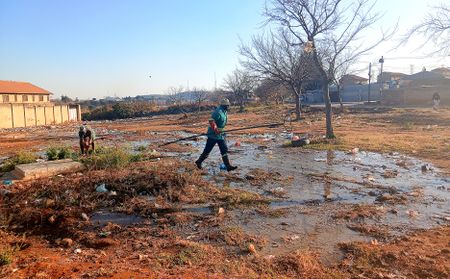
Soweto has extensive electricity issues, and the free rein given to the non-state actor March and March to prosecute its anti-migrant campaign has harmed tourism in the area. It’s a magnet for foreign visitors, but tour operators have told Daily Maverick that numbers dipped ahead of the 30 June warning by the organisation.
State weakness is another example of why the ANC has lost its ability to even convincingly compete in the November poll in Johannesburg. The ANC wins or loses Johannesburg in Soweto, the place from which it staged the final push against apartheid, but which may now be its denouement.
Conclusion: Does this mean the DA’s Helen Zille wins?
Not necessarily. Zille is polling high in her base (the party won a Hyde Park by-election in late 2025 with more than 90% of the vote once her candidacy was announced in September 2025). She is likely to emerge as the candidate with the highest number of votes and has repeatedly told Daily Maverick that she does not think an overall majority is possible.
The final outcome is voter-turnout dependent. The ANC could still turn to the EFF, PA, IFP and also MK with many small parties to form another governing coalition, if they get enough to do so. DM
Comments
Scroll down to load comments...