‘Hunger has no party’ — candidates talk to Soweto residents ahead of elections
On 13 October, at a community meeting with candidates for Johannesburg’s municipal elections, people asked how food storage, safety and prices will be addressed, as well as global market concentration in the food system. They wanted to know how grants will be increased and jobs given, and how young people who are already doing the work will be helped.
A woman stands outside the community hall in Orlando East, Soweto, where election candidates and residents gathered. During the meeting, when Esther Padi, the national organiser of the Union Against Hunger, asked the locals whether they ate three meals a day, not a single person raised their hand. (Photo: Lillian Roberts)
“Hunger has no party” was the rallying cry at a Union Against Hunger community meeting, where people asked mayoral candidates and prospective ward councillors how they will solve hunger in Johannesburg.
It was a hot day in the community hall in Orlando East, Soweto. Some political parties arrived late for the 10am start. At the start, half the hall was empty – much like the voting booths may be on 4 November for municipal elections.
The EFF, Build One South Africa, ActionSA, the ANC, Rise Mzansi, uMkhonto Wesizwe (MK) party, MOVE SA, the Land Party, the African Transformation Movement (ATM) and the United Democratic Party (UDM) were in attendance. DM
Mark Heywood, co-founder of Union Against Hunger, opened the community engagement by highlighting that food insecurity is highest in cities in South Africa. Stunting, where a child does not receive sufficient nutrients to develop properly, affects 29% of children under five in South Africa, particularly black and poor people, he explained. As inspiration for local politicians, he cited an initiative by New York mayor Zohran Mamdani where municipal grocery stores have a 30% discount applied to core foods. (Photo: Lillian Roberts) Kabelo Khumalo, a Youth Against Hunger organiser, said South Africa is ‘in a cold war against the youth of 1976’ because they are today’s leaders. He added that South African leaders should stop using complexity regarding the issue of hunger as a reason for inaction. Youth Against Hunger is a partner organisation to Union Against Hunger. (Photo: Lillian Roberts) From left: Malik Dasoo, a food systems and environmental researcher, is the prospective councillor for wards 87 and 73, and represents Rise Mzansi; Theo Dlamini, the Johannesburg regional convenor for the MK party; and the Land Party’s mayoral candidate for Johannesburg, Nontsikelelo ‘Ntsiki’ Mazwai. ‘We have moved away from our African-ness,’ Mazwai said. She added that the country chases standards of whiteness, with pavements instead of fruit trees, and a heavy meat diet rather than a plant-based diet. (Photo: Lillian Roberts) Build One South Africa co-founder and deputy leader Nobuntu Hlazo-Webster (left), is a mayoral candidate for Johannesburg. Lubabalo Cecil Magwentshu (middle) is a senior member of the African Transformation Movement and former member of the mayoral committee for community development in Johannesburg. One thing Johannesburg should do, he said, is audit unused land and allow people to farm, along with establishing a nutritious food basket identified through wholesalers for the lowest price. Mantombi Nkosi, ANC spokesperson for the greater Gauteng region, was about to list the food security programmes the party has implemented in Johannesburg, but was drowned out by boos from the audience. (Photo: Lillian Roberts) Nobuntu Hlazo-Webster said hunger is an outcome of a system that does not work. It is a systems problem, and an economic problem, she added. She said there is no reason that Soweto isn’t the same as Sandton. Hlazo-Webster questioned why the Soweto Fresh Produce Market is currently an empty field. (Photo: Lillian Roberts) Victor Seshoka, the national spokesperson in Gauteng for the recently formed political party MOVE SA, spoke about the importance of food gardens, land availability and use, and funding nonprofit organisations to address food security in Johannesburg. (Photo: Lillian Roberts) The UDM’s national chairperson and councillor in the City of Johannesburg, Yongama Zigebe, said the city does not need a new system, it needs the system to work. His commitment was on accountability. Zigebe said Johannesburg needs a food resilience plan to be published. Electricity, water and an affordable food basket were needed, not food parcels for the poor, or politicians posing with seeds for pictures. (Photo: Lillian Roberts) ActionSA councillor Mpumi Edward said that opportunities for people to grow food, specifically community and backyard gardens, are currently unexplored. She also said the spaza shop sector is being ‘hijacked by illegal foreigners’. To Daily Maverick, she explained that three weeks ago they met about 300 small-scale farmers in the same community hall, to help them with seedlings and finances. She added that it is very difficult for emerging farmers to acquire unused municipal land, since there are bureaucratic hurdles and people are sent from pillar to post. (Photo: Lillian Roberts) MK party representative Theo Dlamini highlighted how important land and employment are, along with the critical role of women in ‘feeding society’. He said grants should be raised and interest-free loans given, especially to young people and women. MK would remove foreigners from the Johannesburg CBD, clean the city and solve the electricity issues in Soweto by providing solar panels to every roof. (Photo: Lillian Roberts) Rise Mzansi has a food position paper, Malik Dasoo explained. It says the Child Support Grant should be increased to meet the food poverty line, the National School Nutrition Plan should be expanded to feed children during holidays, food prices should be regulated to address market concentration, the tax on sugary beverages should be raised, and early childhood development centres should be supported. Dasoo told Daily Maverick that a ministry of food should be established – like the Department of Electricity and Energy was created – because currently the mandate is fragmented between departments and there is little interministerial cooperation. (Photo: Lillian Roberts) Thabile Mntande asked the candidates how they would support children, specifically with sufficient nutrition during early childhood, along with support for pregnant women. (Photo: Lillian Roberts) ‘All of you have bellies full of food,’ said Mnino Makola from Tshwane. He asked the candidates how the country could stop selling food and move away from capitalistic modes of production and consumption. (Photo: Lillian Roberts) ATM member Ntandazo Mtebele asked the audience to take their ‘anger to the ballot box’. He said the common enemy is the ANC. (Photo: Lillian Roberts) Koketso Poho, an EFF member in the Gauteng legislature, told Daily Maverick that residents’ questions and frustrations were justified and constructive. He said municipalities should not be afraid to expropriate land for small-scale farmers, along with subsidies and incentives. ‘We have fought for more than one household per yard,’ he said regarding expanding the indigent household criteria. ‘But we are also saying for poor families, recipients of Sassa, to afford food they need to be given subsidies on water, electricity and other basic services.’ He added that their debt should be written off. He explained that the EFF-led department had provided access for small-scale farmers to supply the Johannesburg Fresh Produce Market, as well as farming cooperatives. They had also led the upgrade of clinics to provide 24-hour antenatal care and midwifery to women in Gauteng. (Photo: Lillian Roberts) Rise Mzansi member Niel Meyer spoke in his personal capacity about how the ‘middle class needs to do its bit’. He said that ‘all should feed all’ and that there should be a democratisation of food. The barriers are in our own minds, he said, referring to food security. (Photo: Lillian Roberts)





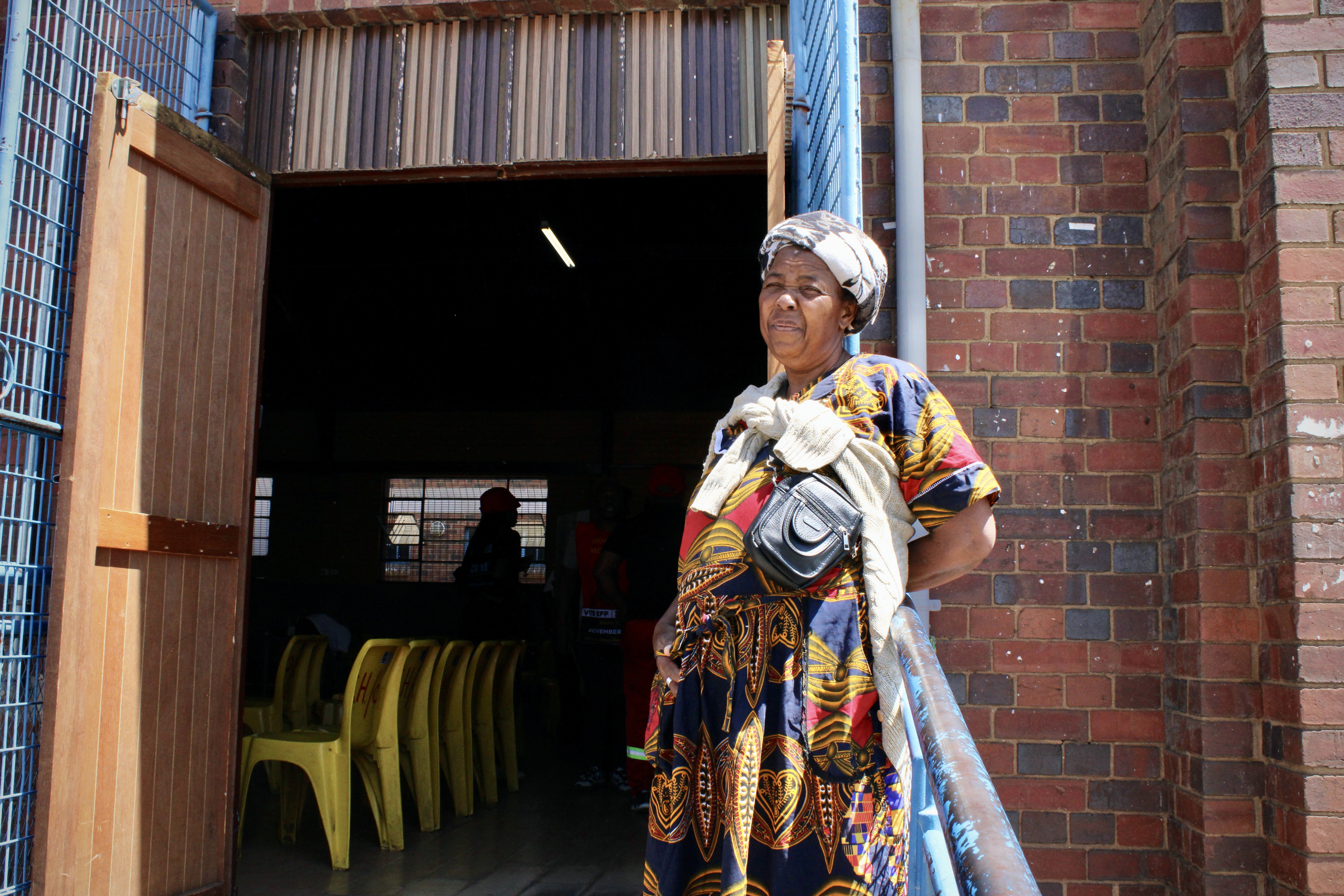 A woman stands outside the community hall in Orlando East, Soweto, where election candidates and residents gathered. During the meeting, when Esther Padi, the national organiser of the Union Against Hunger, asked the locals whether they ate three meals a day, not a single person raised their hand. (Photo: Lillian Roberts)
/file/attachments/orphans/MC-Hunger-Elections16_479636.jpeg "Mark Heywood, co-founder of Union Against Hunger, opened the community engagement by highlighting that food insecurity is highest in cities in South Africa. He said that stunting, where a child does not receive sufficient nutrients to develop properly, affects 29% of children under five in South Africa, specifically impacting black and poor people. He cited US Mayor Zohran Mamdani's policy of having municipal grocery stores where a 30% discount is applied to core foods. (Photo: Lillian Roberts)")
/file/attachments/orphans/MC-Hunger-Elections9_130952.jpeg "Kabelo Khumale, a Youth Against Hunger organiser, said South Africa is \"in a cold war against the youth of 1976\" because they are today's leaders. He added that South African leaders should stop using complexity regarding the issue of hunger as a reason for inaction. (Photo: Lillian Roberts)")
/file/attachments/orphans/MC-Hunger-Elections5_701797.jpeg "Malik Dasoo (left) a food systems and environmental researcher is the prospective ward councillor for wards 87 and 73, and represents Rise Mzansi. Theo Dlamini (middle), the johannesburg Regional Convenor for the Umkhonto WeSizwe Party. Representing the Land Party, the mayoral candidate for Johannesburg, Nontsikelelo \"Ntsiki\" Mazwai (right). (Photo: Lillian Roberts)")
/file/attachments/orphans/MC-Hunger-Elections11_349755.jpeg "Build One SA co-founder and deputy leader Nobuntu Hlazo-Webster (left), also mayoral candidate for Johannesburg. Lubabalo Cecil Magwentshu (middle) is a senior member of the African Transformation Movement (ATM) and former member of the Mayoral Committee for Community Development in Johannesburg. One thing Johannesburg should do, he said, was to audit unused land and allow people to farm, along with establishing a nutritious food basket identified through wholesalers for the lowest price. Mantombi Nkosi, Regional Spokesperson for the greater Gauteng region for the ANC, highlighted that hunger is not an abstract policy decision. She was about to list the programs the ANC had implemented in Johannesburg but was drowned out with boos and shouting. (Photo: Lillian Roberts)")
/file/attachments/orphans/MC-Hunger-Elections13_930172.jpeg "Nobuntu Hlazo-Webster spoke about how hunger is an outcome of a system that does not work. It is a systems problem, and an economic problem. She said there is no reason that Soweto isn't the same as Sandton. Hlazo-Webster questioned why the Soweto Fresh Produce Market is currently an empty field, and not a market. (Photo: Lillian Roberts)")
/file/attachments/orphans/MC-Hunger-Elections8_185670.jpeg "Recently formed political party MOVE, represented by Victor Seshoka (National Spokesperson in Gauteng) spoke about the importance of food gardens, land availability and use, and NPO funding in assisting with food security in Johannesburg. (Photo: Lillian Roberts)")
/file/attachments/orphans/MC-Hunger-Elections1_922813.jpeg "The UDM National Chairperson, UDM Councillor in the City of Johannesburg Yongama Zigebe spoke about how the system in Johannesburg needs to work - that we don't need a new system. His commitment was on accountability, and the need for a food resilience plan, which he said needs to be published. He added that electricity, water, and an affordable food basket is needed: not food parcels for the poor, or politicians posing with seeds for pictures. (Photo: Lillian Roberts)")
/file/attachments/orphans/MC-Hunger-Elections7_995496.jpeg "ActionSA councilor Mpumi Edwards said that food is a justice issue. She said that opportunities for people to grow food, specifically community and backyard gardens, are currently unexplored. She also said the spaza shop sector is being hijacked by \"illegal foreigners.\" To Daily Maverick, she explained that three weeks ago they met with about 300 smallscale farmers at the same community hall, to assist financially and with seedlings. (Photo: Lillian Roberts)")
/file/attachments/orphans/MC-Hunger-Elections18_660254.jpeg "Umkhonto We Sizwe party representative Theo Dlamini highlighted how important land and employment are, along with the critical role of women in \"feeding society.\" He said that grants should be raised, and interest-free loans given, especially to the youth and women. (Photo: Lillian Roberts)")
/file/attachments/orphans/MC-Hunger-Elections17_347360.jpeg "Malik Dasoo from Rise Mzansi spoke about how the party has a food position paper; that says that Child Support Grant should be increased to meet the food poverty line, the National School Nutrition Plan should be expanded to feed children during holidays, food prices should be regulated to address market concentration, the tax on sugary beverages should be raised, and Early Childhood Development centres should be supported. (Photo: Lillian Roberts)")
/file/attachments/orphans/MC-Hunger-Elections12_260868.jpeg "Thabile Mntande asked the prospective candidates how they would support children, specifically with nutrition during early childhood, along with support for pregnant women. (Photo: Lillian Roberts)")
/file/attachments/orphans/MC-Hunger-Elections14_525402.jpeg "Mnino Makola, from Tshwane, asked the candidates how South Africa can move towards not selling food. \"All of you have bellies full of food,\" he said. He asked them how South Africa could move away from capitalistic modes of being. (Photo: Lillian Roberts)")
/file/attachments/orphans/MC-Hunger-Elections10_832176.jpeg "ATM member, Ntandazo Mtebele, asked the audience to take their \"anger to the ballot box\". (Photo: Lillian Roberts)")
/file/attachments/orphans/MC-Hunger-Elections15_654377.jpeg "Koketso Poho, EFF Member of the Gauteng Provincial Legislature, said to Daily Maverick that the community's questions and frustrations were justified and constructive. He said that munipalities should not be afraid to expropriate land for smallscale farmers, along with subsidies and incentives.The EFF MMC of Social Development has advanced policy reviews of criteria for indigent and ESP recipients. \"We have fought for more than 1 household per yard. But we are also saying for poor families, recipients of SASSA to afford food they need to be given subsidies on water, electricity and other basic services.\" He added that their debt should be written off. He explained that the EFF led department has provided access for small-scale farmers to supply the Johannesburg Fresh Produce Market, as well as farming cooperatives. (Photo: Lillian Roberts)")
/file/attachments/orphans/MC-Hunger-Elections3_987185.jpeg "Member of Rise Mzansi, Niel Meyer, spoke about how the \"middle class need to do its bit\". He said that \"all should feed all\" and that there should be a democratization of food. He added that the barriers are in our own minds about what can happen with hunger. (Photo: Lillian Roberts)")
Comments
Scroll down to load comments...