




 illustrative image: iStock, amended with Google Gemini Flash Image 2.5
/file/attachments/orphans/Election2026LogoInarticle_260133.jpg "LGE-2026-logo-signpost")
In the past month, a variety of polls have pointed to very different measurements of sentiment ahead of polling day.
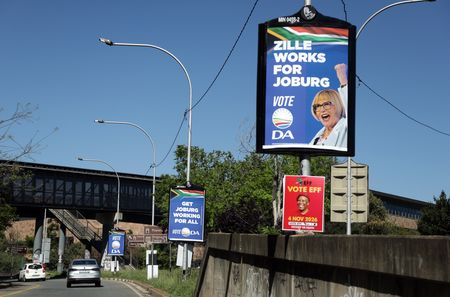
In Joburg, a News24 SABI poll found that more than 29% of voters planned to vote for the DA while about 23% planned to vote for the ANC.
One Social Research Foundation/Common Sense Media poll found the DA at 42% and the ANC at 19%.
Ipsos has suggested that in Joburg, the ANC is at 31% and the DA at 29%.
While each poll is different and each of their questions, timing and methodology must be closely examined, this is still a huge discrepancy.
This is a reminder of how important turnout will be in this election.
Weather and time
One of the under-examined aspects of this is the season in which we’ll vote.
For the decade while the ANC was steadily losing support and still governing alone, local elections were held in winter. The 2016 elections were held in August and the 2011 polls in May.
In 2021, they were moved to November because of the pandemic, and will be held in the same month this year.
In the past, protests about service delivery tended to increase in winter and peak in July. This was because the cold, along with power cuts, would aggravate frustrations.
This might well have led to a lower turnout for the ANC and perhaps a higher turnout for other parties.
In 2021, dynamics around the pandemic and the intense load shedding at the time must have been a factor in the huge decline of the ANC.
This time around, there is no load shedding, but local power cuts remain frequent in many places.
Also, the frustration felt in winter might dissipate. The weather on the actual day of the election in different areas might also be a factor.
Generally speaking, township areas have tended to have longer queues in the afternoon, while suburban polling stations have seen longer queues in the morning.
While each person will plan their own day differently, people with cars are more likely to go earlier, and people who have to walk will go later. Also, people in townships often have to wake up much earlier to get to work in the suburbs, making a later start on a voting day public holiday much more valuable.
Thus, the poorer you are, the more vulnerable you are to the elements. Some poorer people might choose not to spend a public holiday afternoon in a long, hot queue.
The issue of frustration is also important to turnout
In the past, people who were determined to vote out of frustration were, by definition, voting against the ANC. It was the dominant political force and governed in most councils.
A vote against the status quo was a vote against the party that had been in power since 1994.
That is not the case now.
Now a vote against the status quo might well be a vote against a DA-led administration, or against a coalition involving many parties.
This leads to a much more fractured “frustration vote”; different parties will benefit from this feeling in different places.
Beware of by-elections
Over the past few months, there has been much attention on the results of by-elections, amid suggestions that they point to a real change.
In particular, the Patriotic Alliance has made much progress in by-elections in the Western Cape.
However, the latest News24 SABI poll shows that in Cape Town, the DA still has the support of 56% of those asked.
It is worth repeating that by-elections tend to have a very low turnout.
It is not uncommon to have only 15% of registered voters in a ward actually voting. This means that in some cases, a candidate or a party has won a ward after just a few hundred people voted.
While these local elections are probably on track to have the lowest overall turnout across the country on record, it will certainly be much higher than in most by-elections.
This tends to help bigger parties who draw from a more diverse group of voters. Thus, smaller parties who have made progress during by-elections could in fact lose the wards they’d previously won.
/file/attachments/orphans/ED_605337_509131.jpg "Solly Mapaila (SACP General Secretary) briefs the media on the latest developments on elections and the question of dual membership at COSATU House on April 23, 2026 in Johannesburg, South Africa. The South African Communist Party (SACP) delivers its' perspective on the ANC's decision to instruct members to show their allegiance to it as opposed to the SACP in the upcoming local government elections or face dire consequences. (Photo: Gallo Images / Lubabalo Lesolle)")
Meanwhile, the fractured nature of our politics could lead to some strange results as well.
It is now entirely possible that in a rural community a strong candidate for the ANC stands against a strong candidate for the SACP.
Previously, supporters of both parties would have voted for the ANC candidate. Now, that vote will be split.
This could allow another candidate, perhaps from the FF+, to narrowly beat both, despite the fact that voters clearly support someone from the Congress tradition.
The unknown
Finally, there is the factor that no one can really predict, but usually drives the results of elections: events.
It is incredibly likely, given our fractious and changing society, that a particular set of debates, dynamics or events occurs which turns the elections on their head.
The image of Donald Trump, fist in the air, blood allegedly leaking from his ear, is a good example of an uncontrollable event that must have had an impact on the US presidential election in 2024.
In our polls, any incident involving race or ethnic identity could help one or another party.
A very high-profile and violent crime involving an illegal immigrant could lead to more support for MK or Action SA.
An argument about how the Springbok rugby team appears to suddenly have dramatically more white players than black players could make voters feel different elements of their identity on voting day.
A particular scandal involving corruption in the City of Joburg, which officials are trying to hide, might also have an impact.
In particular, risks around strikes in metros could be crucial.
Were the SA Municipal Workers’ Union to go on strike to demand a wage increase in Joburg, residents might well flock to the polls driven by frustrations over rubbish in the streets.
Were the DA to be depicted as the party trying to prevent a wage increase for black workers, that could drive turnout for the ANC.
This means, as the elections get closer, all parties will be looking for events that might help them, while seeking to avoid events that could hurt them.
Polls are now important before an election as a useful indicator of voter sentiment, but many factors can still determine who actually votes on 4 November, and why they vote. DM
Comments
Scroll down to load comments...