




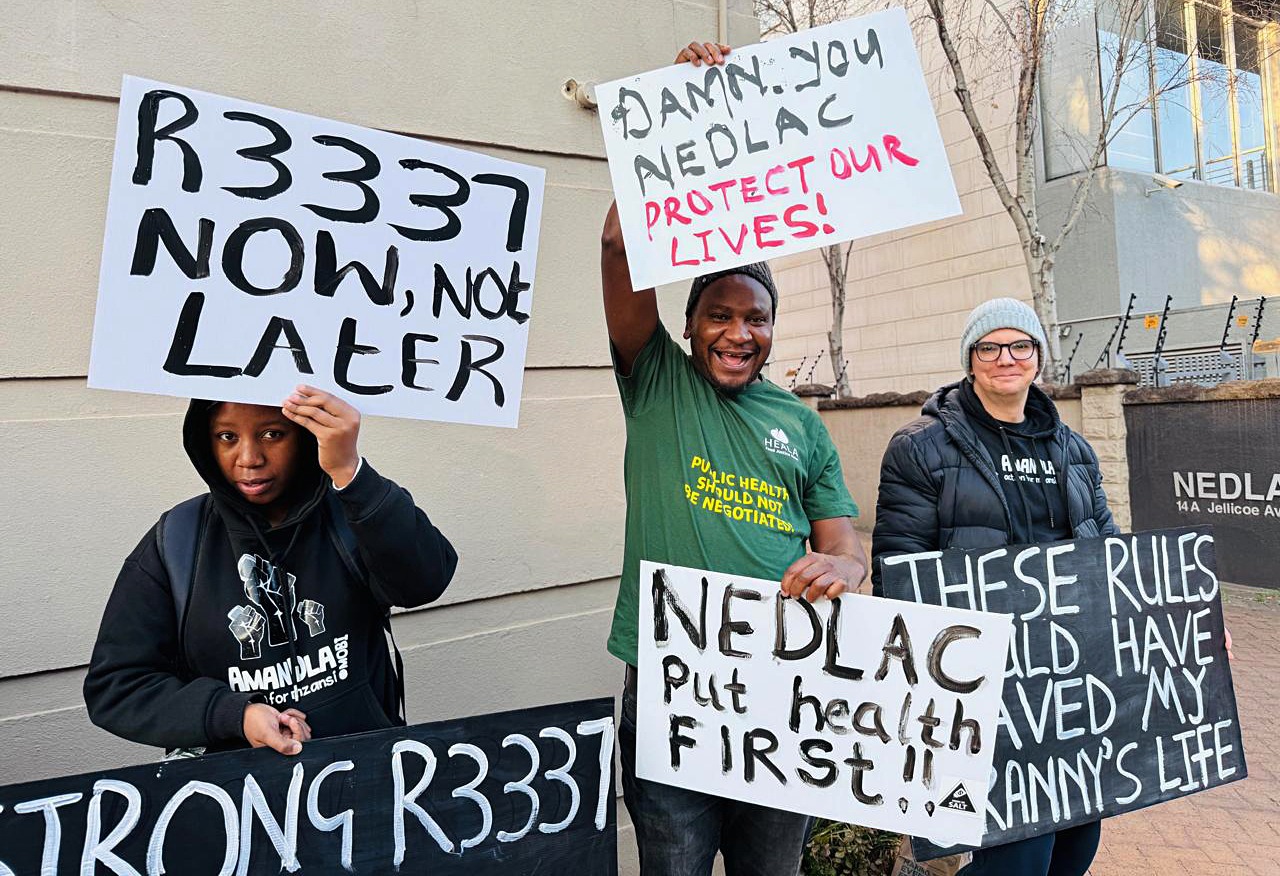
 On 25 June, Healthy Living Alliance and Amandla.mobi staff gathered outside the Nedlac offices in Rosebank, Johannesburg, in support of the Department of Health, which had been called to present the proposed front-of-pack warning label regulations. (Photo: Supplied / Zukiswa Zimela)
As the world enters its fourth wave of global food price crises in 20 years, corporate power, one of the core reasons food systems are failing to sustainably and affordably feed the world, needs to be confronted.
This is according to “Agribusiness Atlas: Facts and figures about the corporations that control what we eat”, a new report by Heinrich-Böll-Stiftung, Friends of the Earth Europe, IPES-Food and the Association of Ethical Shareholders.
Corporate power shapes how our food is grown, processed, marketed and consumed, the report says.
Controlling the foundation
According to the report, seeds form the foundation of the world’s food supply, yet they are increasingly controlled by a small number of multinational corporations. Today, three corporations control 56% of the global seed market, it says.
Farmers are increasingly dependent on a handful of corporations for seeds. One major barrier they face is the commercialisation of hybrid seeds. Because hybrid seeds rapidly lose their desirable traits when replanted, farmers must regularly buy new seeds from commercial suppliers, which is not always economically viable and steadily increases corporate market power.
Another barrier is that seed reuse is limited through patents. Patent holders have the right to control the use of their seeds for a limited period, and farmers cultivating patented plants must have permission from the holder and either repurchase seeds or pay a licence fee every year.
Genetically engineered seed is routinely patented, which creates a powerful economic incentive for agribusiness corporations to turn to genetic engineering, according to the report. Ultimately, these seed laws result in not only less diversity in our food supply, but a significant overall decline in biological diversity.
In South Africa, the Plant Breeders’ Rights Act (PBR) 12 of 2018, which came into effect in June 2025, outlines breeders’ intellectual property rights over their own new plant varieties. Under this act, smallholder farmers may only save and reuse protected seeds within prescribed volume limits and for local farming operations on their own land. They are prohibited from commercially distributing or trading these seeds.
The African Centre for Biodiversity has openly criticised the PBR Act. According to the centre’s director, Mariam Mayet, the law strengthens monopoly rights over corporate seeds while treating farmers’ rights, such as saving, selling, bartering and exchanging seed, as narrow exceptions.
Mayet said the Act entrenches the monopoly control of a handful of multinational seed, biotech and agrochemical companies and erodes food sovereignty.
Pesticide double standards
Although the European Union (EU) has a law regulating which pesticides can be sold and reused in the EU, pesticide companies take advantage of a loophole in the law which allows these banned pesticides to be produced and exported, according to the report.

The largest exporters in the EU are BASF, Teleos, Agria, Corteva, Syngenta and Bayer. In 2024, BASF exported more than 30,000 tonnes of banned substances followed by Teleos with about 11,000 tonnes, to several countries, including South Africa, it says.
The report highlights that the same products could also be given different labels depending on the country of sale. In South Africa, BASF’s Orvego pesticide has warning labels indicating the product is “harmful if swallowed”, and “very toxic to aquatic life with long-lasting effects”, but does not carry a warning that the product “may damage fertility”, as is included on the packaging in Britain and Ukraine.
According to Mayet, South Africa should phase out and ban all highly hazardous pesticides, as it has with terbufos, the pesticide linked to the deaths of six children in 2024.

The African Centre for Biodiversity’s position is that South Africa needs a transparent, precautionary and independently governed process to phase out all highly hazardous pesticides, not just those banned in the EU, Mayet said.
Balance of power in the supply chain
The balance of power in the supply chain lies with food processors or major retailers, according to the report. The drive among processors and retailers to maximise profits is a key factor behind this dynamic. They buy raw materials from farmers at relatively low prices and add substantial mark-ups to mass-market and private-label products, retaining most of the final retail margin, it says.
Additionally, when raw commodity prices or supplier costs fall, retail chains rarely passed these savings on to consumers in the form of lower grocery prices.
In South Africa, the Competition Commission’s 2026 Cost of Living report found it concerning that despite significant decreases in wheat, maize and sunflower seed prices, the producer prices of brown bread, maize meal and sunflower oil remained elevated in August.
This was concerning because consumers were not seeing the benefits of lower grain and oilseed prices.
Corporate lobbying
The Agribusiness Atlas report highlights that corporations and their lobby groups often enjoy privileged access to European and national policymakers. Additionally, with their funding, lobbyists and meetings with officials greatly outnumber trade unions and civil society organisations which defend the public interest, and can lobby policies to their advantage.
In South Africa, the Healthy Living Alliance (Heala) argues that commercial food industry lobby groups have delayed the approval of front-of-pack warning label (FOPL) regulations more than three years after the government’s draft Regulation 3337 was published.
FOPL are placed on the front of products so consumers can readily identify foods high in nutrients of concern such as fat, salt and sugar and help them make healthier food decisions, according to Heala communications manager Zukiswa Zimela.
/file/attachments/orphans/Iman-corporate5_727806.jpg "Warning labels for pre-packaged foods and drinks that have high levels of sugars, unhealthy
<br>fats, and salt – as well as artificial sweeteners – are part of a new draft regulation published
<br>by the Department of Health on 31 January. (Source: Government Gazette No. 47965, 31 January 2023)")
“Health policies are often implemented for the benefit of ordinary citizens to protect their dignity and wellbeing. When these are delayed, undermined and/or weakened, real people become victims of insufficient protections against predatory organisations whose priority is to make as much profit as possible. This leaves us vulnerable to their whims and goodwill, and puts us in a precarious place,” Zimela said.
South Africa has low levels of nutrition literacy and high levels of noncommunicable disease, thus if the country wants to arrest the rapid increase in these life-threatening illnesses it has to make it easier for ordinary people to engage in healthier nutrition, she added. People could not be expected to choose better if they were not given a chance to identify healthier foods.

Tackling corporate power
On 11 September, Heala, in collaboration with SECTION27 and Amandla.mobi, launched its “90 Days to Protect Our Health” campaign, which demands that the government and the Department of Health finalise and ratify South Africa’s FOPL regulations under Regulation 3337 by 10 December.
The campaign will roll out across four phases over the next 90 days, using an aggressive media roll-out to build public support for the regulation, investigative reporting on industry interference and grassroots mobilisations by mothers, community healthcare workers, teachers and youth activists across the country, Zimela explained.
If the FOPL is not approved by 10 December, Heala plans to invite the health minister to an open engagement with various stakeholders to account for the lack of progress on the regulation on 10 December.
If they do not receive a response that satisfies them Heala will engage in protest action the following year, carrying the mandate of the more than 18,000 people who have signed a petition asking the government to give South Africa the warning labels in a timely manner. DM
Comments
Scroll down to load comments...