





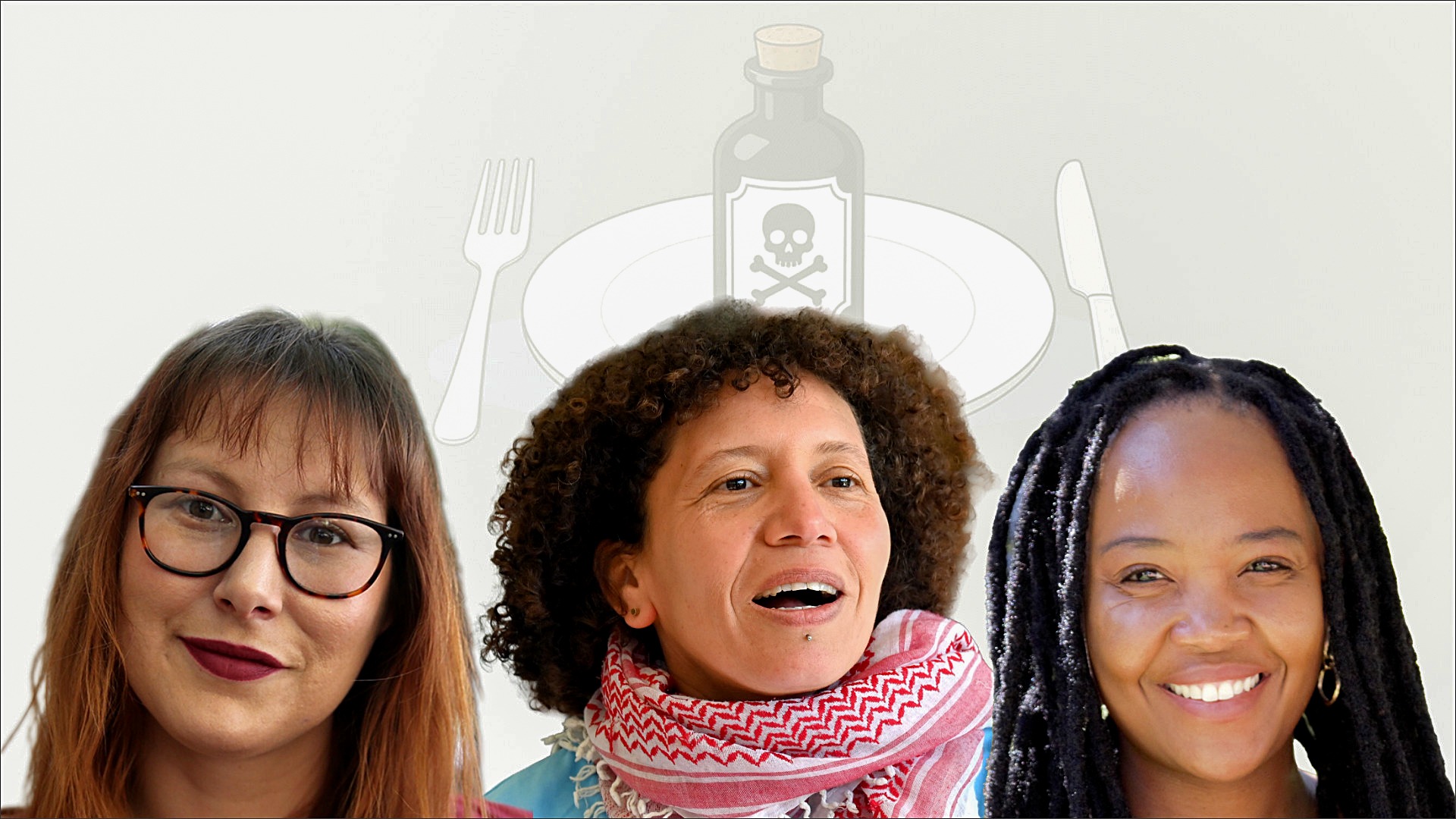
 Daily Maverick Journalist Lillian Roberts (photo: supplied) | Campaigns Programme Coordinator for the Women on Farms Project Kara Mackay (Photo: Supplied) | Programme Manager of Food Sovereignty for Rosa-Luxemburg-Stiftung, Refiloe Joala (Photo: Supplied).
“From 2005 to 2012, South Africa’s domestic use of glyphosate, one of the world’s most widely used herbicides, increased from 12 million litres to 20 million litres,” said Daily Maverick journalist Lillian Roberts, at a webinar on Poison On Your Plate? SA’s battle to ban highly hazardous pesticides.
The scale of that use came into sharp focus this year when South African National Accreditation System (SANAS)-certified laboratory results confirmed glyphosate contamination in maize meal, wheat flour, bread, and baby cereal, with two products exceeding the maximum residue levels (MRLs) set by the government.
The findings were among the submissions before the South African Human Rights Commission (SAHRC) in its ongoing national investigative hearing into SA’s food systems.
This was one of the issues examined in the webinar on SA’s battle to ban highly hazardous pesticides, which brought together voices from civil society, the agricultural sector and farm worker advocacy.
The glyphosate findings
The lab results prompted the African Centre for Biodiversity to formally request that then minister of Agriculture John Steenhuisen deregister and ban glyphosate in South Africa. Glyphosate and AMPA carry growing health concerns, with evidence linking them to cancer risks, endocrine disruption, and gut microbiome damage, Roberts said.
/file/attachments/orphans/Farmworkers_6954_580055.jpg "Common pesticides used on grape farms include fungicides, insecticides herbicides like glyphosate (Roundup Turbo) and growth regulators like Dormex. (Photo: Nathi Nqobile)")
Refiloe Joala, Food Sovereignty Programme Manager at the Rosa Luxemburg Stiftung, co-produced the documentary Toxic Harvest, which independently tested nine fresh produce items and a range of processed foods. Only one fresh produce item – a green pepper – came back with residues below the official maximum residue levels, Joala said at the webinar.
“Pesticides are basically everywhere, and there are multiple sites of exposure, one of them primarily being our food,” she said.
Annelize Crosby, head of legal intelligence, Agricultural Business Chamber (Agbiz), which represents more than 100 organisations across the agricultural value chain, urged caution about how the maximum residue level findings are interpreted.
“Maximum residue levels are not safety thresholds,” she said, pointing to the Department of Health’s use of separate standards, acceptable daily intake and acute reference dose, as the more relevant health benchmarks.
She also noted that glyphosate is not universally classified as a highly hazardous pesticide under Food and Agriculture Organization or World Health Organization (WHO) definitions, though the WHO classifies it as a Group 2A substance, a probable carcinogen.
Banned abroad
SA currently has 195 highly hazardous pesticides legally in use. Only one, Terbufos, was formally banned in early 2026, after being linked to the deaths of six children in October 2024. According to Joala, 60% of the highly hazardous pesticides still in use in SA are banned in the European Union.
This disparity is at the heart of the Women on Farms Project’s Double Standards campaign, said Kara Mackay, campaigns programme facilitator.
“There are pesticides that have been banned in Europe for health and environmental reasons, yet Europe produces these pesticides and exports them to SA for use in our agricultural sector,” she said at the webinar. “If a product is harmful to European bodies, then of course it would be harmful to South African bodies and workers.”
/file/attachments/orphans/DrKaraMackay_7121_403971.jpg "Dr Kara Mackay works with Women on Farms, where they focus on decent work, feminist reparation, and equitable access to land. They have focused heavily on the ‘double standards’ campaign, where pesticides banned in Europe are exported for use in Africa and elsewhere. (Photo: Nathi Nqobile)")
Crosby acknowledged the concern but argued that SA’s climate, pest pressures, and affordability constraints were meaningfully different from Europe’s. She added that substances of concern were progressively being phased out through the re-registration process: once a registration period lapsed without renewal, a substance could no longer be used.
‘The dreams of the children also take a knock’
For Mackay, the regulatory debate has a human face. She described the situation of a farm worker, Solomon Piet, in Rowsonville, employed as a pesticide sprayer. He received no personal protective equipment, no medical testing, and no washing facilities, Mackay said. His wife bought him a rain jacket in an attempt to slow what she could see happening to him.
“After about three years, he got sick. He was diagnosed with cancer and couldn’t work.”
When Piet could no longer work, his employer began eviction proceedings, arguing that the house on the farm was tied to his employment. Women on Farms intervened and stopped the eviction. Because there was no paid sick leave, the family’s daughter dropped out of school to work as a farm labourer so she could buy food and medicine for her father.
“When a worker is not given proper protocols and proper protections, it’s not just that their body and their health are destroyed, their livelihood is decimated,” Mackay said. “But the dreams of the children also have to take a knock.”
/file/dailymaverick/wp-content/uploads/2025/09/DSF3592.jpg "Mekie Piet testified about the death of her husband, Solomon Piet, due to pesticide exposure. (Photo: Natasha Foote)")
Joala said testimonies like Piet’s were corroborated by the South African People’s Tribunal on Agrotoxins’ submission to the SAHRC inquiry, where they referenced a two-year civilian inquiry that heard evidence from farm workers, rural communities, public health experts, scientists and legal specialists. Spraying on farms routinely happens without warning to workers, and women employed seasonally often receive no gloves, boots, overalls or goggles. There is frequently no water available to wash hands before eating.
Food security and the alternatives
Crosby argued that the continued use of agricultural remedies is necessary to maintain the yields that underpin national food security.
“If we had a reduced yield or increased price of agricultural products as a result of no longer being able to use some of these agricultural remedies, the people that are going to be hit hardest are going to be the poorest of the poor,” she said.
Joala challenged this framing. SA already faces serious food insecurity, with roughly a third of the population living below the poverty line, not because of insufficient production, but because food is unaffordable. She also raised a less-discussed consequence: many highly hazardous pesticides degrade soil biodiversity and kill beneficial microorganisms essential for nutrient cycling.
“The food system can produce more calories in the sense of yield output of maize and wheat, but often these are less nutrient-dense. It delivers less healthy food.”
Crosby acknowledged that biologicals are growing and that regenerative agriculture is gaining ground, but cautioned that alternatives must be both available and affordable before any transition is viable. She pointed to the Global Framework on Chemicals, to which SA is a signatory, which sets a 2035 target to phase out highly hazardous pesticides where risks have not been managed, and no safe alternatives exist.
The season ahead
“The season is coming,” Mackay said. “Women are going to have to go into those vineyards. The re-entry times are not going to be adhered to. There’s no toilet. There’s no water. These are the low-hanging fruit. Can we at least implement the legislation that we currently have?”
Crosby agreed that enforcement matters.
“The law is there, and it should be enforced. It is basically unacceptable not to comply,” she said.
She acknowledged, however, that Agbiz has no direct power to sanction individual farmers for non-compliance, as its members are organisations rather than individuals, and membership is voluntary.
Underpinning the conversation is legislation that, as Roberts noted, predates apartheid, the Fertilisers, Farm Feeds, Agricultural Remedies and Stock Remedies Act of 1947, which remains the governing framework for pesticide registration and use in SA.
/file/attachments/orphans/46_142435.jpg "Former minister of agriculture, John Steenhuisen (middle), leads a delegation before the Human Rights Commission, accompanied by Director-General Mooketsa Ramasodi (right), and Lebogang Botsheleng, the Acting Deputy Director-General for Food Security and Agrarian Reform, on 18 March 2026. (Photo: Given Makhuvele / Wysani Baloyi)")
When the SAHRC questioned the act’s registrar, Jonathan Mudzunga, about the long-promised overhaul, he acknowledged that little to no progress had been made. Roberts also noted that at the 15th UN Biodiversity Conference in 2022, countries committed to reducing pesticide risk by 50% by 2030, a target only Chile is currently on track to meet.
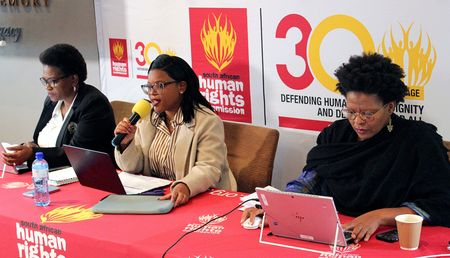
Joala called for an update to pesticide legislation to reflect current scientific thinking, and a broader transition toward what she described as a more equitable and environmentally sustainable food system.
“Climate change is here,” she said. “We need all actors to participate, and for the government to take the lead in thinking through the transition to a more just food system.” DM
Comments
Scroll down to load comments...