



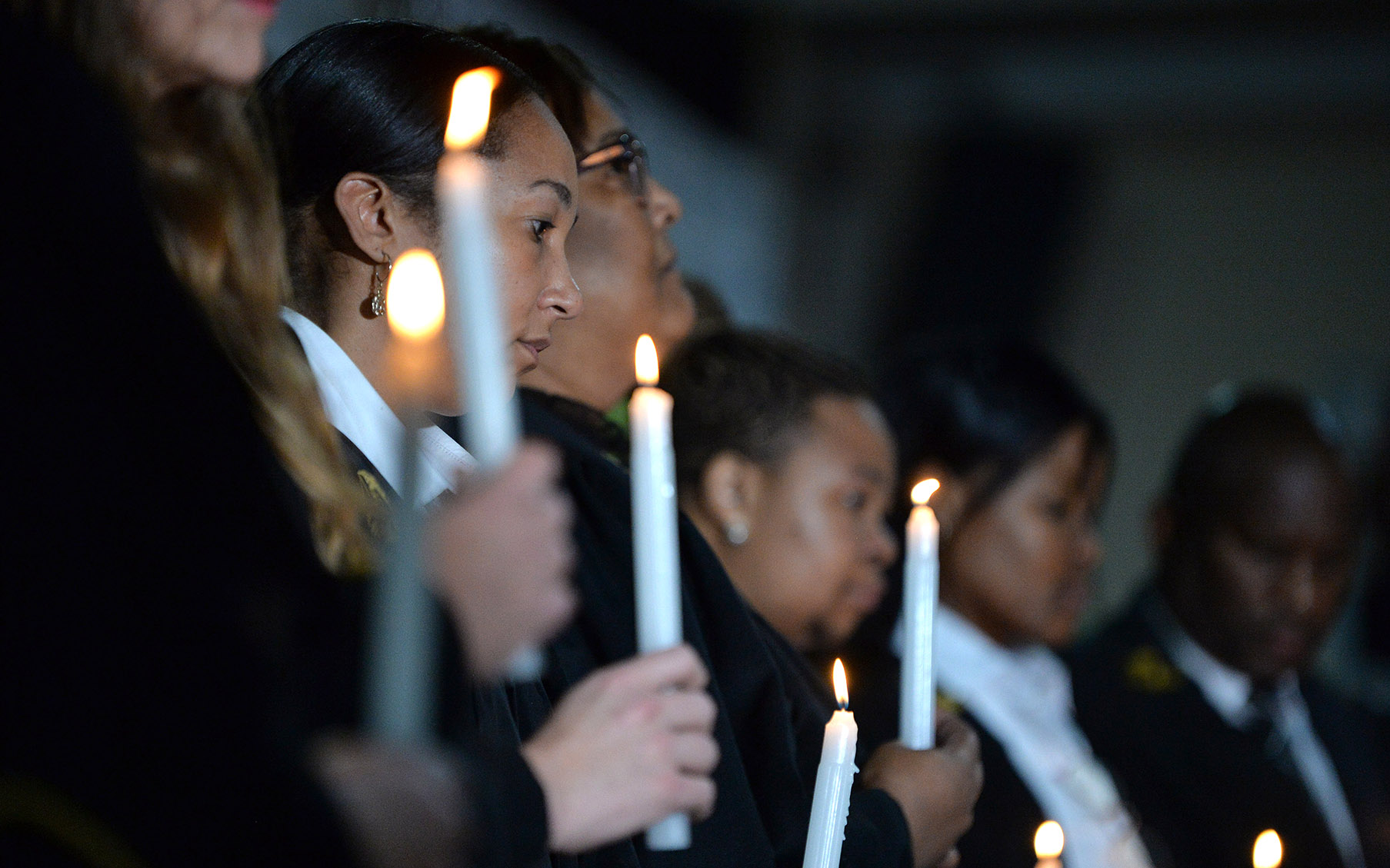
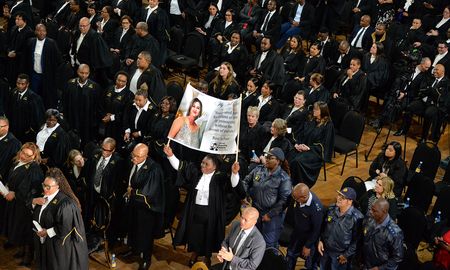
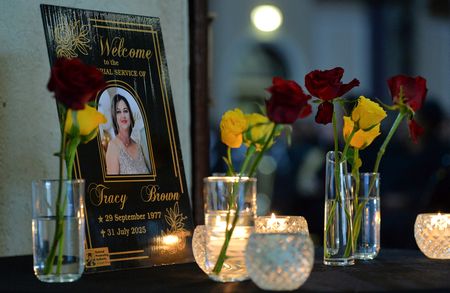
 Prosecutors from the New Brighton Magistrates’ Court line up for a ceremonial roll call during a memorial service for murdered colleague Tracy Brown. (Photo: Deon Ferreira)
As the men accused of orchestrating the hit murder of Nelson Mandela Bay prosecutor Tracy Brown await their trial date, court officials are once again questioning their safety inside and outside courthouses.
While the Department of Justice and the police have said the necessary steps have been taken to improve security at courts and around officials, prosecutors remain uneasy and concerned about being targeted.
Former colleagues of Brown have spoken out, saying her death in July 2025 came amid ongoing discussions about the safety of prosecutors at the New Brighton Magistrate’s Court where she was stationed.
Seemingly little has changed in the last 15 months, as moments before her alleged murderers appeared in court Daily Maverick witnessed another prosecutor recusing himself from an unrelated case, citing safety concerns after reportedly receiving threatening messages.
“This does not surprise me. I don’t think enough is being done to ensure the safety of court officials, particularly prosecutors. It seems like our working conditions are worsening. We don’t know who to trust, and when we leave the court, many of us are completely vulnerable,” a state prosecutor said.
Brown and New Brighton
“Please just make sure, when you take my morgue pictures, that I look good.”
That was the morbid comment Brown made on a WhatsApp group with colleagues in the months leading up to her death.
Complaints about prosecutors’ safety, corrupt court orderlies and blatant threats in open court had fallen on deaf ears, and with a dark sense of humour developed over many years working in the court system, Brown told her colleagues that her death would likely be linked to a case she was working on.
/file/dailymaverick/wp-content/uploads/2025/08/Tracy-Brown-1.jpg "Gqeberha public prosecutor Tracy Brown. (Photo: Supplied / Facebook).")
Little did they know that the macabre comment would actually be a premonition, because not long afterwards, she was gunned down outside her home in Young Park. The hit was allegedly orchestrated from inside the St Albans Prison in Nelson Mandela Bay.
On 9 April this year, a targeted search at St Albans Prison turned up cellphones, sharp objects, mandrax and dagga, Correctional Services said. National prisons commissioner Makgothi Thobakgale said the prison was among the 10 most overcrowded and high-risk in the country.
“We had a chat group among the prosecutors at New Brighton where we would often discuss work, and safety concerns were often part of the discussion. These concerns were regularly raised with our superiors but never taken seriously,” one of Brown’s former colleagues, who chose to remain anonymous to avoid victimisation, said.
“We always said it would probably take one of us to be killed before something is done. Then Tracy was murdered. More than a year has gone by, and not much has changed.”
Brown was one of five prosecutors shot dead in five years, three of them in Eastern Cape, Justice and Constitutional Development Minister Mmamoloko Kubayi told Parliament in September 2025.
Prosecutors’ concerns ranged from the darkened corridors among the holding cells under the court, cells rendered useless as they are filled with piles of discarded documents, to preferential treatment of certain accused who had befriended court orderlies and security guards. Prosecutors said they constantly had to question which police and court officials were involved in possible underhanded and corrupt activities.
A prosecutor stationed at New Brighton mentioned an incident where an accused, who had been facing charges of drug trafficking and had known affiliations with other criminal networks, had been allowed to park his vehicle inside the court building’s security gates, in parking spaces reserved for court and police officials.
At the public entrance to the court building, metal detectors were seldom operational and security officials conducted lacklustre pat-downs when visitors entered.
In some instances, prosecutors opted to go down into the holding cells personally to collect and bring the accused to appear before court as they feared court orderlies were providing them with contraband, such as cellphones and drugs.
“Threats are a regular occurrence. Some of us get threatening messages from unknown numbers, while some accused look us straight in the eyes and drag their fingers across their throats while court is in session.”
In Brown’s case, evidence before court indicated that her hit, on 31 July 2025, was orchestrated from inside prison and was linked to the prosecution of Buhle Mbini, who was arrested for the illegal possession of an unlicensed AK-47.
Mbini, along with Simthembile Xungu, Thamsanqa Mthembu, Andile Mathumbu and brothers Ayabulela and Xolani Busakwe, are due back in court later this month on charges related to the Prevention of Organised Crime Act. Some of the accused have been linked to Brown’s murder, while others have been tied to kidnappings in the area.
At their next court appearance, they expect to hear when their matter will be transferred to the high court for trial.
In April, Daily Maverick found that at least 10 professionals, including Brown, had been killed in work-related attacks over three years. Their work had placed them at the centre of high-stakes legal, financial or political disputes. At the time, no alleged mastermind had been arrested.
Brown’s case has since progressed, with Mbini charged in June as the alleged mastermind of the hit.
Xolani Busakwe, who was arrested most recently, is a warrant officer attached to the police’s Directorate for Priority Crime Investigation, commonly known as the Hawks.
The alleged involvement of a police officer prompted Brown’s former colleagues to speak up about their ongoing safety concerns.
One said in the months leading up to her death, members of the police’s Flying Squad would on occasion follow her home from court to ensure her safety.
“This was not part of their job and it shows there are still good cops around. However, we also know there are rotten ones, and hearing that one of the men linked to her case was a member of the Hawks, just proves that point again. Who can we trust?”
In August 2025, shortly after Brown’s murder, Kubayi visited New Brighton Magistrates’ Court and said urgent attention was needed to address its security and infrastructure problems. “Here we do not have CCTVs, we do not have digital cameras, and we don’t even have personnel physically,” she said, Algoa FM reported.
Kubayi said the safety and security of prosecutors and other court officials, in New Brighton and in general, would be prioritised.
/file/attachments/2991/ED_555757_644737.jpg "Minister Mmamoloko Kubayi at Orlando Communal Hall on 3 May 2025. (Photo: Fani / Mahuntsi / Gallo Images)")
These promises, and whatever steps taken by the department, were inadequate it seems.
On 25 September 2026, moments before the men accused of Brown’s murder stood in the dock at the Gqeberha Magistrates’ Court, the courtroom was filled with heavily armed police officers. They were tasked with keeping an eye on four accused appearing before court on an unrelated matter.
While the exact details of these court proceedings were unclear, the State asked for a postponement after indicating that a new prosecutor had to be appointed. The previous one had recused himself after receiving threats related to the case and was no longer willing to continue with the matter.
‘Strengthening and enhancing security measures’
Department of Justice and Constitutional Development spokesperson Palesa Rammitlwa said all reports of threats against court officials were treated with “utmost seriousness” and security measures were continuously being assessed and adapted as needed.
“The department has continued to strengthen and enhance security measures at courts informed by identified risks, operational requirements and the evolving security environment. These measures include the enhancement of CCTV surveillance and access control systems, the strengthening of security screening procedures at court entrances, increased security visibility and the ongoing conduct of comprehensive risk assessments to identify and address potential vulnerabilities.”
Rammitlwa said threats directed at judicial officers had increased in recent years, and each reported incident was assessed based on its individual circumstances before being “addressed through established security protocols and appropriate law enforcement processes”.
She said given the sensitivity of the information and the risk of compromising ongoing matters, she could not provide details or statistics on the number of cases currently under investigation.
“Risk is heightened on matters involving organised crime, gang-related activities, serious and violent crimes and other high-risk criminal prosecutions. Accordingly, the department applies a risk-based approach to the deployment of security measures and resources.
“The department remains firmly committed to ensuring a safe and secure environment in which judicial officers can discharge their responsibilities without fear, intimidation, or undue interference,” Rammitlwa said.
Asked about safety concerns and the conduct of court orderlies at New Brighton, police spokesperson Captain Sandra Janse van Rensburg said previous investigations into such allegations had found the claims to be unsubstantiated.
“SAPS New Brighton regularly monitors court operations at New Brighton. The station commander visits the court, addresses staffing needs and has put measures in place to prevent corruption.”
She said concerns about members’ conduct were raised with the police, but no supporting evidence or formal statements were provided. An internal inquiry was conducted, and the Crime Intelligence and the Anti-Corruption Unit were included.
“No actionable leads were identified and the claims remain unsubstantiated. Currently, there is no formal investigation into the conduct of court orderlies,” Janse van Rensburg said. DM
Comments
Scroll down to load comments...