




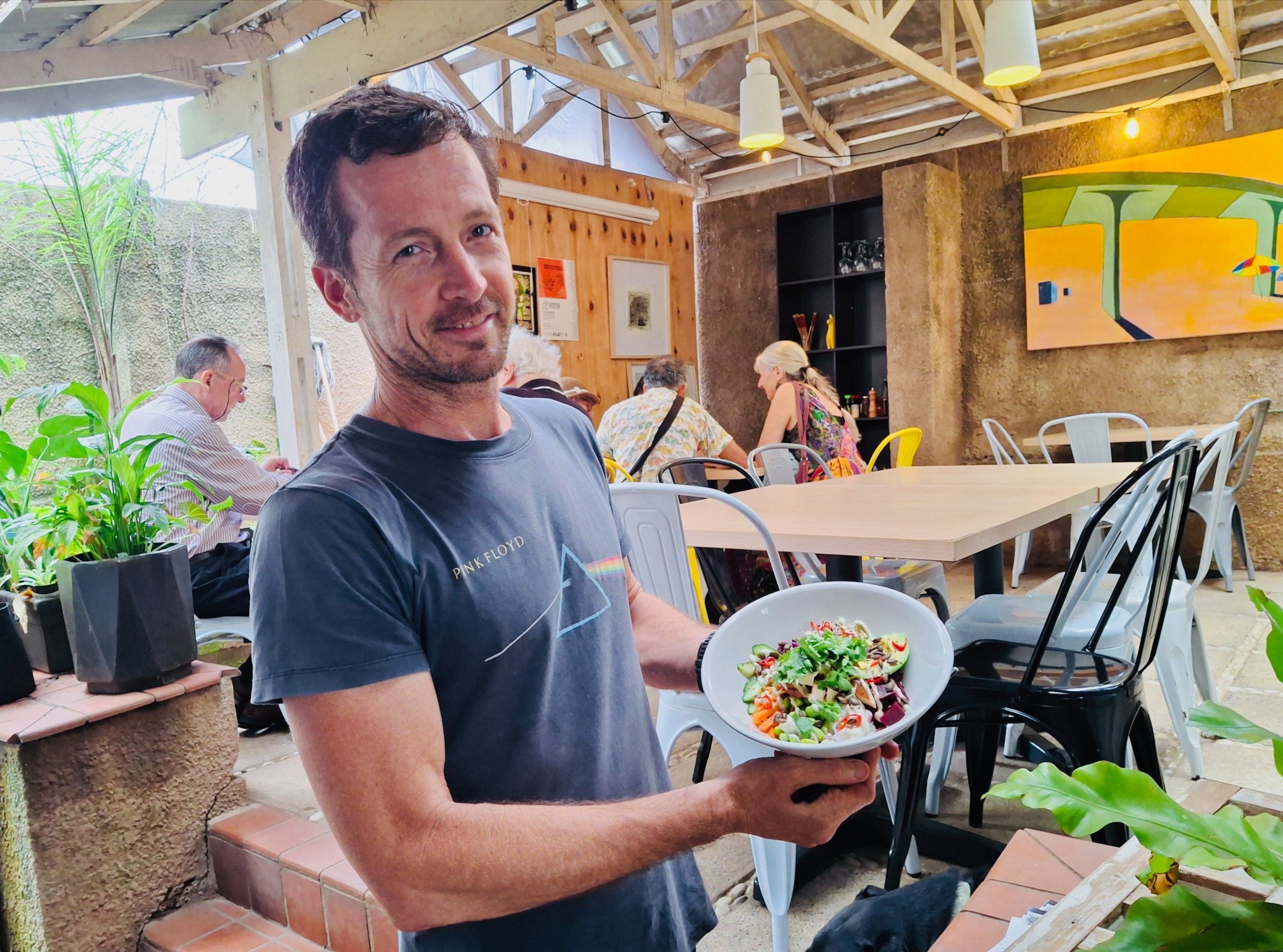
 Thomas Wright serves it up at Poké Box at Phansi. (Photo: Wanda Hennig)
Heritage. Custom. Culture. Tradition. Roots. How about Hawaii meets Vietnam meets Korea meets China via Australia at one of South Africa’s finest repositories of indigenous African art.
This is a condensed version of the story behind Thomas Wright’s Poké Box at Phansi Museum; architect, cultural conservationist, 2023 UKZN honorary doctorate recipient Paul Mikula’s trove of African art and artefacts. To quote Mikula: “We exist to treasure, share and inspire.”
If you’re not in Durban, you can take a virtual tour of the Phansi Museum here.
Wright opened his initial Poké Box from a hot-pink strip-lit hole-in-the-wall find-it-if-you-can converted garage in a bougainvillea-meets-barbed wire single lane service alley that runs for a block parallel to Florida Road. We wrote about it in TGIFood soon after it opened, here.
Morningside fans lamented and Glenwood celebrated when Wright shuttered there and moved across town to open Poké Box, version two, in a “proper eatery” space, right next to Adam Robinson’s Glenwood Bakery.
As soon as he got there, he expanded his menu and, with his engaging quicksilver energy and enthusiasm, created a buzzy hub in Glenwood with movie nights, dance club nights, music nights, art exhibitions and assorted cool informal happenings, mainly shared through his fun, often funny, sometimes serious, occasionally whacky, always informative posts on TikTok and other social media platforms.
/file/attachments/2998/Surf_552396.jpeg)
Wright, since he opened, has whetted appetites and made tastebud waves in Durban (between riding big surf waves early mornings at North Beach), serving up his deconstructed sushi-style poké bowls, Asian street food, ramen and Korean-style toasted sarmies.
Everything he slices, chops, preps and puts on the menu or his “specials board” is fresh and made from the best quality ingredients he can source and afford.
Fish, of course, from Bartho Brothers (whom we wrote about here). Everything creatively prepared and delicious. Always a few treats, usually with quirkiness and humour mixed in, like his “sneaky banana & bran muffins”.
Then there are the weather-inspired specials such as an “uncomplicated pork belly ramen” or a “Durban curry with Japanese vibes” or a “katsu curry fish cake & carrot salad”. Also noodle salads with a choice of beef, chicken or tofu (vegan).
Signature poké options include a free range smoked chicken box, sesame marinated tofu and trout ceviche. Newly added, and in a sense a throwback to his pre-poké days, is a short menu of pasta classics.
/file/attachments/2998/Poke_Read_481560.jpeg)
“I grew up in Glenwood. I went to Glenwood Primary and Glenwood High. I had this romantic idea about opening in my old neighbourhood,” he tells me.
We’re sitting chatting in Poké Box, version three, which has opened in “the cowshed” at Phansi Museum, which those familiar with this urban landmark will know. Mikula is rehousing, to an alternative Phansi space, what was in the cowshed before Poké Box. Namely, the collected works of the late Peter Engblom, another legendary Durban (and Zululand) creative; for years, a close friend of, and collaborator with, Mikula.
Mikula was recognised by UKZN with an honorary doctorate in architecture for his outstanding contribution to architecture and the preservation and promotion of KwaZulu-Natal’s arts and cultural heritage.
He is also a recipient of the gold medal of the Heritage Association of South Africa “in recognition of his outstanding contributions to preserving South Africa’s cultural heritage. His work spans multiple domains including traditional art, music and architecture, with a particular focus on ensuring that indigenous knowledge systems and cultural artefacts are preserved for future generations…”
/file/attachments/2998/Phansi_Poke_634829.jpeg)
When Wright shared, not too long ago via a TikTok post, that he had bitten off more than he could chew with Poké Box, version two, and was going to close in Glenwood (he had, by then, opened a food-truck-like mini-Poké up the drag in Gilletts), fans rallied. In no small part due to the make-it-happen enthusiasm of another long-time Durban legend, Gloria Hoff, moving his Poké Box to the Phansi Museum – walking distance away, if you’re fit, from where he was (there’s a steep hill) – became an option.
Hoff had been involuntarily retired from running the shop at the KZNSA gallery (also in Glenwood) after 45 years and counting of KZNSA evolutions. When that happened, she immediately spoke with Paul Mikula about taking her abundant energy to Phansi.
Hoff rooted for Poké Box to open at Phansi, as for some time there had been no café, let alone a restaurant, there. And so was born this interesting and unusual alliance, green-lighted by Paul Mikula and his son, Max Mikula, musician, composer, music teacher, actively involved in Phansi in support of his octogenarian dad.
Funny thing, when Poké Box, version three, opened at Phansi, while it is a lovely indoor-outdoor space with foliage and great natural light and a cool vibe, the lack of frontage makes it, as “version one” was, one of those special Durban places where to find it is to love it. But it’s not going to jump out and hit you over the head.
Here, once again, for take-out, there is a “hole in the wall” hatch.
To eat in, especially at night, you often need to call through the order hatch or press a buzzer. This because the Phansi Museum security driveway gate is often closed.
But once you know this, no problem. And inside, things often rock.
/file/attachments/2998/Thomas_Mo_Draper_348876.jpeg)
A couple of weeks ago on a Sunday afternoon, the final day of the four-day Glenwood Book Fair was happening at Phansi. Talks, panel discussions and book launches were on the go in the gallery space. There was an Ike’s Books table on the tiled wrap-around veranda of the historic Phansi Museum house. A Denis Hurley Centre StreetLit book table was among a bunch of goings-on in the courtyard and parking area.
I caught Wright and his service dog and companion, Mo, short for Giaco“mo” Puccini, as in the Italian composer. Service dog because Wright is deaf in one ear and can’t hear too well out of the other and needs an extra pair of ears.
A silent book club reading was about to begin in the Poké Box, where participants were gathering, ordering lunch, tea and crunchies, and setting up. The previous night, Wright had collaborated on a food and wine pairing with charismatic Durban wine maven, Matt Draper.
Poké Box opens directly into the pottery studio of ceramic maker and craftsman, Sbu Mthembu, one of a number of artists and craftspeople who have forged their careers through their association with Paul Mikula. Mthembu sometimes leads tours at Phansi, a museum popular with international visitors, tourists, school groups from around KZN, researchers and others.
He says he doesn’t mind, in fact rather enjoys, having customers pop in to chat and ask about his work when they arrive at Poké Box at Phansi’s light-filled-sanctuary-cum-neighbourhood-hub.
Wright’s Poké Box story is a pretty fascinating tale of life’s twists and turns, bumps and grinds. To start at the beginning…
“I was 10 or 11 when I began cooking. My parents divorced. My father got hold of this lever arch file into which he stuck recipes. Things like roast chicken, beef olives, cottage pie, mac and cheese. He liked to go and spend time sitting in the pub at the Point Yacht Club. He also liked to come back to a nice home-cooked meal.”
There were three sons. They were assigned to prepare the home-cooked meals.
“My oldest brother would drink the milk, eat the bread.” A clever avoidance ploy. “So dinner prep was left to my middle brother and me,” says Wright, who is candid, funny; with gravitas and at the same time, a lightness of being.
Proactive practical parenting? Child labour? A gift, perhaps? Because, ultimately, it became the foundation for what would grow into a fallback career turned full-time calling.
/file/attachments/2998/Sarm_poke_379093.jpeg)
Once he finished school, his dad, whose second wife had twice been hijacked, decided to emigrate to Australia. Did his youngest son want to go with him?
“I thought, why not?”
And so begins the story of his career as a cook.
“I was keen to study art. My dad thought I should study engineering first, to fall back on.” So he enrolled at a college in Brisbane. Chose laser engineering and did this until his dad was made redundant. At which point, “Basically, to make money to live in Brisbane, I started washing dishes.”
It was at a trendy café.
“A 24-hour joint with a sort of military chef who had cooked for generals, would hide his beers behind the lettuces,” and who taught Wright – who worked the graveyard shift – his knife skills “chopping, chopping, chopping, among other things 50kg of mushrooms” before prepping 30 litres of scrambled eggs.
Within a couple of years the dishwasher, under the chef’s beady eye and attention to good kitchen practices in others, had learned to cook “everything” including steaks and many 3am breakfasts for the drunk and disorderly. But while Wright was doing all the cooking, he was still earning a dishwasher’s wages.
So he left to work at a nearby Malaysian restaurant, where he learned the refinements of nasi goreng, chicken korma and the like.
Then he decided to move closer to the sea and got a job at a Vietnamese restaurant in Wollongong, south of Sydney, where he spent two years as sous chef working at the wok and learning about authentic Vietnamese food and techniques from two elderly women who spoke little English, hated each other, but took delight in instructing him.
He subsequently spent time as head chef at a Sydney sports bar, also getting to know the city’s haute cuisine dining scene. The sports bar people he worked with, though, he found racist, bigoted, homophobic.
/file/attachments/2998/Kitchen_270383.jpeg)
“Ultimately, I was unhappy in Australia. I got psoriasis and psoriatic arthritis. More from unhappiness than from stress.” His mom, who by then had returned to South Africa after a few years in England, suggested he come back. So he did.
He opened a restaurant called Vanille, in Kloof, with a friend. “Café food. I made my own sourdough bread and pasta. A salad called “frog in the hill”, with Parmesan and toasted pine nuts, which some people still remember.
After two years there, Wright headed for the UK and spent 10 years in London, working with cameras in the film industry. Often thinking, he says, from around 10am what he would make for dinner and eating out a lot, but not working with food.
Which he got back into, when having returned to South Africa – Cape Town, where he worked, again, in film, for a spell – he set up his Kommetjie noodle bar. Which took him about a year and a half to “kind of find my groove, and I was doing pretty well to keep myself alive”. But then came – the virus.
After being shut down by the Covid lockdown, a friend said: “Come back to Durban where you have so many friends.” Wright loaded his wok, his steamers, his chopping knives and all he could fit into a trailer, attached it to his little old jalopy and hit the road.
He got to Durban the day before lockdown.
“Spent most of my savings on just surviving.” Then started offering poké boxes, initially out of a friend’s pantry near the Durban University of Technology.
As luck would have it, he was invited to make poké boxes one evening for a group of friends, one of whom – Durban architect-designer Richard Stretton – offered a garage-like space behind his house, which became the hole-in-the-wall original Poké Box.
Times change. The venues have changed. The menus have expanded. The food remains fresh and delicious. So why not, as Wright says, often, on social media: “Munch a poké box!” DM
Check out the Poké Box website. Follow Poké Box on Instagram and Facebook.
Check out Phansi Museum on Google Arts & Culture, on Instagram and Facebook.
Check out Wanda Hennig’s website and follow her on Instagram.
Comments
Scroll down to load comments...