




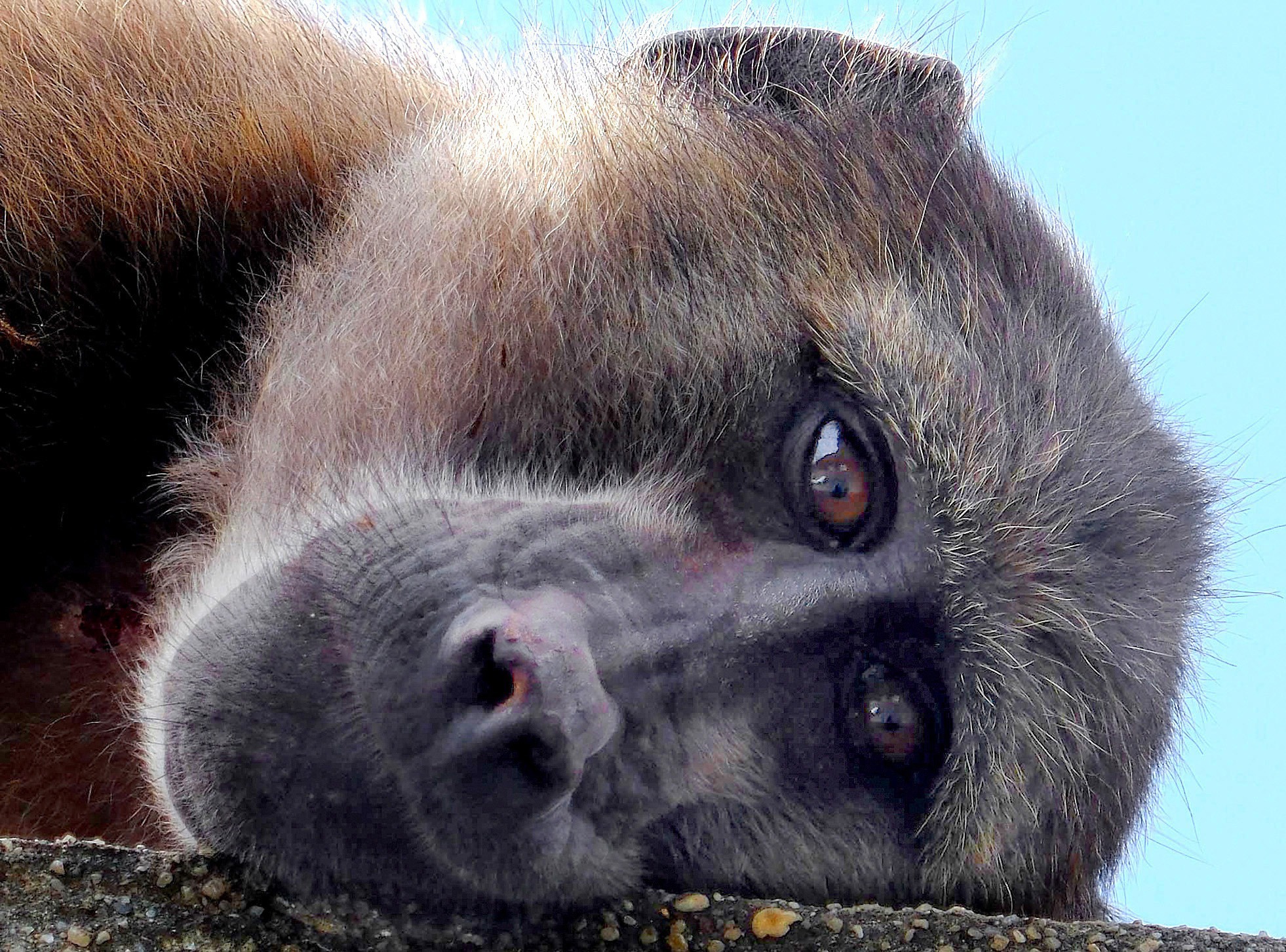
 At least 60 baboons will be captives for the rest of their lives in Cape Town’s Urban Baboon Centre. (Photo: Don Pinnock)
There’s something about the Urban Baboon Centre that projects both exasperation and intent. The architecture seems to say: get those damn baboons out of town once and for all and make absolutely sure they stay put. C-Max prison yard meets fynbos playground.
There will be comfortable roosts, ropes to swing on, pools of fresh water and regular meals. The fence will deliver an estimated 8,000 to 9,000 volts if you question the hospitality. Full board. Life term.
Sarah Waries, zoologist and CEO of Shark Spotters, which manages Cape Baboon Partnership, sees the accommodation rather differently. For her, this is a chance to give two troops a safer existence than the one they have negotiated among Simon’s Town’s cars, kitchens and increasingly irritated humans.
“We think kind of the baboons deserve a bit of a break from people,” she says.
People, presumably, will appreciate the break from baboons. The awkward question is whether either party needed quite so much fencing to achieve it.
/file/attachments/orphans/Don-Baboon411_809776.jpg "The builders of the holding centre are taking no chances about baboons escaping. (Photo: Don Pinnock)")
/file/attachments/orphans/Don-Baboon410_788035.jpg "The centre under construction. (Photo: Don Pinnock)")
/file/attachments/orphans/Don-Baboon48_737652.jpg "baboons Urban Baboon Centre CEO zoologist Sarah Waries. (Photo: Don Pinnock)")
Waries is an enthusiastic guide, picking her way through the still-present rubble, Port Jackson aliens and fynbos site and explaining the thinking behind it.
Feeding and maintenance have been designed to minimise human contact, she says. Sleeping platforms offer differing heights because even in detention, a senior baboon expects an upstairs apartment.
“But if we’re going to do it, we’re going to do the absolute best that we can.” That task will fall on Karen Sacs, who will be Animal Care Manager when the captives arrive. No doubt that also involves being part of the capture itself, which people who know the Waterfall troop say has little chance of going smoothly.
How many?
The numbers, briefly: 2.3 hectares for Waterfall’s 44 baboons and 1.6 hectares for Seaforth’s 16, with extensions planned once environmental approval allows. According to Waries, R10-million covers development and up to three years of operation. More than a third has gone into the fence.
/file/attachments/orphans/Don-Baboon412_348206.jpg "baboons: Access to the sites is an electrified ‘airlock’ preventing baboon escape when humans enter of leave. (Photo: Don Pinnock)")
It’s electrified on both sides. The neighbouring wild troop must also be discouraged from checking in. Solar power and batteries should keep it working through three weeks without sunshine. Even the weather is being denied an opportunity to assist an escape.
The Baboon Management Action Plan speaks of vivisecting all the males, but that turned into something of a flashpoint, so members of the Baboon Advisory Group say it will most probably involve only the contraception of the females.
/file/attachments/orphans/Don-Baboon42_338607.jpg "An electrified tunnel linking parts of the area. (Photo: Don Pinnock)")
We walk carefully around the enclosures, conscious that the bee-sting fence is already taking its job seriously. Workers are building sleeping platforms and clearing firebreaks. Construction began on 1 July. Two-and-a-half months later, an abandoned roads depot has become something close to a functioning baboon detention centre.
That’s the intent part. Whatever the objections, the argument is about acquiring poles, gates and a completion date.
It’s not popular. Waries says protesters gather outside the gates every Sunday at 11am. Inside, construction continues.
/file/attachments/2998/Peninsulababoons-15_953550.jpg)
Then there’s fire
There will be hydrants, access for fire engines, boundary sprinklers and firebreaks extending 10 metres outside and 10 metres inside the boundary. There are daily fire-risk assessments.
But what happens if the precautions are overwhelmed by a wild southeaster, or smoke makes the enclosures unsafe?
“The default thing is we just turn off all the electricity, open the gates and let the baboons out.”
Just like that? Yep, rangers would herd them to safety and manage them outside for a day or two. “And then when it’s safe, bring them back here.”
The explanation is brisk. The prospect of moving two troops away from a fire, then persuading them to return, invites a little more lingering. A lot hangs on that word “bring”. They say you can’t trick a baboon twice. After all this ingenuity devoted to keeping baboons in, the emergency plan depends on letting them out. And on the Peninsula, wildfires are as regular as summer mosquitoes.
After a fire, there would be nothing but blackened earth and smouldering shelters. Tough accommodation.
/file/attachments/orphans/Don-Baboon47_817433.jpg "One of the roosts constructed for the inmates. (Photo: Don Pinnock)")
The funding issue
Money presents a slower emergency. Some of these animals could require care for another 20 years. The City’s committed funding cycle is three.
Waries says that’s how municipal budgets work: further funding would follow and the centre’s location on City land keeps responsibility with the City. Here’s hoping captive baboons remain a priority project when budgets get tight.
Nevertheless, she acknowledges that the management plan contains a final contingency. If funding fails and another home cannot be found, the baboons would be euthanised.
“It doesn’t mean that that’s what we’re going to do,” she adds hastily.
It is worst-case planning, she explains. Her expectation is that the animals will live longer, healthier and less stressful lives here under the care of independent baboon researcher Karin Saks than in Simon’s Town.
/file/attachments/orphans/Don-Baboon49_282144.jpg "Sarah Waries pointing to the Centre’s outer fence. (Photo: Don Pinnock)")
Her conviction is evident, as is the effort and money being poured into the place. There are people here working hard to make captivity agreeable. Yet every improvement carries the same small qualification: the baboons will have no choice about it.
For now, their future is being built, down to the last insulator. The detainees have not yet arrived. How you capture 60 wily baboons who see their friends being tricked with lunch is another story. DM
Read Part 1 here
Read Part 2 here
Read Part 3 here
Link to baboon resource site
Coming tomorrow: Jane of Waterfall speaks to the tall tailless.


Comments
Scroll down to load comments...