




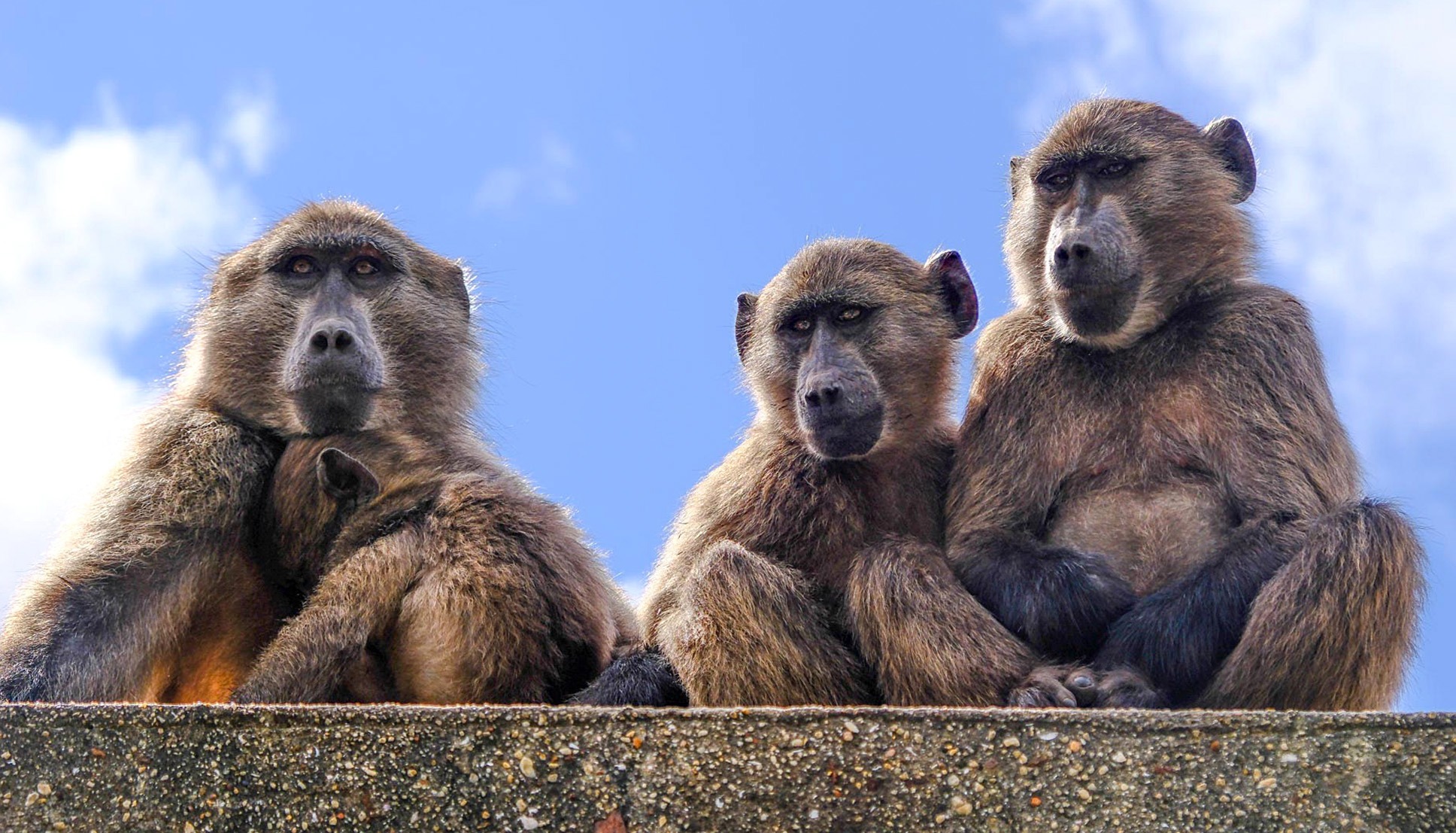
 Members of the Seaforth troop watch traffic from the naval yard wall in Simon’s Town. (Photo: Don Pinnock)
The baboons of Simon’s Town are slated for removal to a fenced area where they will spend the rest of their lives.
As that day looms, the battle between pro-stay groups and City of Cape Town officials planning the removal is escalating. Demonstrations, posters, baboon solidarity days and officials convinced they’re doing the right thing for baboon and citizen safety – it’s a confusing space to negotiate.
Maverick Earth took a deep breath and decided to try to sort the scat from the sagacity. In this series we’ll look at the official position, the science around baboon management, citizens who are appalled at the impending imprisonment and the forever sanctuary itself. Then, in fairness, we’ll ask a baboon for comment.
Today, we give the scientists a voice.
A simple question
By the end of our conversation, University of Cape Town Professor Justin O’Riain has reduced Simon’s Town’s sprawling baboon argument to a deceptively simple question: Where do you put the fence?
Around the town, keeping baboons outside? Or around a sanctuary, keeping them inside?
“Fencing is the solution,” he says. What’s important is which arrangement can “guarantee relief for the residents and relief for the baboons”. After years of studying the Waterfall troop’s adventures in town, he believes the Urban Wildlife Centre at Kogelfontein near Scarborough offers the surest answer.
As we will see below, researcher Dr David Gaynor supports fencing, but rejects abandoning the option of a fence above Simon’s Town in favour of encagement. He is, to use an irresistible metaphor, a scientist on the opposite side of the fence from O’Riain.
Anthropologist Samantha Hurn put her finger on the current dilemma over baboons. Her research into baboon management found conservation authorities, scientists, welfare groups and residents divided – not simply over what worked, but over what a baboon is: wild animal, troublesome neighbour, protected wildlife or something approaching a fellow citizen.
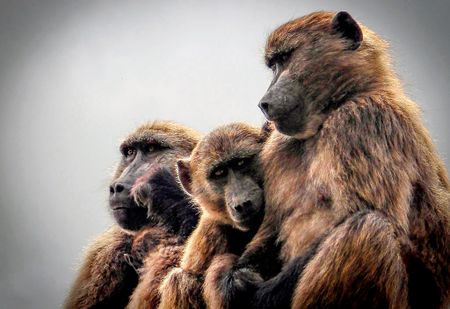
/file/attachments/orphans/Don-Baboon2-1_704637.jpg "Chilling. (Photo: Don Pinnock)")
Political compromise
The proposed facility, O’Riain acknowledges, is a political compromise shaped by opposition to euthanasia. What exasperates him is the sequence: protests against killing the baboons, demands that they be allowed to live, then protests against the centre intended to keep them alive.
“The relief from those people who are anti-culling was palpable,” he recalls of the decision to relocate the baboons to the Urban Wildlife Centre. “And then the next thing you know, a new movement starts.”
From his perspective, the authorities have committed themselves to years of expensive care, only to face another round of opposition. He recognises that a different movement is now challenging captivity, but his question is pointed: “What’s your alternative?”
He believes reliable food, shelter and protection could make the baboons happier than their hazardous urban excursions do. He expects their play and mating to continue.
Would the City keep paying for their care over the next 20 or 30 years of their natural life?
“I’m confident they’ll keep it going. There’d be a massive outcry if, in a few years’ time, the baboons were euthanised.”
His view of the Waterfall troop has been shaped by watching what it does when people are not steering it away from town. Human food and comfortable sleeping places exert a powerful pull.
“They want to sleep in our structures. They want to eat our food.”
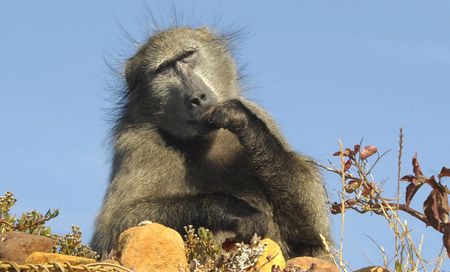
/file/attachments/orphans/Don-Baboon2-3_934508.jpg "Anything to declare? (Photo: Don Pinnock)")
He recalls filming baboons entering cafés at 10pm, long after the rangers’ shift had ended. Roofs offer another attraction. Once an animal has learnt to get beneath tiles or sheeting into a warm ceiling, a cliff may lose some of its appeal.
“It’s like a ratchet,” he says of their acquired urban skills. “It just goes in one direction.”
/file/attachments/orphans/Don-Baboon2-2_639213.jpg "Most baboon food is from natural foraging, contrary what the citizens of Simonstown think. (Photo: Don Pinnock)
<br>
<br>")
Fast food
The problem, he says, is that towns are baboon fast-food outlets. A 2017 study by Gaelle Fehlmann, O’Riain and colleagues found that 90% of food resources sampled in urban areas provided roughly 10 times more energy per bite than food in the natural environment. The payoff radically altered how the animals spent their day.
The raiding males studied spent only 9.5% of their time foraging, compared with between 20.3% and 59.3% for baboon populations elsewhere in Africa. They could, in effect, eat far better while spending far less time looking for food.
O’Riain says he tried to stay out of baboon management, but found the research was accumulating. “We couldn’t stay out of it any more. We got dragged in there.” He insists that advising authorities doesn’t mean supplying scientific decoration for whatever they want to do.
“We need to speak without fear or favour. So you can’t cherry-pick.”
/file/attachments/orphans/Don-Baboon2-4_638298.jpg "Someone objected to fear mongering about baboons. (Photo: Don Pinnock)
<br>
<br>")
O’Riain is not against fencing, but argues that it should have entered the picture much earlier in Simon’s Town. His team studied the effectiveness of game fencing in the Cape Town suburb of Zwaanswyk, comparing conditions before and afterwards. “There it worked, and it worked fantastically well.”
The decision to cage, he says, comes from years spent trying to keep baboons out of town. He believes those efforts have been exhausted.
“The baboons are now too deeply habituated to urban space. The sanctuary offers a way to keep them alive while ending the incursions and the injuries that follow.”
His test is practical: protection for residents and baboons no longer exposed to gunshots and other urban hazards. “There’s only one answer that will guarantee that,” he says. “And that’s the sanctuary.”
A different fence
Researcher Dr David Gaynor has secured funding for a fence above Simon’s Town and argues that an urban boundary could keep the Waterfall and Seaforth troops wild while protecting residents, including against future incursions by neighbouring troops.
Gaynor also wants the genetic consequences assessed before removal. His calculation suggests that losing the two troops – roughly 60 animals – could reduce the effective genetic size of the Southern Peninsula’s wild baboon population from about 106 to 86.
/file/attachments/orphans/Don-Baboon2-5_539443.jpg "Baboon troops on the peninsula. (Source: Cape Baboon Partnership)
<br>
<br>")
“Removal of the Waterfall and Seaforth troops to a sanctuary is a complete distraction,” he says, “and has no conservation value in terms of sustaining a viable baboon population on the South Peninsula and keeping baboons as part of the functioning ecosystem.
“The direction we need to take is very simple: become incrementally better at keeping baboons out of residential areas, effectively and humanely, using what works best. There’s substantial agreement that properly designed baboon-proof fencing, supported by monitors, is one of the most effective interventions.”
He says animal-welfare organisations have committed to:
Funding the full proposed 8.3km baboon-proof fence along the Simon’s Town firebreak.
Baboon-proofing the Signal School perimeter and upgrading the tourism potential around the grave of the legendary Great Dane Just Nuisance, to the benefit of Simon’s Town’s tourism industry.
Baboon-proofing the fence around the naval yards, where there are concerns about baboons accessing dangerous materials and sleeping inside buildings.
Collaborating with developers along Kommetjie Road to upgrade the fence along the entire length from Ocean View to Capri to a baboon-proof standard.
“Removal does not make the urban attractions or neighbouring baboons disappear,” he points out.
He contends that permanent captivity is being selected before alternative solutions are adequately tested. Challenging the assumption that the upland habitat above Simon’s Town cannot support the baboons, he is calling for transparent ecological calculations.
“What I really object to is the misrepresentation of science to justify a predetermined management outcome.
“Once implemented and properly managed,” he says, “the fence could demonstrate how we keep baboons on the landscape sustainably, performing their ecological functions in a landscape that includes a national park and World Heritage conservation areas.” DM


Comments
Scroll down to load comments...