




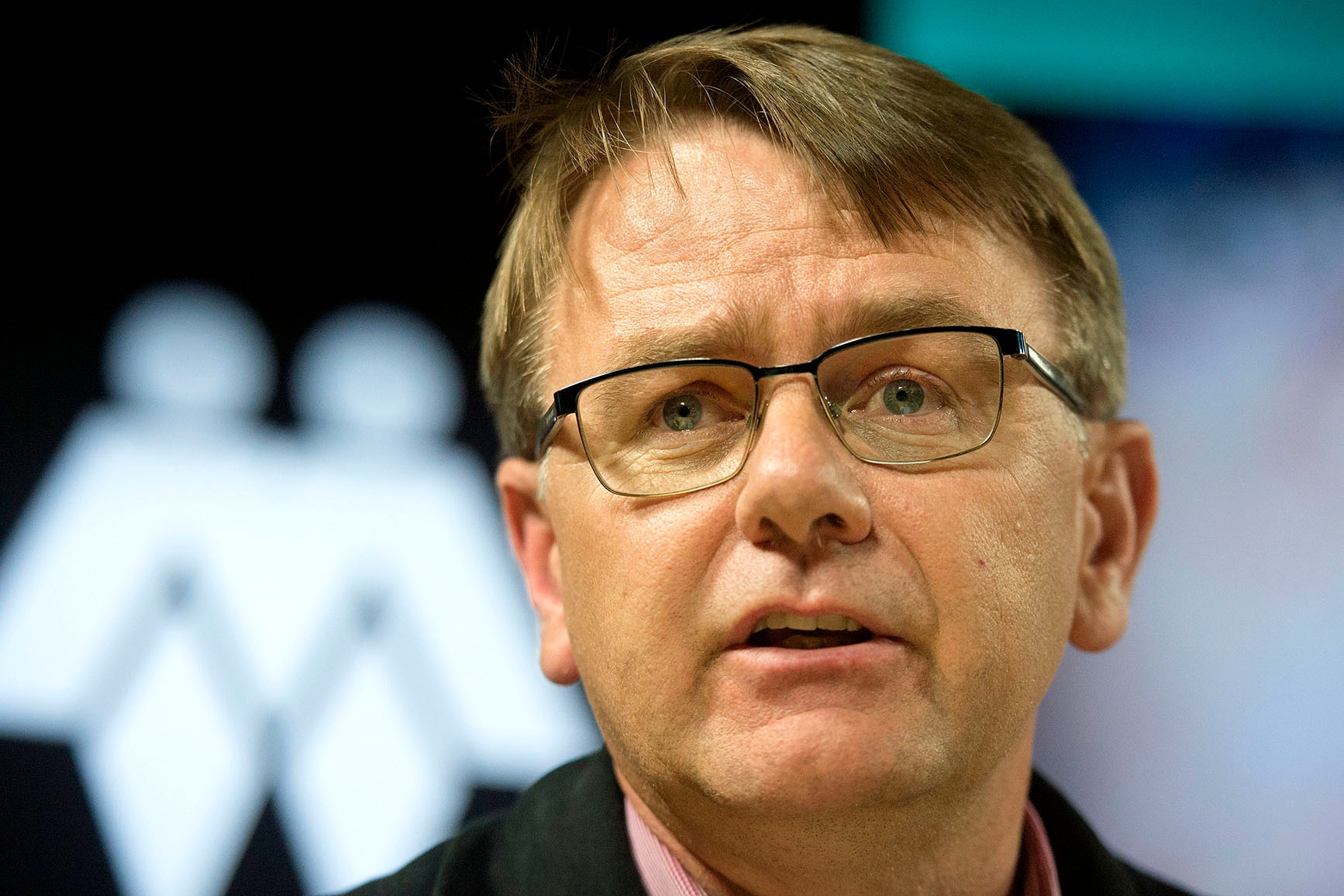
 Freedom Front Plus Tshwane mayoral candidate Willie Spies has returned to politics from the legal sector. (Photo: Gallo Images / Beeld / Deaan Vivier)
DA Tshwane mayoral candidate Cilliers Brink is taking a different approach after his turbulent 18-month stint as the City’s executive mayor. He ultimately lost his position through a motion of no confidence in October 2024.
Drawing on lessons from his previous tenure, he has pledged to prioritise clearer rules, stronger partnerships and principled coalition management to ensure stable governance and better service delivery.
/file/attachments/orphans/IMG_9017_402530.jpg "DA Tshwane mayoral candidate Cilliers Brink addresses the party’s 2026 Manifesto Launch at Mary Fitzgerald Square, Johannesburg, on 8 August 2026. (Photo: Reitumetse Pilane)")
Brink has promised to “finish what we [the DA] started” if given “five years and 50%” – an outright majority that would allow the party to govern without relying on coalition partners.
In Tshwane, however, South Africa’s second-largest party could struggle to secure an outright majority, particularly as its traditional support base faces competition from a surging Freedom Front Plus (FF+), which could split the vote.
The growth of the FF+ could strengthen the broader DA-led bloc if the two parties ultimately govern together, but every percentage point the FF+ takes from the DA also makes an outright DA majority harder to achieve.
FF+ Tshwane candidate
FF+ Tshwane mayoral candidate Willie Spies is making a political comeback after more than 15 years in legal practice.
Spies previously served as an FF+ MP from 2004 to 2009 before moving into law, where he became a prominent legal representative for AfriForum in several high-profile cases involving minority rights, language and place-name disputes.
He describes his return to politics as a response to another opening, arguing that coalition politics offers smaller parties more leverage than they had when South African politics was dominated by the ANC-DA binary. According to Spies, the decline in the ANC’s dominance has also created greater room for competing political views.
“There is more tolerance towards diverse political views,” said Spies, adding that he is less focused on winning outright power in Tshwane.
“For us, it’s not an issue of power politics. It’s policy politics. We would like to affect policy... we would like to see our principles being brought into policymaking.”

Numbers behind FF+ surge
In the 2021 local government elections, the FF+ more than quadrupled its vote share in Tshwane compared with 2016, rising from 1.99% to 7.87%. Its representation on the 214-seat council increased from four seats to 17. Meanwhile, the DA fell from 43.15% to 32.03%.
The party’s growth was part of a broader national trend. FF+ won 2.34% of the vote in the 2021 local government elections, up from 0.77% in 2016, making it the party’s strongest local election result since 1994. Its number of seats rose from 67 to 221.
The latest September Ipsos poll puts the DA at 31% in Tshwane, ahead of the ANC at 22%, ActionSA at 11% and the EFF at 9%. The remaining 18% is split among other parties, with the FF+ not reported separately in Ipsos’s Tshwane breakdown.
A separate poll by the Social Research Foundation (SRF) puts the DA at 43%, the ANC at 32%, the FF+ at 8%, ActionSA at 7%, and the EFF at 5%. By these numbers, the DA and FF+ would clear the 50% mark, making a DA-FF+ coalition viable and pushing ANC, EFF, ActionSA and MK to the opposition benches.
A News24/SABI poll released in October puts the DA in the lead with 32%, compared to the ANC’s 24%. The poll puts the EFF third with 14%, ActionSA at 11%, MKP at 6% and FF+ at 4%. This poll suggests that, even together, the DA and FF+ would fall short of the 50% mark needed for an outright majority.
A growing threat to the DA
FF+’s growth has increasingly put it in direct competition with the DA for voters in areas where the two parties have historically drawn support from similar constituencies.
Tshwane, Mangaung and parts of Ekurhuleni are among the metros with sizeable Afrikaans-speaking voting blocs where the DA faces what political analyst Wayne Sussman described as a “tremendous threat” from the FF+ specifically, rather than the Patriotic Alliance, which has taken support from the DA mainly among coloured voters in the Western Cape.
In January’s Ward 57 by-election in Centurion, the DA retained the seat, but saw its share fall to 54.2%, while the FF+ surged to 44.38%, up from 16.11% in the 2021 local government election. The FF+ won two of the ward’s three voting stations.
Sussman said the Centurion by-election result should have set off “alarm bells” in the DA, given Brink’s position as a prominent Afrikaans-speaking face of the party. The result suggested that even a candidate who might be expected to hold on to that constituency will not necessarily prevent support from shifting to the FF+.
The FF+ has historically built much of its support around the interests of minority communities, particularly Afrikaners, and has been a vocal opponent of policies such as affirmative action and Black Economic Empowerment.
/file/attachments/orphans/Tumi-ffplus-TshwaneMain_IMG_2682_227641.jpg "FF Plus Tshwane mayoral candidate, Willie Spies. (Photo: Reitumetse Pilane)")
Spies said the party’s opposition was rooted in what he described as a rejection of racial politics, arguing that policies introduced to address the legacy of apartheid had instead entrenched racial divisions.
“A minority elite, which was a minority white elite, has been replaced by a minority black elite. By replacing one elite with another, the experience of a person on the street doesn’t change,” he claimed
Spies acknowledged that the inequalities of the past had not been adequately addressed, but said he believed creating individual opportunities was more effective than state redistribution.
He said the party was increasingly attracting members and voters of colour. The party has also sought to expand its presence beyond its traditional Afrikaner base, including by engaging with other minority communities, who share its conservative approach to community issues and oppose the government’s current race-based policies.
In 2024, FF+ CEO Pieter de Necker said the party was deliberately trying to broaden its appeal beyond Afrikaans speakers and had worked with Venda, Tsonga and Khoisan communities.
Allies and rivals
Spies’ coalition ambitions centre on parties he believes share the FF+’s preference for a smaller state, deregulation and greater scope for private-sector and community involvement. He described the DA and FF+ as ideologically closer to each other than to other parties in Tshwane.
There are clear areas of overlap between the parties, particularly around reducing government constraints and creating greater scope for private sector involvement.
But Spies’ enthusiasm for a possible DA-FF+ alignment is tempered by what he described as his disappointment with the DA’s performance in the Government of National Unity.
Spies said he had initially been excited by the appointment of DA Communications and Digital Technologies Minister Solly Malatsi, expecting the party to push for deregulation and greater freedom in the communications sector (many had expected Malatsi to open the way for Elon Musk’s Starlink to enter the sector). Instead, he said, he was disappointed by what he regarded as moves towards greater regulation of the radio and online industries.
/file/attachments/orphans/ED_487897_914940.jpg "Solly Malatsi MP, DA spokesperson during the DA address to the media on the readiness for the second registration weekend at DA Head Office on February 03, 2024 in Cape Town, South Africa. (Photo: Misha Jordaan / Gallo Images)")
During the Ward 57 by-election campaign, the FF+ accused the DA of telling voters that an FF+ victory would effectively benefit the ANC, while the DA’s Helen Zille has repeatedly argued that voting for smaller parties splits the anti-ANC vote and indirectly hands the power back to them.
In August, the FF+ lost its former Tshwane caucus leader, Grandi Theunissen, who joined the DA after being removed from his leadership position following an internal investigation into a controversial Groenkloof property development vote. The DA welcomed Theunissen, with Brink describing the move as significant for the party and the city.
Spies downplayed the defection, saying it was insignificant compared with what he described as growing support for the FF+. But the move underlines the increasingly direct contest between the two parties for Tshwane voters.
“Unfortunately, there have been disappointments,” Spies said, adding that setbacks had not changed his view that there was scope for political alliances around shared policy priorities.
“I would like to see a coalition of parties that are connected to deregulating the economy, to liberalise the regulatory environment within which businesses, communities have to function, and that enables communities to be themselves and to get things done. And I believe in Tshwane that is quite possible.”
Coalition chaos
Tshwane has already provided a warning of what a fragmented result can produce. The City has had four mayors since 2021, while its current mayor, ActionSA’s Nasiphi Moya, leads an administration supported by the ANC and EFF. Moya took over after Brink’s removal in 2024.
/file/dailymaverick/wp-content/uploads/2024/10/ED_532606.jpg "City of Tshwane Mayor Nasiphi Moya. (Photo: Fani Mahuntsi / Gallo Images )")
The coalition has since been marked by political tensions that go further back. After the 2016 election, neither the DA nor ANC won an outright majority, and the DA-led government relied on smaller parties and informal support from the EFF. The arrangement became increasingly unstable, with four mayors in the five years before the 2021 election and the City eventually being placed under provincial administration in 2020.
The instability continued after the 2021 election, when the DA again failed to secure a majority. Randall Williams led a coalition but resigned as mayor in 2023. His successor, Brink, was removed the following year.
The current administration’s political disputes include a recent legal battle over the suspension of city manager Johann Mettler, with ActionSA and its coalition partners taking different positions on the matter.
Spies described the current Tshwane coalition as a “marriage of comfort” between what he called a corrupt ANC and an EFF he characterised as “eager for muscle”.
That instability is central to the DA and FF+ campaigns. Both parties can point to Tshwane’s recent political churn as an argument for a different governing arrangement.
Spies’ plan for Tshwane
Spies believes Tshwane needs a fundamentally different approach to some of its service delivery problems, with a greater scope for private and community-led initiatives.
He pointed to the growing use of rooftop solar and off-grid electricity systems as an example of residents effectively taking greater control of their own power supply.
“There’s always been huge resistance to privatisation, for instance. But in practice, people privatise their power supply,” he said, arguing that rooftop solar and off-grid systems already represent de facto privatisation of power supply. He believes the City should “encourage” rather than tax that trend.
/file/dailymaverick/wp-content/uploads/2023/05/fdrooiwaal3.jpg "The Rooiwal Waste Water Works. (Photo: Felix Dlangamandla)")
Spies also proposed a similar rethink of Tshwane’s water infrastructure, arguing that the City should reconsider continued investment in ageing facilities such as the Rooiwal Water Treatment Plant and explore alternatives including modular treatment systems.
The Auditor-General’s 2024/25 report found that 39.1% of Tshwane’s water was lost, citing factors including inaccurate metering, leaks, pipe bursts and water theft.
Spies blamed the broader collapse of the City’s water and electricity infrastructure on years of inadequate maintenance and alleged corruption in attempts to address it.
He also blamed the current Tshwane coalition for creating obstacles to development, arguing that excessive regulation discouraged entrepreneurship. Rather than targeting “black” informal economy workers over permits and other regulatory requirements, Spies said the City should “hammer the criminals” and “construction mafias” that undermine legitimate businesses and development.
He says that the FF+ would take a different approach to infrastructure and service delivery, including greater use of private and community-led initiatives. DM
Comments
Scroll down to load comments...