



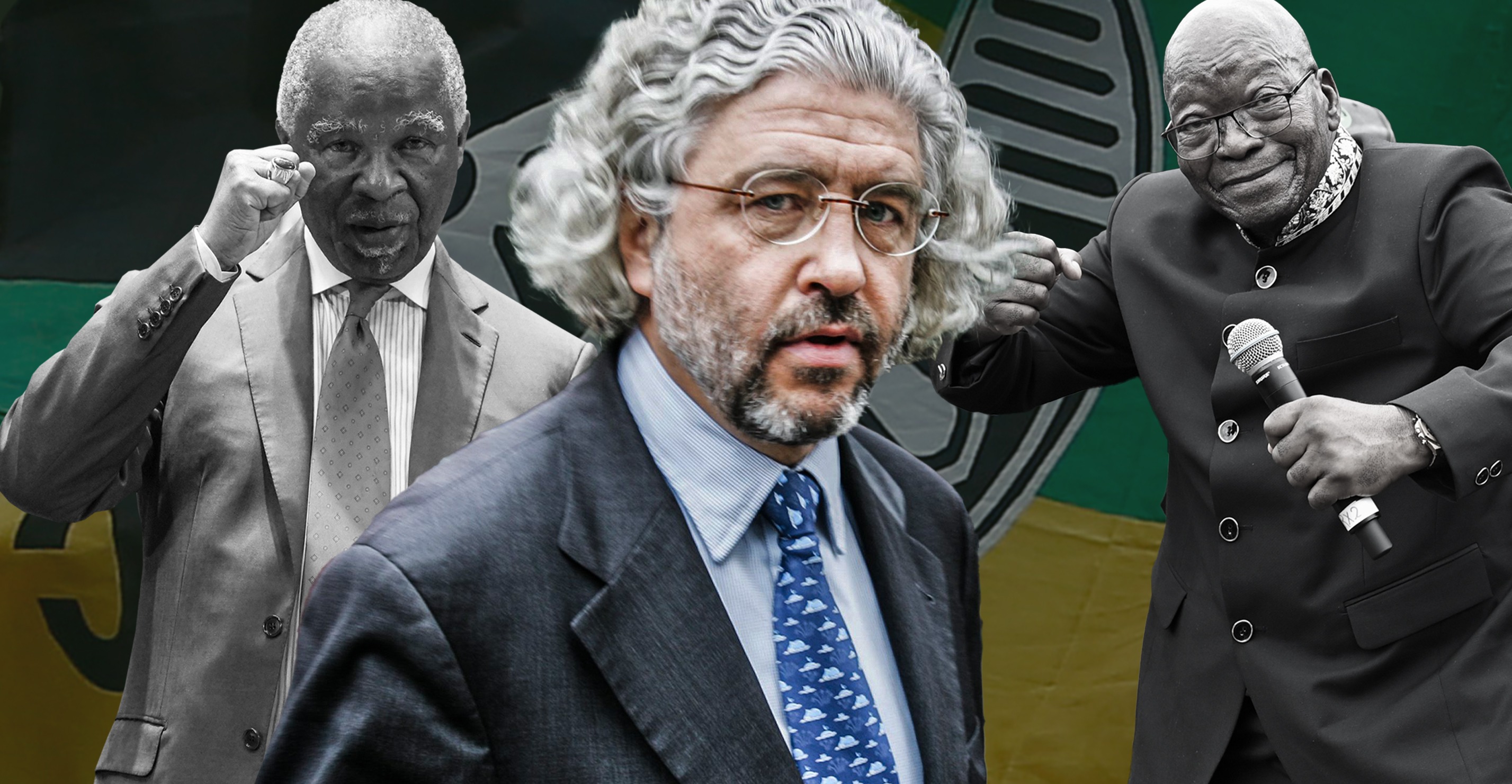
 Illustrative image / sources: Former president Thabo Mbeki (left). (Photo: Gallo Images / Darren Stewart) | Former president Jacob Zuma (right). (Photo: Gallo Images / Darren Stewart) | Jurgen Kögl outside the high court in Johannesburg, 17 November 2009 (right). (Photo: Gallo Images / Foto24 / Lauren Mulligan)
Seated across the dinner table sat former “enemies” – apartheid’s enforcers, the powerful generals alongside former president FW de Klerk and the top echelons of ANC leadership.
The men (for they were mostly men) gathered there many times to chew the fat about post-Truth and Reconciliation Commission (TRC) prosecutions for those who had committed human rights abuses and who had not been granted amnesty.
‘Nothing sinister’
Jürgen Kögl, who was identified later as the source of several payments to Jacob Zuma totalling around R1-million, told the Mail & Guardian that sponsoring politicians was all in a day’s work.
“There [is] nothing sinister about these relationships. What happens is that you provide support and find ways of making sure these guys are able to get on with negotiations or with governing the country,” he told Stefaans Brummer and Sam Sole.
Later, his home was raided by the Scorpions at the same time they pounced on Zuma’s house in August 2006.
Kögl has noted that one of the reasons the ANC government had reached out was to persuade the generals to “come clean” on “third-force” operations in KwaZulu-Natal and in particular to disclose the sites of arms caches that could be used in “future political violence”.
Back then, the generals had been keen on a “blanket amnesty” based on an admission of crimes committed, but without the need to make full disclosure.
This way they were hoping to leverage the fact that the TRC had not granted amnesty to 37 ANC leaders. And so, along with Kögl’s generosity and hospitality, both sides fashioned a spade with which they hoped to bury the past.
/file/dailymaverick/wp-content/uploads/2023/02/9E7A7740.jpg "Lindiwe-Sisulu")
Political fixer
The Khampepe Commission of Inquiry into delayed TRC prosecutions summoned Kögl to testify on his knowledge of the machinations of these backroom deliberations.
As a political fixer, Kögl counted many of South Africa’s politicians as close friends and provided Thabo Mbeki with a flat in Hillbrow when he returned from exile. He was later to act as an “adviser” to Lindiwe Sisulu, former Minister of Human Settlements, Water and Sanitation.
Kögl, after Namibian independence in 1989, founded a consulting firm with South African sociologist and politician Dr Frederik van Zyl Slabbert and labour affairs lawyer Charles Nupen. The firm aimed to provide “strategic and political analysis to companies operating or wishing to operate in southern Africa”.
Kögl noted to the commission that he “neither authored, generated, nor assumed ownership of the content arising from the stakeholders’ deliberations” and that he had “no knowledge of any efforts or attempts made to halt or interfere with the investigation or prosecution of TRC cases.
/file/attachments/orphans/GettyImages-91120664_669351.jpg "South Africa. Tuinhuiys. Nelson Mandela, Thabo Mbeki and FW de Klerk, May, 1994. (Photo: Media24 / Gallo Images / Getty Images)")
At the table
Shortly after the TRC had denied amnesty for the ANC 37, Mbeki had informed Parliament that the government was considering further amnesty proposals that had been put forward by the SADF generals, Khampepe evidence leaders noted in their communication with the businessman.
In the commission’s Rule 3.3 notice, it notes that the main aim of the get-togethers at Kögl’s home appeared to have been the need to reach agreement on a legislative solution for how to avoid prosecutions in the aftermath of the finalisation of the TRC process.
Those who attended these clandestine meetings were General Constand Viljoen, former chief of the SADF, who was initially approached to begin the dialogue with ANC leaders; General Jannie Geldenhuys, former chief of the SADF, who led the generals’ delegation; Major General Dirk Marais, former deputy chief of the Army and convenor of the SADF Contact Bureau; General Magnus Malan, former minister of defence, and General Kat Liebenberg, former chief of the Army.
/file/dailymaverick/wp-content/uploads/2024/05/3_173c23.jpg "Op-ed-Wilmot-34th Principle MAIN")
Other “Specialists/Generals”, depending on topics that were discussed, included General Niël Knobel (former Surgeon-General) and former Air Force chiefs and their legal advisers.
The ANC delegation included senior political leaders and members of the Cabinet’s “security cluster”.
Zuma was present, initially as deputy president and later as president; so too Mathews Phosa, former premier of Mpumalanga with Cabinet ministers Joe Modise (Defence), Sydney Mufamadi (Safety and Security), Dullah Omar (Justice), Penuell Maduna (Justice), Charles Nqakula (Safety and Security), Mosiuoa Lekota (Defence), Steve Tshwete (Safety & Security), Joe Nhlanhla and Ronnie Kasrils (Intelligence) and Brigitte Mabandla (Justice).
Legal advisers for the state and a Department of Justice legislative drafter presented proposed indemnity mechanisms to those present.
/file/attachments/orphans/000065674_445492.jpg "17 August 2007. South Africa. Pretoria. Former Police commissioner, Johan van der Merwe, at the hearing of former minister of Law and Order, Adriaan Vlok.
<br>(Photo:Deaan Vivier / Media 24 / Gallo Images)")
Central role
The commission noted that author Ole Bubenzer, in his book, Post-TRC Prosecutions in South Africa, wrote that former police commissioner and head of the Foundation for Equality Before the Law (FEL), Johan van der Merwe, had said De Klerk played “a central role, often consulting Mbeki directly or with other high-ranking members of the government”.
Zuma had approached Constand Viljoen with the aim of discussing questions of criminal accountability. Viljoen had referred Zuma, in turn, to Geldenhuys and the Contact Bureau.
These talks, noted the commission in the rule 3.3 notice, had been aimed at finding “a new indemnity mechanism” or “a backdoor amnesty”, as others have termed it. In 2019, investigative journalist Michael Schmidt, author of Death Flight, interviewed Major General Marais, former deputy chief of the Army and convenor of the Contact Group.
Schmidt wrote that, according to Marais, the generals were seeking a “quid pro quo”.
“They don’t want us to be charged – and they don’t want them to be charged,” Marais told Schmidt.
Enthusiastic agreement
Marais had also shown Schmidt an unsigned handwritten letter (which he photographed) that he had prepared for the signature of the former chief of the SADF in early 2004.
The letter was addressed to Deputy President Jacob Zuma, and it recalled the initiation of “a series of secret, high-level talks” between the government and former SADF generals.
This letter stated that “there was enthusiastic agreement that the commenced communication should be continued and that more meetings should follow”.
At the ANC’s 51st national conference in December 2002 in Stellenbosch, a discussion of guidelines for a broad national amnesty, possibly in the form of presidential pardons, was scheduled.
In February 2003, a delegation of SADF generals led by Geldenhuys met then Justice Minister Penuell Maduna and then Police Minister Charles Nqakula in Cape Town. A law drafter from the Department of Justice read out proposed legislation.
It was then that the rift occurred, when the alarmed generals pushed back, declaring that everyone who had wanted to make statements and ask for forgiveness had already confessed at the TRC.
“Our other people,” Schmidt quotes Marais as saying, “don’t have to do that, so this [the legislation] means nothing to us”.
Limited functions
Despite having had a ringside seat to history and offering hospitality and sustenance both liquid and solid, Kögl told the Khampepe Commission that his role was merely that of a facilitator.
“My functions were limited to arranging and providing forums for meetings and offering logistical and practical support during the stakeholders’ deliberations, involved principals and related partners”.
He said he had rendered this support voluntarily and in his private capacity, using his own material resources.
“I am not in a position to assist the commission in advancing the substantive aspects of its mandate as I possess no direct knowledge of, nor involvement in the content of the deliberations in question,” Kögl signed off. DM
Comments
Scroll down to load comments...