Testing the teeth of CT’s planning tribunal: Penalties, objections and refusals in 1,328 rulings
For more than three years, in the Blaauwberg district of Cape Town, ratepayers have been sounding the alarm on the proliferation of illegal and structurally unsafe buildings. In this second part of Daily Maverick’s analysis of all Municipal Planning Tribunal rulings from 1 July 2025 to 31 July 2026, we look at what the data say about the efficacy of administrative penalties. We also look at the numbers on objections, conflicts of interest and refusals.
Illustrative image: City of Cape Town Deputy Mayor Eddie Andrews. (Photo: Gallo Images / Die Burger / Jaco Marais) | Cape Town. (Photo: iStock)
Analysis
This article is an Analysis. It goes beyond the basic facts of a news story to provide deeper context, explanation and interpretation. While it may include the author's judgment and expertise, it aims to be more objective.
The first part of this series, titled “Zero deviations — the record of Cape Town’s planning tribunal in 1,328 rulings”, can be accessed here.
Penalties (or not so much) for proven malfeasance
On 6 May 2023, exactly one year before the notorious and fatal building collapse in the Western Cape town of George, dozens of Cape Town ratepayers gathered on Corsair Road in Sanddrift. Apart from the Sanddrift locals, there were also representatives that day from the surrounding suburbs – Brooklyn, Ysterplaat, Rugby, Milnerton, Phoenix, Summer Greens and Tijgerhof. The ratepayers, who had recently joined forces under the banner of the United Residents Association, represented the interests of about 40,000 Capetonians.
The reason for their choice of gathering place, as Daily Maverick would later confirm, was that although an administrative penalty of R150,000 had been levied against a resident of Corsair Road by the City of Cape Town’s Municipal Planning Tribunal (MPT), the resident was still operating – and profiting handsomely from – his illegal boarding house. Also, as far as the United Residents Association members could tell, the boarding house remained structurally unsound and in danger of collapse.
It was, for these activist ratepayers, a case that embodied a disturbing new trend. For them, there was a direct line between the proliferation of illegal boarding houses on their streets and the fact that crime was up, public order was down and their properties were losing value.
They were initially grateful, therefore, that their protest action had been treated with all due seriousness by the City of Cape Town’s most senior officials. On the day, the mayoral committee member for the spatial planning and environment directorate, Deputy Mayor Eddie Andrews, had come out to Sanddrift to receive their memorandum of concerns.
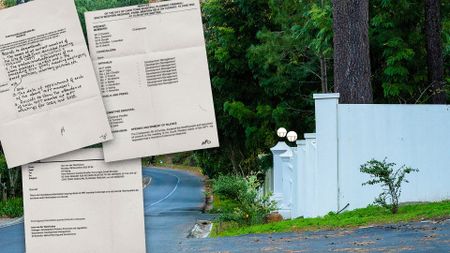
Garron Gsell reads a list of demands as Deputy Mayor Eddie Andrews listens on 6 May 2023. (Photo: Supplied / Source)
“To provide you with a substantive indication of the extent of [the] impact,” the memorandum stated on its opening page, “attached hereto please find a list comprising over 160 properties compiled across these suburbs.”
On the second page, after referring to the “intensity and frequency” of municipal by-law infringements in their district, the United Residents Association members requested “the implementation of increasing penalties for deviations [from] approved plans with further consideration for harsher consequences for repeat offenders”.
In other words, the protest action, at its core, was about the fact that the enforcement mechanisms employed by the City of Cape Town were not achieving the intended results. Whether it was due to the “perceived complacency and inefficiency” of City officials or perhaps something more sinister (the memorandum referred to United Residents Association members that had been subjected to “intimidation” and “death threats”), there was, according to the protesters, an unexplained reluctance to impose demolition orders “in instances of deliberate proven malfeasance”.
And so it was right here, in terms of Daily Maverick’s analysis of the 1,328 rulings issued by the Cape Town Municipal Planning Tribunal between 1 July 2025 and 31 July 2026, that our benchmark was located.
As readers of our investigative “Clean Break” series may recall, our third and final piece – titled, “Phantoms and forgeries: The cover-ups of Cape Town’s planning officers” – focused on the work of two leading members of the United Residents Association, Bouwe van der Eems and Garron Gsell. It was Gsell, we reported, who had taken charge of the United Residents Association’s relations with the City of Cape Town’s “task team”, which had been set up by Andrews in direct response to the protest action of May 2023.
The United Residents Association leaders, we noted, would meet in relatively good faith with the task team in July, September and November of 2023, but by the fourth meeting – held on 11 April 2024 – their patience had run out.
A presentation compiled and delivered by Gsell at that latter meeting would allege, in 70 detailed slides, that the task team was a smokescreen for inefficiency at best and corruption at worst.
In the first few slides, while Gsell acknowledged that the City’s densification policy was a theoretically “reasonable” response to the population growth from the influx of new residents, he contended that the rights of existing residents continued to be sidelined. In slide 23, referring to the United Residents Association’s suspicion that the City was capitalising on its own inefficiencies through the Municipal Planning Tribunal, he asked whether there was a line item in the budget for administrative penalties and, if so, whether there was a target to be met. Although he had no evidence to back up this allegation, he was working on an assumption that was by now common among United Residents Association members – a low, repeatable, easily absorbed penalty was cheaper for a violator than actual compliance, so rather than the hassle of enforcing harsher consequences, the City could generate recurring revenue from recurring noncompliance.
Slide 23 of United Residents Association presentation to City of Cape Town officials, 11 April 2024. (Source: Garron Gsell / URA)
Finally, in the last few slides, Gsell referenced a comprehensive online survey that had recently been published by Corruption Watch and The Conversation, in which 43% of South African urban planners “indicated that colleagues, superiors or senior officials had a personal interest in planning activities they oversaw, at least on occasion”. The survey had been conducted by the African Centre for Cities at the University of Cape Town.
For the rest of 2024 and well into 2025, as Gsell told Daily Maverick, the number of illegal properties on the United Residents Association’s list continued to grow. Throughout this time, in interactions with Democratic Alliance MPs and senior staffers of the spatial planning and environment directorate, he repeated his allegation that the City, given its lack of effective enforcement, was “monetising [its] inefficiencies” through the Municipal Planning Tribunal.
In late August 2026, on behalf of the 40,000 residents that comprised the United Residents Association, Gsell updated Daily Maverick on the current situation. Across the broader Blaauwberg district, we asked, had the enforcement of administrative penalties led so far to a noticeable drop in illegal building activity?
“Not at all,” Gsell insisted. “Eddie [Andrews] told us he was amending the Municipal Planning By-Law so that there would be harsher penalties, but clearly it’s not working.”
Statutory maximums and unanswered questions
For his part, in his response to our right-of-reply questions on the “Clean Break” investigative series sent in May 2026, Andrews had already clarified his position on this point.
“Where allegations about Municipal Planning Tribunal dysfunction or enforcement failures were brought to my office, they were referred to the relevant administrative structures for consideration,” he informed Daily Maverick.
“The City does not accept the characterisation of the MPT as dysfunctional. The MPT is a statutory decision-making body that determines matters based on the law, the Municipal Planning By-Law, applicable policy, the evidence before it and relevant planning considerations.”
Three months later, responding to Daily Maverick’s follow-up questions regarding our analysis of the Municipal Planning Tribunal’s rulings between 1 July 2025 and 31 July 2026, the deputy mayor was equally emphatic.
Our first question on administrative penalties (the sixth question on the 11-question list) was a simple matter of caseload composition, to which we expected no pushback. After repeat stress-testing, our analysis had shown that 966 of the 1,328 decisions in our sample (72.5%) were administrative penalty determinations relating to already-built unlawful work, rather than prospective planning decisions. We wanted to know whether the City agreed with that characterisation.
“In the last financial year (1 July 2025 to 31 July 2026),” Andrews informed us, “approximately 54% of all applications that served before the Municipal Planning Tribunal were for administrative penalties, and 46% were for planning decisions.”
There was no reference to how the City had arrived at such a divergent percentage, neither were there any numbers offered in its support. Still, it was in the next question that the more important discrepancy lay.
Of the 966 penalty decisions we reviewed, Daily Maverick found that only nine cases recorded an explicit statutory maximum penalty alongside the penalty actually recommended. In each of those nine cases, we discovered, the penalty imposed fell far short of the statutory maximum, ranging from roughly 1.0% to 9.8% of the applicable cap. Further, across all 943 cases where a penalty amount was stated, the average penalty was R28,153, with a total of approximately R26.5-million collected across the full dataset.
By our reading, this was where the United Residents Association’s allegations about the City “monetising their inefficiencies” through the Municipal Planning Tribunal appeared to earn a measure of statistical support. Our question on the data was therefore split into two parts.
First, since the penalties in our sample consistently fell well short of the statutory maximum, did the City agree that this pattern lent support to the allegation that the Municipal Planning Tribunal’s penalty function operated more as a revenue-collection mechanism than as a deterrent? And second, did the City consider an average administrative penalty of R28,153 sufficient to deter unlawful construction, given the potential financial upside to building without approval?
Andrews responded with one answer to both parts.
“Devoid from context and case specific facts in each instance (such as contravention scale and gravity),” he stated, “especially given the range of applications tabled at the MPT, the average stated in your question is not helpful and/or a logical measure to consider or apply.”
He then quoted section 129(8) of the Municipal Planning By-law, which “requires that when determining an appropriate penalty” there should be five criteria taken into consideration.
For starters, Andrews cited “the nature, duration, gravity and extent of the contravention”; second, “the conduct of the person involved in the contravention”; third, “whether the unlawful conduct was stopped”; fourth, “whether a person involved in the contravention has previously contravened this by-law or a previous planning law”; and finally, “any matter relevant to redressing the contravention”.
Indeed, in section 129(8) of the Municipal Planning By-law, this was precisely what it stated. But what Andrews did not acknowledge was that these same criteria were invoked by the Municipal Planning Tribunal in several of the nine cases cited above in order to justify the partial movement towards the maximum – to be specific, among the words and phrases employed by the tribunal were “wilful”, “negligent” and “previously contravened”.
By our reading, then, whether he was aware of the phrasing or not, Andrews was invoking the statutory test that the Municipal Planning Tribunal’s own language said was already met in order to explain why the tribunal still imposed penalties at only 1.0% to 9.8% of the cap.
For Daily Maverick, it was an answer that fit the pattern we had encountered through the three parts of our “Clean Break” series and in Part 1 of this current “Rubber-Stamped” series, where the City of Cape Town dispensed with our questions by offering a structurally unfalsifiable response. Here again, our queries about the effectiveness of the Municipal Planning Tribunal’s administrative penalties were left fundamentally unresolved.
Nothing to see, please move along
Our following two questions – numbered eight and nine in the 11-question list – sought clarity on how the City of Cape Town dealt with public objections across the 50 meeting minutes that comprised our dataset.
“Only 63 of the 1,328 decisions we reviewed (4.7%) reference objections anywhere in the panel’s recorded decision text,” we stated, “despite our identifying cases in the addenda to these same minutes where hundreds of formal objections were lodged. Can the City explain why the volume of public objection is not reflected in the decision record itself?”
As he had done in part 1 of this series, Andrews alleged that Daily Maverick was conducting itself in a misleading and insincere manner.
“Where the MPT decides an application (whether approval or refusal), this is only done after due consideration of the full report including any public objections and/or comments received and attached to the report,” he stated.
“Anyone attending an MPT meeting, or listening to a recording of one, would be able to clearly attest how objections are, as a matter of course, carefully considered and weighed up against the merits of an application by MPT members in their deliberation and decision-making.”
For Andrews, there was “no need or requirement to repeat or reference objections in the minuted decision” – and therefore, he scolded us, to “imply that the absence of such a reference… is problematic or somehow evidence of inadequate consideration of same would be disingenuous.”
In bold font, the deputy mayor then stated the following: “It appears from the content of your question that you only considered the final decisions of the MPT and not the full record.”
Again, Daily Maverick was clear from the start that we were working strictly from the publicly available meeting minutes, which was why, although our data could not infer that the Municipal Planning Tribunal had overlooked hundreds of objections, it could infer that hundreds of objections did not make into the record of the tribunal’s rulings.
Our ninth question approached the same issue from a different angle.
“What is the City’s process,” we asked, “for ensuring that the substance of public objections – as opposed to merely their existence – is addressed in the MPT’s written reasons for a decision?”
Here, Andrews responded with two words: “As above.”
Likewise, our final pair of questions brought us no closer to the procedural clarity that we hoped would elucidate the City of Cape Town’s publicly available record of Municipal Planning Tribunal decisions.
Our tenth and penultimate question had to do with declarations of conflict of interest by MPT members, which numbered only 11 from the full dataset of 1,328 rulings. Broken down by district, these comprised eight declarations from the Cape Town MPT’s southeastern panel and three from its northwestern panel, with none recorded on either the northeastern or southwestern panels – the two highest-volume panels in our data. Could the City explain this disparity?
“There is no logic to suggest case volume must necessarily correlate with conflicts of interest, and an attempt to imply such relation or describe the absence thereof as a ‘disparity’ is irrational,” Andrews responded.
“No conflict of interests [sic] was declared for these samples. If you have evidence that point to the contrary, you are encouraged to submit this to the City’s Ombudsman for investigation.”
Andrews was of course correct that case volume did not necessarily correlate with conflicts of interest, and Daily Maverick was happy to concede the point. But in part 2 of our “Clean Break” series, we reported that the City of Cape Town kept no records of the employment histories or commercial affiliations of its active Municipal Planning Tribunal members, according to a City official. To us, this suggested that there was no baseline against which to measure potential conflicts.
As we noted in that earlier piece, the City’s technical advisor to the MPT, Jaco van der Westhuizen, had challenged a concerned resident to provide proof of any conflicts when these anomalies initially arose – a challenge that Andrews had now repeated in his response to us.
And so, just as Andrews had done in part 1 of the “Rubber-Stamped” series, he answered our final question by repeating the allegation that Daily Maverick suffered from a “sheer misunderstanding” of the MPT’s processes.
Fittingly, or so we thought, this last question had to do with the fact that the Municipal Planning Tribunal did not always approve land-use applications – on the (very) odd occasion, and almost always when it was following the recommendations of City staffers, the tribunal would refuse a submission regarding land use.
“Of the 1,328 decisions reviewed,” we stated, “we identified 34 refusals, all of them land use applications. More specifically, of these refusals, 25 were recorded as following the recommendations in the planner’s report, with the text in the remaining nine ambiguous/non-definitive about whether the planner’s report was followed. What does the City consider this refusal rate to indicate about the rigour of the MPT’s review process for land use applications specifically?”
Andrews’s response: “See the answers to questions no. 1 and 2.”
As Daily Maverick readers will recall, our opening queries focused on the fact that our dataset recorded zero explicit deviations from the planners’ reports, which – when taken in the context of the national legislation under which all MPTs across the country had been set up – rang a number of alarm bells about the situation in the Cape Town municipality.
In the answers that he referenced above, Andrews had insisted time and again that the Cape Town Municipal Planning Tribunal acted “independently” of his directorate, but he had not referred to any hard evidence to counter Daily Maverick’s analysis of the rulings. DM
For the deputy mayor’s full answers to Daily Maverick’s right of reply questions across parts 1 and 2, please read here.




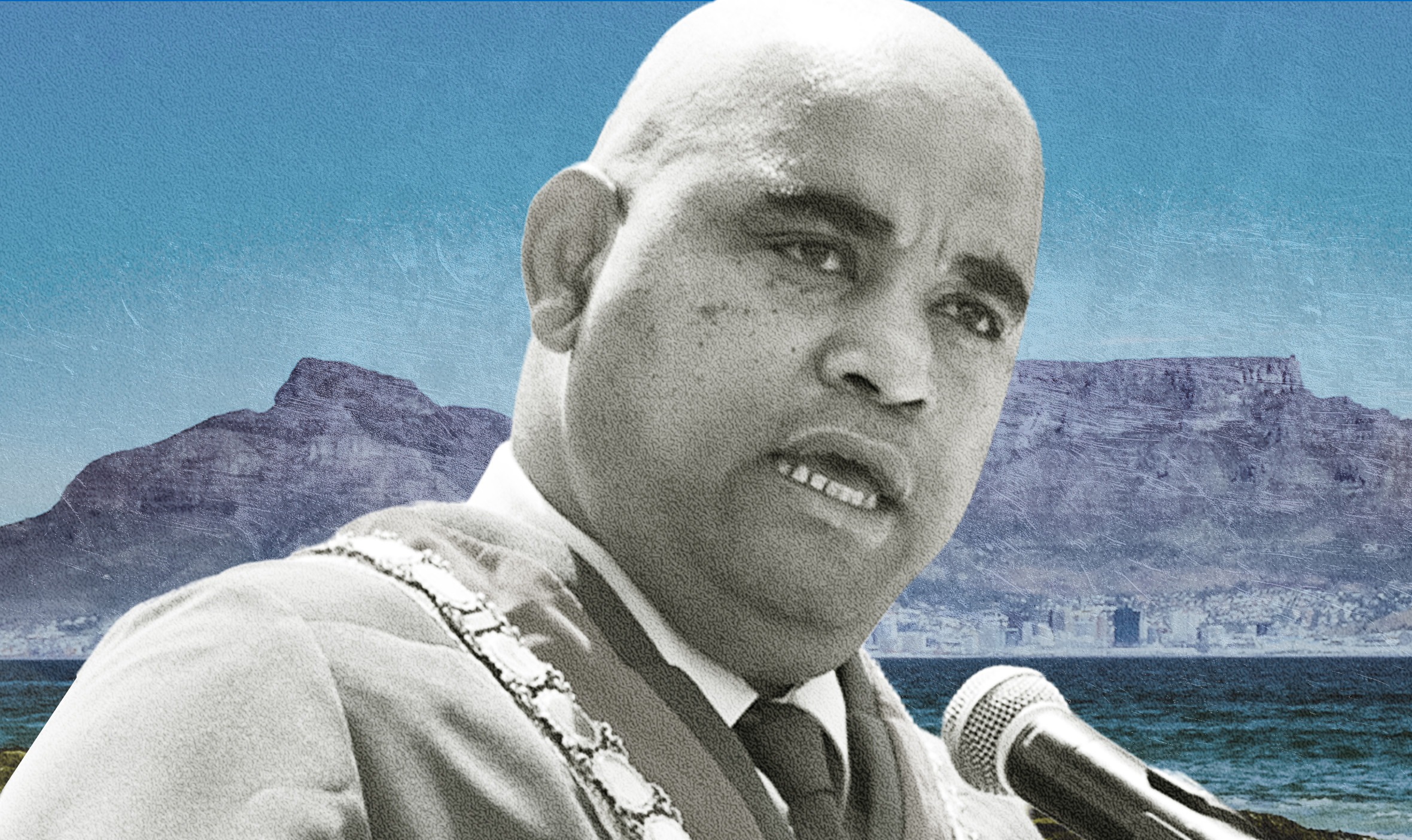 Illustrative image: City of Cape Town Deputy Mayor Eddie Andrews. (Photo: Gallo Images / Die Burger / Jaco Marais) | Cape Town. (Photo: iStock)
/file/attachments/orphans/Bloom-PlanningTribunal4_458939.jpg "Garron Gsell reads a list of demands as Deputy Mayor Eddie Andrews listens on 6 May 2023 (Photo: Supplied / Source)")
/file/attachments/orphans/Bloom-PlanningTribunal2_409046.jpg "Slide 23 of URA presentation to City of Cape Town officials, 11 April 2024. (Source: Garron Gsell / URA)")
/file/attachments/2998/Screenshot2026-09-23at142428_209519.png)
/file/attachments/orphans/Bloom-PlanningTribunal1_416731.jpg "Panel comparison. (Sourec: Claude by Anthropic)")
Comments
Scroll down to load comments...