




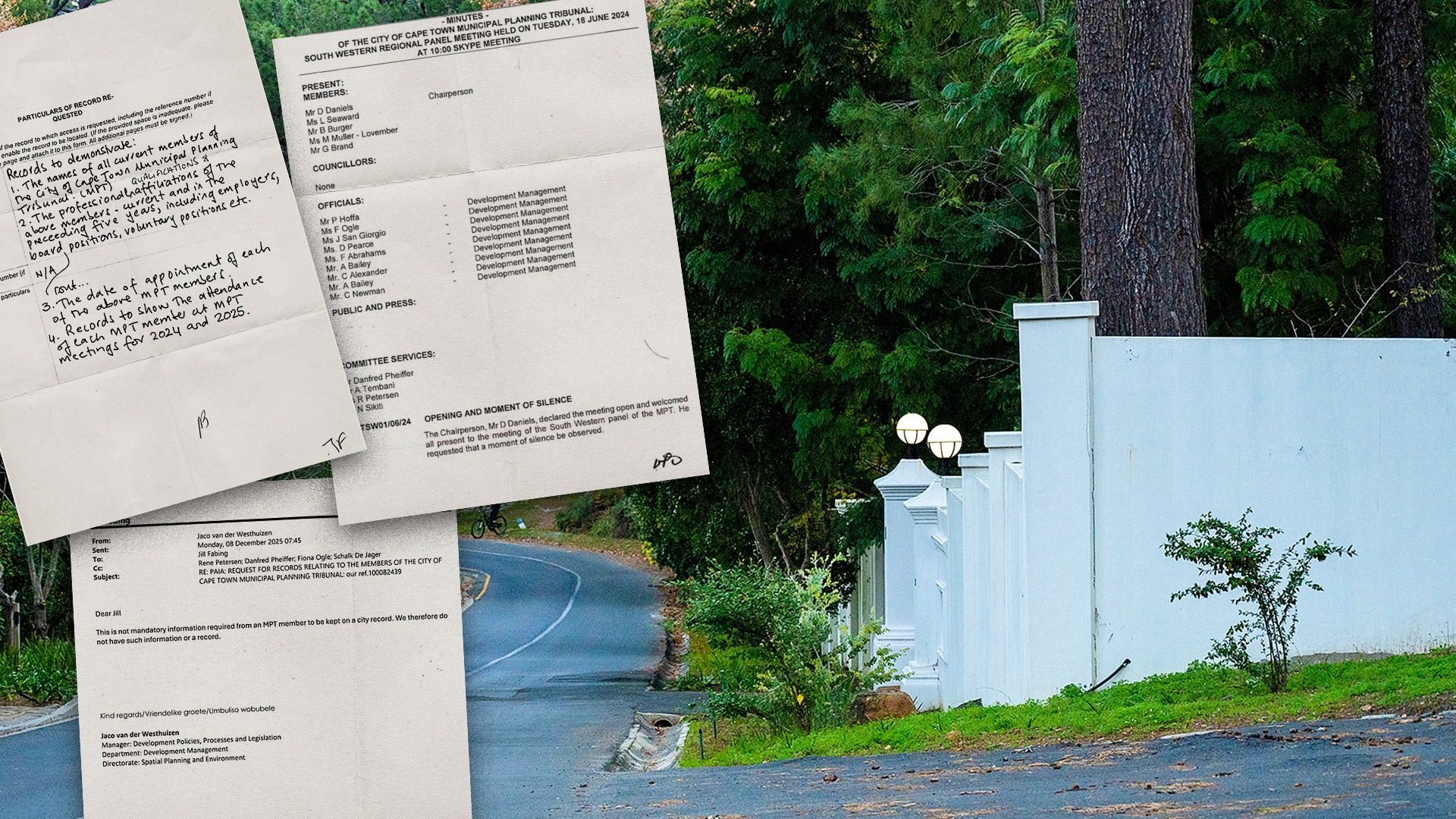
 Belle Ombre, 19 Monterey Drive, Constantia, on 21 May 2026. (Photo: David Harrison) (Documents: Supplied by sources)
To catch up on Part 1 of this series, “Members for life – the capture of Cape Town’s planning tribunal,” click here.
Theatre of unrecorded baselines
On Monday 8 December 2025, at around 7.45am, an email landed in the inbox of Jill Fabing, the deputy information officer for the municipality of the City of Cape Town.
“Dear Jill,” the email began, “This is not mandatory information required from [a municipal planning tribunal] member to be kept on a city record. We therefore do not have such information or a record.”
The sender was Jaco van der Westhuizen, manager of development policies, processes and legislation in the development management department of the City of Cape Town’s spatial planning and environment directorate. Wrapped up in his lengthy title, as Fabing was well aware, lay Van der Westhuizen’s role as administrator and record-keeper of the aforesaid municipal planning tribunal (MPT), the highly influential yet somewhat obscure body that decides on all category 1 land use applications — rezonings, subdivisions, permanent departures and removals of restrictive title deed conditions, to name the most common examples of the type.
It wasn’t her place to comment on such things, but Fabing may also have been aware that in Cape Town’s booming property market, where a change in status could more than quadruple the value of a registered plot, Van der Westhuizen – just like the MPT members whose records he kept – had lately been presiding over an ever-increasing store of decision-making heft.
Whatever her views, three days later, on 11 December 2025, Fabing appended Van der Westhuizen’s email to an affidavit that she was obligated to depose. As it turned out, a senior member of the Constantia Ratepayers and Residents Association — a source known to Daily Maverick who wished to remain anonymous – had issued a formal request under the Promotion of Access to Information Act (PAIA).
What the Constantia ratepayer sought to obtain, in the form of official documents from Van der Westhuizen’s archives, was fourfold: first, “the names of all current members of the City of Cape Town MPT”; second, “the professional qualifications and affiliations of the above members – current and in the preceding five years, including employers, board positions, voluntary positions, etc.,”; third, “the date of appointment of each of the above MPT members”; and fourth, “records to show the attendance of each MPT member at MPT meetings for 2024 and 2025.”
Fabing, in keeping with the precepts of PAIA, granted the ratepayer’s request for the first item, the third item and parts of item four. In respect of the second item, she advised the ratepayer in writing that the City of Cape Town “does not have such information on their records” – and then she referred him to the affidavit in which Van der Westhuizen’s email was marked as “Appendix B”.
/file/attachments/orphans/pic_542020_246919.jpg "Documents supplied by Sources")
By the evidence of the paper trail alone, it was clear that the ratepayer would remain haunted by Fabing’s response for the following three-and-a-half months – because, on 29 March 2026, he would send an email directly to Van der Westhuizen himself.
“If the City does not require information on the qualifications and professional affiliations of members of the City’s municipal planning tribunal,” he asked, “how does the City ensure that members are (a) competent to sit on the tribunal and (b) do not have professional conflicts of interest which could influence their decisions?”
Van der Westhuizen got back to the ratepayer early the next morning.
In the opening paragraph of his reply, he stated that “the MPT consists of 23 members, [eight] external experienced planning professionals and the remainder internal senior… planning officials.” According to Van der Westhuizen, the “knowledge and experience levels of each of these members in the field of land use management” was “indisputable”. As outlined in Part 1 of this series, he then stated (somewhat problematically) that “most of them” had served “more than 10 years” as MPT members.
Van der Westhuizen’s closing remark to the first half of the ratepayer’s query was an outright challenge: “If you believe that [any of them] do not qualify to serve as a member of the MPT, kindly provide me with the necessary evidence and I will investigate.”
As for the second half of his reply, Van der Westhuizen was equally insistent.
“It is mandatory that each member that serves on a regional MPT panel must sign a form that they have no interest or conflict in any matter that serves before the MPT on that day of the meeting,” he wrote. “If a member is conflicted he/she must then recuse himself/herself from the report.”
Still, Van der Westhuizen’s insistence did not change the patent facts – first, the City of Cape Town could not (or would not) provide even the most elementary information to verify the competence of the people who were deciding on land use applications worth multiple billions of rands per year; second, to an interested and affected party like the Constantia ratepayer, declarations against an unrecorded baseline were bound to be viewed less as declarations than as performative theatre.
Case of the missing legal opinion
“This is the same slide I had in my previous presentation,” said Tracey Davies, “so I won’t bore you with all of it, but I will reiterate that a legal opinion is just that, it is not a court judgment. It is absolutely inexplicable that residents and ratepayers, who have paid for that legal opinion, are being denied access to it when it is being used to infringe our rights.”
The date was 14 April 2026, and Daily Maverick had been invited by Davies to attend a set of back-to-back online MPT hearings for subdivision applications in Constantia. A former human rights and environmental lawyer who had served for more than eight years as the executive director of Just Share – arguably South Africa’s most effective shareholder activism non-profit – Davies had recently been moonlighting as a front-line objector for the Constantia Ratepayers and Residents Association.
In the opening minutes of her presentation, before touching on the thread that ran through this second part of Daily Maverick’s investigative series – the missing legal opinion, by our reading, confirmed the tribunal’s proclivity for withholding critical information from residents – Davies had told the MPT members exactly what she had told us in numerous interviews.
To start with, as Davies saw it, the City of Cape Town was no longer interested in applying the law as set out in its so-called development management scheme (DMS) for the Constantia overlay zone. The protected character of the upmarket suburb – large erven, expansive gardens, thick tree canopies and dwellings set far apart – was, in her estimation, being sold out to unscrupulous developers. As a Constantia resident with a history of social engagement, she wanted Daily Maverick to know that this had implications that extended far beyond the frustrations of privileged Capetonians like herself.
/file/attachments/orphans/1AugustasWayConstantiaDH0117copy_817478.jpg "1 Augusta's Way, Constantia, on 21 May 2026. (Photo: David Harrison)")
It was “settled law” in South Africa, Davies informed us, that restrictive title deed conditions were linked to the property rights enshrined in section 25 of the Constitution. Here, she was referring to a precedent-setting case heard by the Supreme Court of Appeal in 2011, where it was ruled that these conditions were “inserted for the public benefit” to “preserve the essential character of a township”. Quoting directly from the judgment, Davies explained that “if landowners across the length and breadth of South Africa” were to be told that their rights “could be removed at the whim of a repository power” they would “rightly be in a state of shock”.
And so, when it came to the MPT hearings on 14 April, Daily Maverick was familiar with the arguments. As we knew, despite her years as an activist lawyer on the national stage, which had included numerous high-profile victories, Davies had not once prevailed against the MPT in around a dozen hearings as an objector.
For her, the City’s “densification” policy – the catch-all phrase by which the DA-led municipal council referred to the project of redressing spatial inequities and accommodating the influx of new residents – did not, in any way, justify the MPT’s consistent (and unanimous) decisions in favour of development in Constantia.
“Once again, we have a corporate purchaser,” Davies had stated in the first few minutes of her second presentation on 14 April. “This is not a Constantia landowner who wants to add a house for his children or for his mother or any of the things that the DMS envisaged. This is a registered property company buying a large erf in Constantia with the express purpose of carving it up for high-end development, which will clearly not contribute to the City’s purported aims of addressing spatial injustice, socio-economic divisions or the housing crisis.”
Cluster developments in Constantia?
In other words, if actual densification was mostly about easier access to services, facilities and jobs for lower- and middle-income Capetonians, then, as Davies saw it, new cluster developments in Constantia (selling for upwards of R10-million per unit) could hardly be counted as a solution.
Still, at both the online hearings that Daily Maverick attended – the first for a property on Augusta’s Way and the second for a property on Monterey Drive – the policy was referred to as the overriding rationale for the granting of the subdivision applications. And, by our reckoning, if this was the why behind the MPT’s decisions, the how was even more questionable.
/file/attachments/orphans/19MontereyDdriveBelleOmbreDH8889copy_129018.jpg "Belle Ombre, 19 Monterey Drive, Constantia, on 21 May 2026. (Photo: David Harrison)")
“I reiterate again,” said Davies, referring to the abovementioned legal opinion, “this is a serious infringement and a breach of our rights under PAJA.”
So what, exactly, was the legal opinion about and why was Davies, given her decades of experience as a lawyer, so insistent that the Promotion of Administrative Justice Act had been breached?
The full answer to this question took Daily Maverick back to February 2025, when Fiona Ogle, a legal advisor to the City of Cape Town with a particular focus on the Spatial Planning and Land Use Management Act of 2013 (Spluma), had first relied on the opinion of an unnamed senior counsel to make a submission before the MPT. Davies, who was present at the hearing – and who was just beginning to learn that her objections to subdivision applications in Constantia, however well argued, were failing dismally – sent an email request for a copy of the opinion that same day.
Danfred Pheiffer, an administrative officer for the MPT based in the Cape Town Civic Centre (and therefore either a colleague or subordinate of Van der Westhuizen) responded almost instantly, promising Davies that Ogle’s submission would “form part of the minutes.” Davies, of course, replied that she was after the opinion itself, not a summary of Ogle’s presentation. For the next week, Davies and Pheiffer went around in circles, with even the former’s requests for Ogle’s contact details left unacknowledged.
Fast forward to April 2026, when the same senior counsel opinion – still unseen by the ratepayers who had footed the bill for it – was used by the MPT to legally justify its position on the subdivision applications for the properties on Augusta’s Way and Monterey Drive. At the bottom of both the City of Cape Town’s documented approvals, the minutes of Ogle’s submission from back in February 2025 were attached – in the former as “Annexure L” and in the latter as “Annexure O”.
“The City of Cape Town did not adopt its Municipal Planning By-Law in terms of Spluma,” Ogle had stated in the minutes, “it did so in terms of its original powers conferred by the Constitution.”
Although the minutes ran on for five pages, it was fundamentally for this reason, according to Ogle, that the City of Cape Town and its MPT were empowered to override any national legislation (like Spluma) that protected a municipality’s overlay zones.
“The approach is [that] the MPT continue,” Ogle had concluded her submission, with an apparent shift in her attention to Davies herself, “you have a right to appeal and you have the right to take the matter on review if you don’t agree. A court will determine who is right and who is wrong in this matter.”
Judge, jury and executioner
As far as Daily Maverick was concerned, this reference to the Constitution as a higher authority than Spluma was an exact mirror of what the City of Cape Town had told us in its right-of-reply response to our first article in this series – essentially, as its spokesperson had relayed to us in that instance, the City had the right to remove the term limits for MPT members (and effectively reappoint them for life) because, in the view of its legal advisors, the precepts of Spluma were a “constitutional overreach”.
Also, like the Constantia Ratepayers and Residents Association, Daily Maverick was denied access to both the original opinion behind the “overreach” argument as well as to the identities of the people responsible for its formulation.
Such information, we were told, was “legally privileged”.
But, as our reporting showed, there were strong indications that Ogle may have been among the names that were protected. In late June 2015, around a week before the MPTs began to operate nationwide, Ogle gave an official City of Cape Town training presentation on the Municipal Planning By-Law that governed the local tribunal, with a particular focus on its relationship to Spluma. A little more than two years later, in September 2017, she gave another presentation, to the City of Cape Town’s Transport and Urban Development Authority, in which the “enforcement” of Spluma was the lead item.
Then there was the linking piece of evidence, from the PAIA application of the Constantia ratepayer who wished to remain anonymous (as above). The fourth item of the application, to recap, was “records to show the attendance of each MPT member at MPT meetings for 2024 and 2025.” As it so happened, when Daily Maverick went through those records (which referred, to be technically specific, to the MPT’s south-western district, which covers Constantia), we found the name “F Ogle” listed as an attendee from “development management” at every one of the meetings.
/file/attachments/orphans/WhatsAppImage2026-06-09at121958_558484.jpeg "Documents supplied by Sources")
The questions, from our perspective, were obvious.
If Ogle was one of the City’s leading authorities on Spluma, as the history of her presentations demonstrated, what was her role in the sudden downgrade of this national statute in the amended Municipal Planning By-Law of 2025?
The above, like the follow-on question, was put directly to Ogle: “The combination of designing the by-law under which the MPT operates (if that was indeed an aspect of your role), attending every meeting of the MPT as its legal advisor, and appearing at hearings to defend the legal validity of that by-law when objectors challenge it raises a question about whether the legal advice the tribunal receives is structurally independent. What is your response to that characterisation of the institutional arrangement?”
As in the first part of the series, Daily Maverick did not receive any responses from the City of Cape Town officials to whom we sent our questions. Instead, the centralised response from the City’s spokesperson, Tyhalibongo, noted only (and at some length) that “district managers who serve on the MPT do not consider items from their district” – which dealt with, and conclusively squashed, another conflict-of-interest angle we had been pursuing.
In other words, Tyhalibongo, aside from bypassing the independence questions sent to Ogle, declined to address the lack of official employment records for members of the MPT, the basis for the MPT’s apparent policy of development-above-all-else, or the reason for hiding the legal opinion for which Cape Town’s ratepayers had paid.
Clearly, as Davies intimated, there was a case to be made under PAJA. But if the lack of fair administrative action was one thing, the City of Cape Town’s spatial planning cover-ups (to be reported on in Part 3 of this series) were another thing entirely. DM
Comments
Scroll down to load comments...