



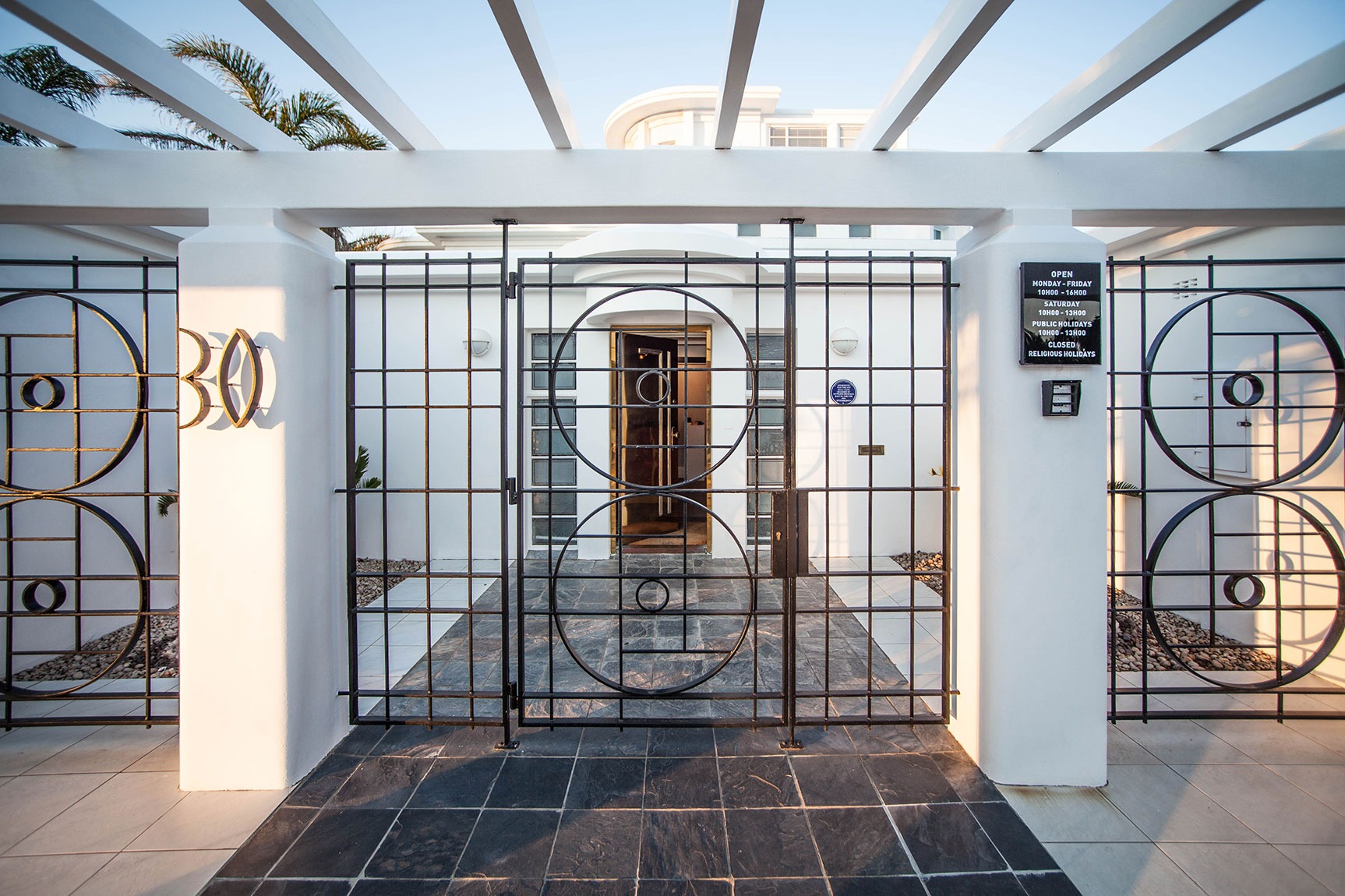
 The gates and fencing around the GFI Gallery were a unique design trait of Gertruida Brinkman, South Africa’s first female architect. (Photo : Supplied / GFI)
Last month, Daily Maverick invited readers to attend a tour of an historic luxury home in one of the oldest parts of Nelson Mandela Bay.
House Stockelbach, also known as Ridgewood, currently operates as an art gallery and has become a lasting example of modern architecture in Gqeberha. But research into this iconic home soon led down a rabbit hole that quickly revealed a strong link between this building and several other prominent structures in the city, and the country.
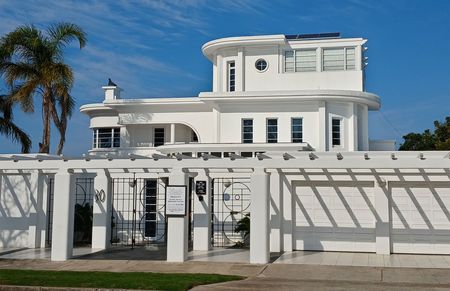
The thread tied Ridgewood to the Ford Motor Company, two state hospitals and several beachfront apartment buildings in Gqeberha, and even the Union Buildings in Pretoria.
All of these buildings have one thing in common – they were designed by four generations of the same family, including one of the most recognised names in South African architecture, Gertruida Brinkman.
/file/attachments/orphans/Riaan-BrinkmanLegacy1_951569.jpg "Getruida Brinkman, nee Siemerink, was the first woman to qualify as an architect in South Africa and her legacy lives on through her family and the myriad of buildings she designed across Nelson Mandela Bay. (Photo: Supplied / Bryan Brinkman)")
That same family is still actively involved in the architecture industry, and have set themselves apart from their competitors by specialising in hospital and healthcare design – a seed planted by their predecessors.
“To this day I am not even sure how many buildings the family has had a hand in designing or building. I often get queries from people who picked up on some of my grandmother’s signature design elements, and it would be a building I’d never even heard of,” chuckled Bryan Brinkman, Gertruida’s grandson and fourth-generation architect.
Family history
The family’s involvement in the South African built environment dates back to the early 1900s, when Hendrick Siemerink left the Netherlands and came to South Africa (SA), taking up the position of district engineer of the Transvaal Department of Public Works. Through this role he played an instrumental part in the construction of the Union Buildings in Pretoria in 1913.
Two years later he was transferred and became the district engineer for Gqeberha (then Port Elizabeth), before resigning and starting an architecture firm.
In 1906, his daughter Gertruida was born and raised in Gqeberha, before following in her father’s footsteps and attending the University of Witwatersrand, where she became the first South African woman to qualify as an architect.
She married fellow architect and engineer Jack Brinkman, and the couple joined forces with Siemerink, forming the firm Siemerink and Brinkman in the 1930s.
During that same period, Siemerink was commissioned to design the original factory when the Ford Motor Company wanted to set up shop in Gqeberha. The building, now occupied by multiple different companies, still stands on the corner of York and Stockelbach streets, named after the first managing director of Ford Motor Company SA, Axel Stockelbach.
/file/attachments/orphans/Riaan-BrinkmanLegacy4_405594.jpg "On the corner of Stockelbach and York, sits the original home of the Ford Motor Company in Nelson Mandela Bay. The firm Siemerink & Brinkman designed the original factory in North End, Gqeberha, which also secured them more design contracts across the city. (Photo: Riaan Marais)")
Impressed with their work, Stockelbach commissioned the firm to design his private home in Park Drive, and Gertruida took the lead on the project that became Ridgewood.
The property changed hands twice over the decades, and was ultimately acquired by the Gutsche Family and converted into the GFI Gallery. It focuses on showcasing artworks predominantly by Nelson Mandela Bay and Eastern Cape artists.
/file/attachments/2995/GFI-1_149708_909298.jpg)
The firm added unique touches to their designs, like an artist would place a signature at the bottom of a painting. These included ornate patterns woven into perimeter fences or balustrades along staircases, as well as rounded walls and windows.
/file/attachments/orphans/Riaan-BrinkmanLegacy5_987830.jpg "The family were involved in the design of several apartment buildings in the beachfront suburb of Summerstrand, including the landmark building Harrodene, which overlooks the beach from Fourth Avenue. (Photo: Riaan Marais)")
Much of these design elements were inspired by Gertruida and Jack’s visit abroad in the months leading up to the Second World War – a particularly volatile time to be visiting Europe. But the trip proved invaluable and helped set their designs apart from other local firms.
Segway into hospitals
The couple’s son Bruce also joined the family business, becoming the third generation in the field of architecture. In later years he took a particular interest in the family’s work in the healthcare sector.
The company had been involved in designing extensions at Port Elizabeth Provincial Hospital, and in the 1950s designed the first structures that made up the Livingstone Hospital complex. This became somewhat of a family legacy project as Bruce and his son Bryan – who later formed the firm b4 Architects – were involved in the design of Livingstone Hospital’s state-of-the-art emergency care unit, which was constructed in preparation for the 2010 Fifa World Cup, hosted in SA.
/file/attachments/orphans/Riaan-BrinkmanLegacy2_487851.jpg "The original block of the state-run Livingstone Hospital on Stanford Road in Gqeberha. Completed in the 1950's, this hospital was one of the projects that planted the seed for the family business to continue pursuing healthcare facility design. (Photo: Supplied / Bryan Brinkman)")

Business today
As the fourth generation of his family in the field of architecture, Bryan said he never consciously set out to follow in the family’s footsteps.
“As kids, we used to visit friends of my parents and grandparents that lived in houses they designed. But we were kids, so we didn’t even know, and it meant very little to us back then.
“It is only now that I am older and I’m doing more research into my family history that I have developed an appreciation for the work they’ve done over the last 100 years.”
/file/attachments/orphans/Riaan-BrinkmanLegacy3_142352.jpg "The North End Public Library in Gqeberha, designed by the firm Siemerink & Brinkman, is another example of the family's legacy dotted throughout Nelson Mandela Bay. (Photo: Riaan Marais)")
When he finds the time, Bryan sometimes delves into the archives to find out more about his grandparents and great-grandfather’s work, occasionally finding new projects that he never knew were tied to their family.
“People sometimes phone me when they see one of the special fence designs my grandmother was famous for, and ask if I know the history of that building, then I have no clue. I always ask for the address so that I can visit to find out more, and that list keeps getting longer and longer,” said Bryan.
/file/attachments/orphans/Riaan-BrinkmanLegacy_588789.jpg "Fourth generation: Bryan Brinkman is a practicing architect and director at b4 Architects, a firm that specialises in designing healthcare facilities. (Photo: Supplied / SAIA EC)")
But by focusing on the healthcare sector, setting themselves apart from their competitors in this niche design field, Bryan believes he continues building on the family legacy.
“It was never really a conscious decision, but it is a field I have always been fascinated by. My father built on that part of the business that my grandparents started, and I was fortunate enough to work with him on some of those projects.
“Our firm has become one of the go-to places for this type of design, and many young architects come through our doors, work with us for a period, and go off to spread the knowledge they acquired here. I like to think that forms part of the Siemerink & Brinkman family legacy.”
Asked about the family’s future in architecture, Bryan jokingly indicated that despite his best efforts, his daughter has shown an interest in the family business.
“I would never discourage anyone from pursuing the field of architecture, but they need to realise that it comes with many challenges and has become increasingly tough in recent years.
“It is not for everyone, but we have managed to carve out a niche for ourselves, and I hope to continue building on the legacy,” he said. DM
Comments
Scroll down to load comments...