




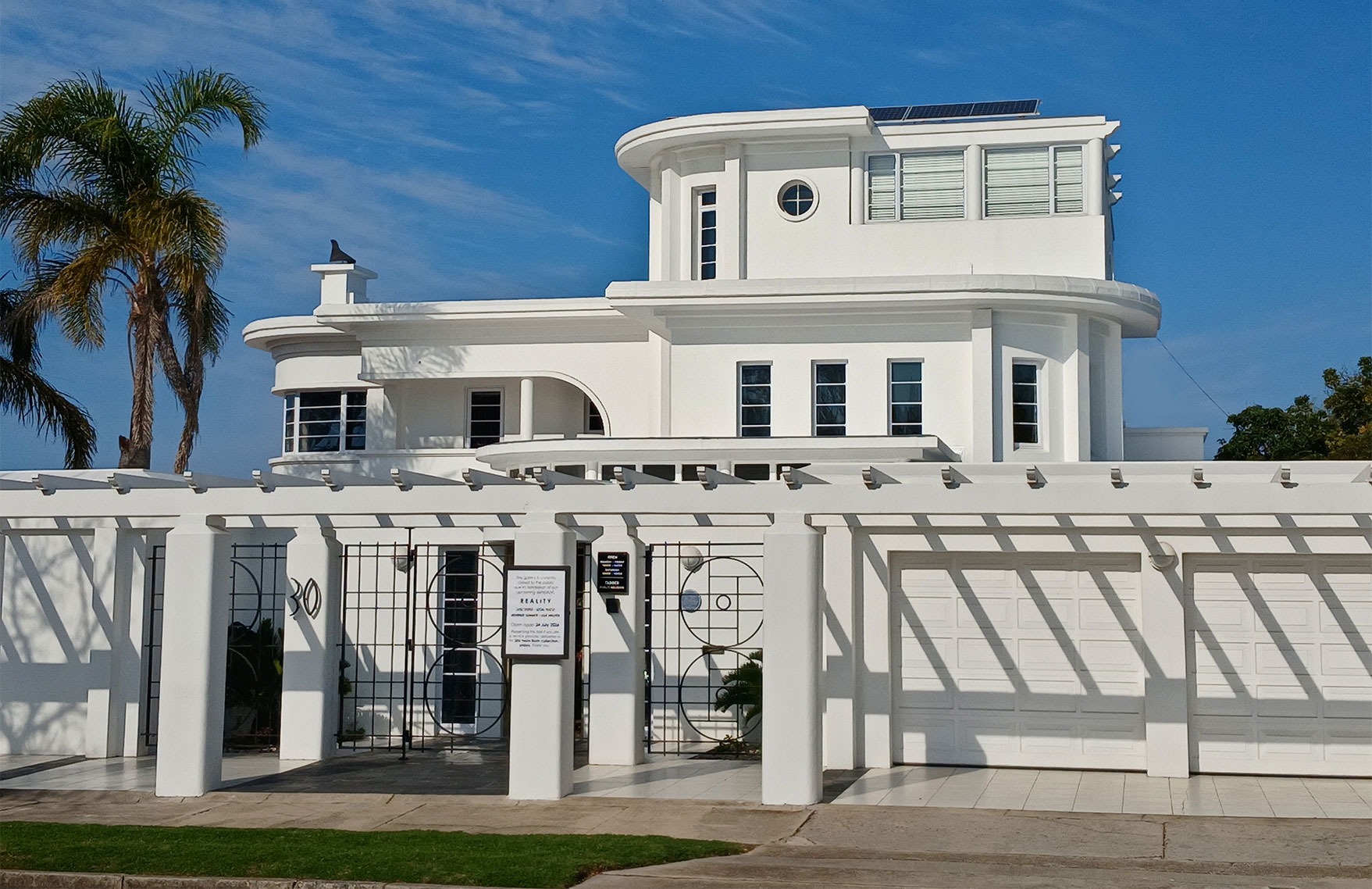
 With a rich history of art and architecture, the GFI Gallery in Park Drive, Gqeberha has cemented itself as a Nelson Mandela Bay landmark. Originally named Ridgewood due to its proximity to the woods around the Baakens Valley, it is a fine example of the Art Deco design style, popular in the 1930s. (Photo: Riaan Marais)
St George’s Park is one of Nelson Mandela Bay’s most historically significant locations, not only in its own right, but due to some of the interesting and unique sites surrounding it.
Caught between the southern edge of the park and the Settlers Park Nature Reserve, stands a property steeped in history, telling tales of the city’s wealthy business personalities, artists from past and present, as well as the country’s first woman to qualify as an architect.
While many know it by its modern name, the GFI Gallery stretches back nine decades, and while it is a shining example of 1930s Art Deco design, it is still making waves in the current art world.
/file/attachments/orphans/GFI-4_536696.jpg "Since its construction, Ridgewood changed hands several times. In 1988, it was purchased by prominent Nelson Mandela Bay businessman Philipp Gutsche, who ultimately converted it into an art gallery in 2000. (Photo: Supplied / GFI)<br>")
However, the story of its design comes with a twist and a look back to Pretoria in 1906 and the birth of Getruida Brinkman (née Siemerink).
Her father, Hendrick, was the district engineer for the Transvaal Department of Public Works during the construction of the Union Buildings. In 1914, he was transferred to Gqeberha (then Port Elizabeth) and relocated with his wife, Adrianne, and their three children, of whom Getruida was the youngest.
She attended Collegiate Girls School and grew up in their family home at 34 Park Drive, only a stone’s throw from the site that would ultimately house her iconic design.
After completing her studies in architecture at the University of Witwatersrand, becoming the first South African woman to hold this qualification, she joined her father’s architecture firm and was appointed to design House Stockelbach, the home of Ford Motor Company South Africa’s first managing director, Axel Stockelbach.
The house, officially dubbed Ridgewood, became a significant example of Early Modern architecture, incorporating many traits of the Art Deco design style.
/file/attachments/orphans/GFI-7_963622.jpg "Gertuida Brinkman (nee Siemerink), South Africa's first woman architect, designed the original Ridgewood in the 1930s. (Photo: Supplied / Bryan Brinkman)")
It stood out among the manor homes surrounding St George’s Park, featuring curved walls and window frames, roof terraces and uninterrupted views of the adjacent nature reserve. Inside, the Art Deco style was perpetuated with copper ship-style balustrades flanking the staircase to the upper levels.
The balustrade design, as well as the iron gates and fences surrounding the property, features a unique circular pattern that Brinkman incorporated into many of her designs, like an artist’s signature, over the years.
/file/attachments/orphans/GFI-3_224098.jpg "The gates and fencing around the GFI Gallery were a unique design trait of Gertruida Brinkman. (Photo: Supplied / GFI)<br>")
After her passing, her son Bruce became a prominent architect in Nelson Mandela Bay, and her grandson Bryan, director of B4 Architects, continues the family legacy.
In 1962, the property was renamed House Karstaedt, after it was bought by Abe Karstaedt, who enclosed sections of the upper terraces with additional steel window frames.
/file/attachments/orphans/GFI-2_204493.jpg "The Valley Room overlooks the Baakens Valley, a natural landmark that runs through Gqeberha. (Photo : Riaan Marais)")
In 1988, prominent Gqeberha businessman Philipp Gutsche acquired the property and appointed local architects Londt, Knight, Fieggen and Moors to incorporate the existing design style while making further alterations and additions to the structure.
In 1999, a section of the house was converted into an art gallery where Gutsche Family Investments (GFI) put its prized collection of Ron Belling’s famous military and aviation oil paintings on display. To this day, a section of the house’s upper floor is dedicated to a permanent Ron Belling art exhibit.
/file/attachments/orphans/GFI-6_344555.jpg "After purchasing the property, Philipp Gutsche made several alterations and extensions before converting it into an art museum. (Photo: Supplied / GFI)")
The top floor consists of little more than a single office and an extensive terrace from where Gutsche oversaw operations of the family’s business ventures. GFI Gallery manager Anna Stewart has now moved into the space.
Meanwhile, the lower ground floor serves as an art gallery dedicated to temporary exhibitions, predominantly featuring artists from Nelson Mandela Bay and surrounds.
Currently on display is a group exhibition titled REALITY, and features various mediums from artists Llise Dodd, Leon Hugo, Wehrner Lemmer and Lisa Walker. DM
Comments
Scroll down to load comments...