




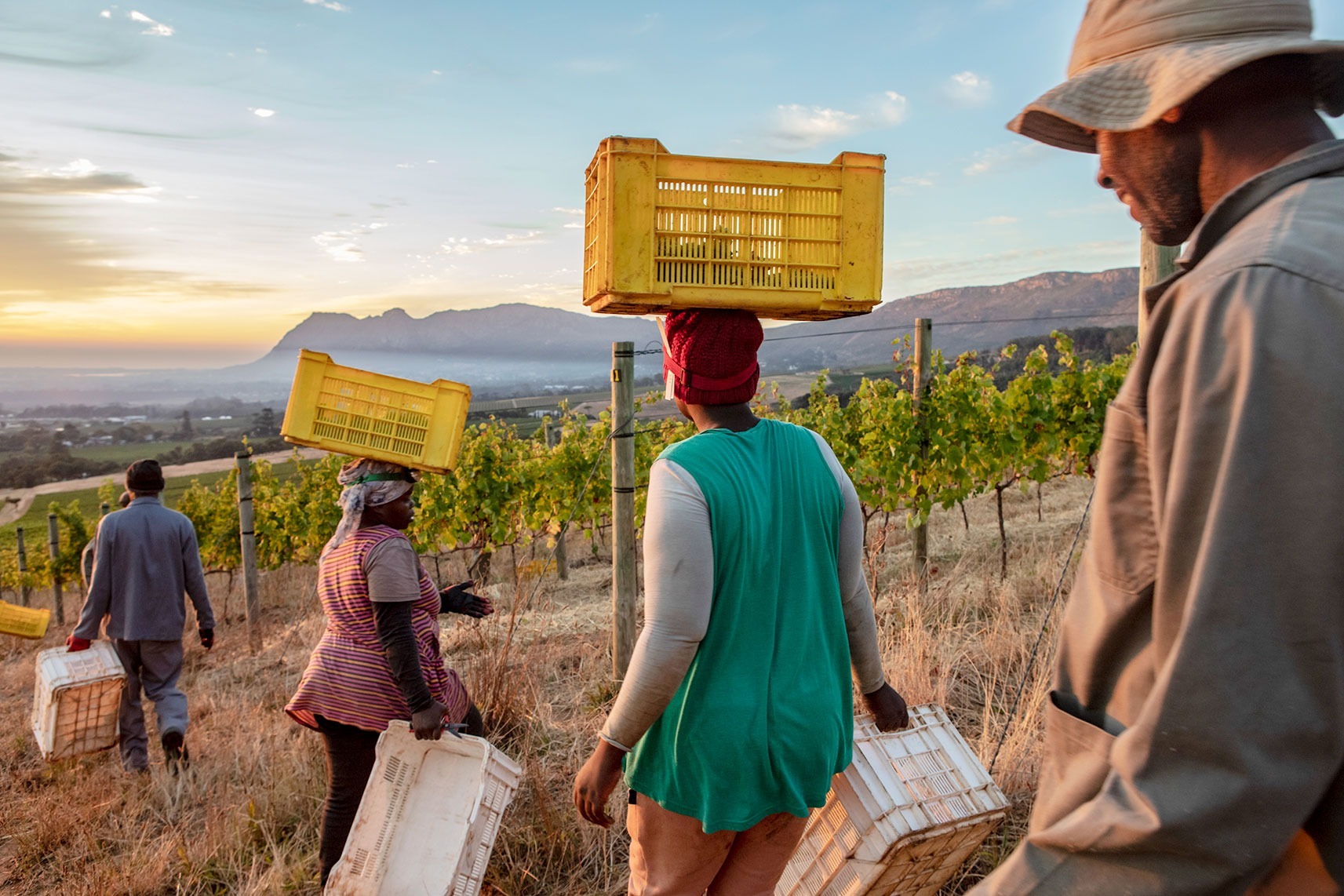
 Farm labourers head into a vineyard at sunrise to harvest Sauvignon Blanc grapes on the historic Klein Constantia Wine Estate in January 2024 on the upper slopes of the Constantiaberg Mountains near Cape Town in South Africa's Western Province. (Photo: David Silverman / Getty Images)
This is the third in a six-part series. Read Part One here and Part Two here.
Johan Simons still looks at vineyards like a farmer, although he’s relieved not to be one any more.
In the late 1990s he and his wife Diana pooled with friends to buy a farm in the Paardeberg near Malmesbury. As a trained molecular biologist, Johan understood organisms at the level of cells, yeasts and genes. The farm taught him about hail, weeds, fire, debt and the stubborn refusal of nature to follow a business plan.
Would he do it again?
“Yeah, I probably would,” he says. Then he adds the lesson learned too late: “But I’d employ a marketer early on.”
This is not a small admission. Johan believes that perhaps only 10% of South African wine farms are genuinely profitable. A vineyard may be beautiful, its wine excellent and its tasting room full on a Saturday, while the underlying agricultural business steadily eats money.
“It takes 15 years to develop a brand,” he says. “Continuous investment, and you’re not going to get [a return]. There’s only a handful of wineries that charge enough that they can make money.”
The numbers are brutal. Vines take roughly four years to produce a useful crop and perhaps seven before they yield grapes capable of making the wine a producer really wants. Meanwhile, the farmer is paying for planting, pruning, labour, equipment, bottles, barrels, diesel, chemicals and marketing.
Johan estimates that maintaining a vineyard now costs about R70,000 a hectare. Industry figures are in the same neighbourhood: Vinpro’s 2024 cost guide put the break-even income required in Stellenbosch at about R80,000 a hectare, while average grape income in that district was considerably lower.
“So how are you going to make money out of that?” Johan asks.
Often, you don’t. You add cottages, weddings, a restaurant, olive oil, mountain-bike trails and a tasting room. Or you sell the farm for housing. Or somebody who made a fortune elsewhere buys it.
/file/attachments/orphans/3BWwine2_921205.jpg "Wine maker Julia Blaine sorts through Syrah wine grapes at the Bacco Estate Winery on February 3, 2024 near Paarl in the Western Cape Province of South Africa. The Cape's wineries are facing a challenging harvest amid extreme summer temperatures reaching into the mid-40 degrees C and threats of wildfires fueled by the hot temperatures and strong winds. (Photo: David Silverman / Getty Images)")
Johan remembers the old joke about Fritz Maytag, the American appliance heir who owned a vineyard. Asked how to become a millionaire in wine, Maytag supposedly replied: Begin as a multimillionaire in another business.
“I think that’s still the case,” Johan says. “In America it’s all the tech guys, all the dotcom guys. They went into wine in a big way.”
The Western Cape version involves fortunes made in mining, finance, technology and industry. Wine gives capital something that shares and factories cannot: land, history, a cellar, a vanity project, a mountain and one’s own name on a bottle.
This money can preserve farms and support ambitious winemaking. But it also reveals something odd about the industry. Wine presents itself as agriculture while increasingly depending on wealth generated far beyond agriculture.
Around Johan, he says, many estates were “millionaires or rich people funding things, more or less successfully”. His own farm was eventually bought by Swiss investors.
It was not, however, simply a vanity project. Of its 318 hectares, Johan and his partners placed about 270 into a nature reserve protected in perpetuity. It’s the achievement of which he is most proud.
The decision also reduced the farm’s commercial value. Land that cannot be planted or developed cannot be made to earn in the usual way. But for Johan, the protected mountain was the point: the farm remained “an extraordinarily beautiful place and extraordinarily rich in flora and fauna”.
The vineyards themselves were another matter.
Making a vineyard
To establish vines on the acidic granite-derived soils found across much of the Cape Winelands, a farmer first has to remake the ground.
“You plough to as close to 1.5 metres as you can get,” Johan says. On his farm, they added about 50 tonnes of lime per hectare, raising the soil from a pH of roughly 4.7 to just above five.
“You’ve got to change the soil chemistry. You have to.”
That makes the ground suitable for vines, but unsuitable for fynbos, which evolved in acidic, nutrient-poor soil. Once land has been deeply ploughed, limed and planted as a monoculture, Johan doubts that its original ecology can return.
“I think the seed banks have gone,” he says. “Wine farming can never be truly ecological. Essentially it’s a monoculture. You have all the problems of a monoculture. You can do the best you can to mitigate it.”
When Johan arrived, the vineyard soil was almost white and apparently lifeless.
“There was not a single earthworm to be found.”
/file/attachments/orphans/3BWwine3_991147.jpg "Winemaker Matthew Day rolls a barrel from the cellar through the winery at the historic Klein Constantia Wine Estate on February 1, 2024 near Cape Town in South Africa's Western Province. The country celebrates this week the 365th anniversary of winemaking in the region, documented by Jan van Riebeeck, the Commander of the Cape Colony, in his diary entry of February 2, 1659 which reads: “Today, praise be to God, wine was made for the first time from Cape grapes”. (Photo: David Silverman / Getty Images)")
Previous farmers had removed the vine prunings instead of allowing them to rot back into the ground. Johan’s team spread compost, straw bales and organic matter. Slowly, worms returned.
“It probably took us five, six, seven years before we managed to re-establish it,” he remembers. “After that it was fine. It was healthy.”
His vineyard was farmed without irrigation, synthetic pesticides or herbicides. Chicken manure was applied in alternate rows and weeds were removed by hand.
Which part was hardest?
“The weeds,” he says immediately. “That’s an ongoing issue. If you’re not going to spray herbicides, then you have to deal with weeds and grass. That’s the biggest expense.”
Hand-weeding could cost many times more than spraying. Johan puts the choice plainly: “It’s cheaper to use poison than people. Always.”
What is sprayed and what reaches the glass?
His operation was organic, but not “chemical free”. No serious farmer can honestly make that claim. Vines are vulnerable to fungal diseases, and Johan’s team hand-sprayed small quantities of sulphur and copper from September until mid-December.
Hand spraying was slow: three workers needed about two-and-a-half days to cover 15 hectares. But they aimed directly at the vines instead of sending a cloud from a tractor-mounted machine across the rows.
“We only sprayed the plant itself,” he says. “It’s more efficient.”
Conventional vineyards may use a wider range of contact and systemic fungicides. Some residues can remain on grapes and enter must or wine, although fermentation, settling, filtration and other winemaking processes may reduce different compounds by very different amounts.
A 2024 scientific review concluded that pesticide residues can survive winemaking in some circumstances and can also interfere with yeasts and wine quality. However, Johan is careful not to claim that conventional wine is full of poison.
“I don’t know how you would know that,” he says when asked what reaches the bottle.
His concern is the possibility of residual fungicides and pesticides on the fruit – and the large volumes sprayed into the wider environment.
The sulphur added in the cellar is different from sulphur dust used on vines. When Johan’s grapes were crushed, he added about 50 grams per tonne of sulphur dioxide to inhibit bacteria long enough for the naturally occurring yeasts to begin working.
“There’s up to 200 different yeasts coming in with the grapes,” he says. “They have to get a chance to grow first before they get knocked down by bacteria.”
After that, fermentation was allowed to happen. Whites fermented and were pressed, reds remained on their skins longer then went into barrels for a year.
/file/attachments/orphans/3BWwine1_289668.jpg "An aerial view of the historic Klein Constantia Wine Estate's vineyards on the upper slopes of the Constantiaberg Mountains on February 1, 2024 near Cape Town in South Africa's Western Province. The country celebrates this week the 365th anniversary of winemaking in the region, documented by Jan van Riebeeck, the Commander of the Cape Colony, in his diary entry of February 2, 1659 which reads: “Today, praise be to God, wine was made for the first time from Cape grapes”. (Photo: David Silverman / Getty Images)")
“Fermentation for us was just a natural process.” It was never completely predictable, which was part of the pleasure. “Every year is different. There are always different challenges. You can’t predict it.”
Sometimes the challenge won. Hail in September once removed almost the entire crop. In 2011, smoke from a fire tainted the wine so badly that they threw it away.
Yet when asked what was most beautiful about wine farming, Johan does not mention sunsets, soil organisms or the protected mountain.
“Grape,” he says.
Then he corrects himself.
“Drinking the wine. Of course.”
He has sold the farm now, aged 76, with the nature reserve secure. He’s comfortable rather than rich and pleased to be free of the annual gamble.
Still, he stands by the way he farmed.
“I think that’s the best way to do it,” he says. “It impinges the least on the environment and does the best at maintaining some semblance of a proper place.”
His advice to the person lifting the resulting glass is simple: buy from people who use natural yeast, learn how the grapes were grown and be prepared to pay more.
“I’ve never persuaded anyone to do that,” he confesses.
Bread and wine are ordinary things only at the table. In the field they’re expensive, disruptive and difficult to produce well. Johan’s argument is not that we should stop drinking wine. It is that an honest bottle has a price, and somebody – or something – always pays it. Fynbos and renosterbos never send an invoice. DM
Tomorrow: When the wheat stops paying


Comments
Scroll down to load comments...