




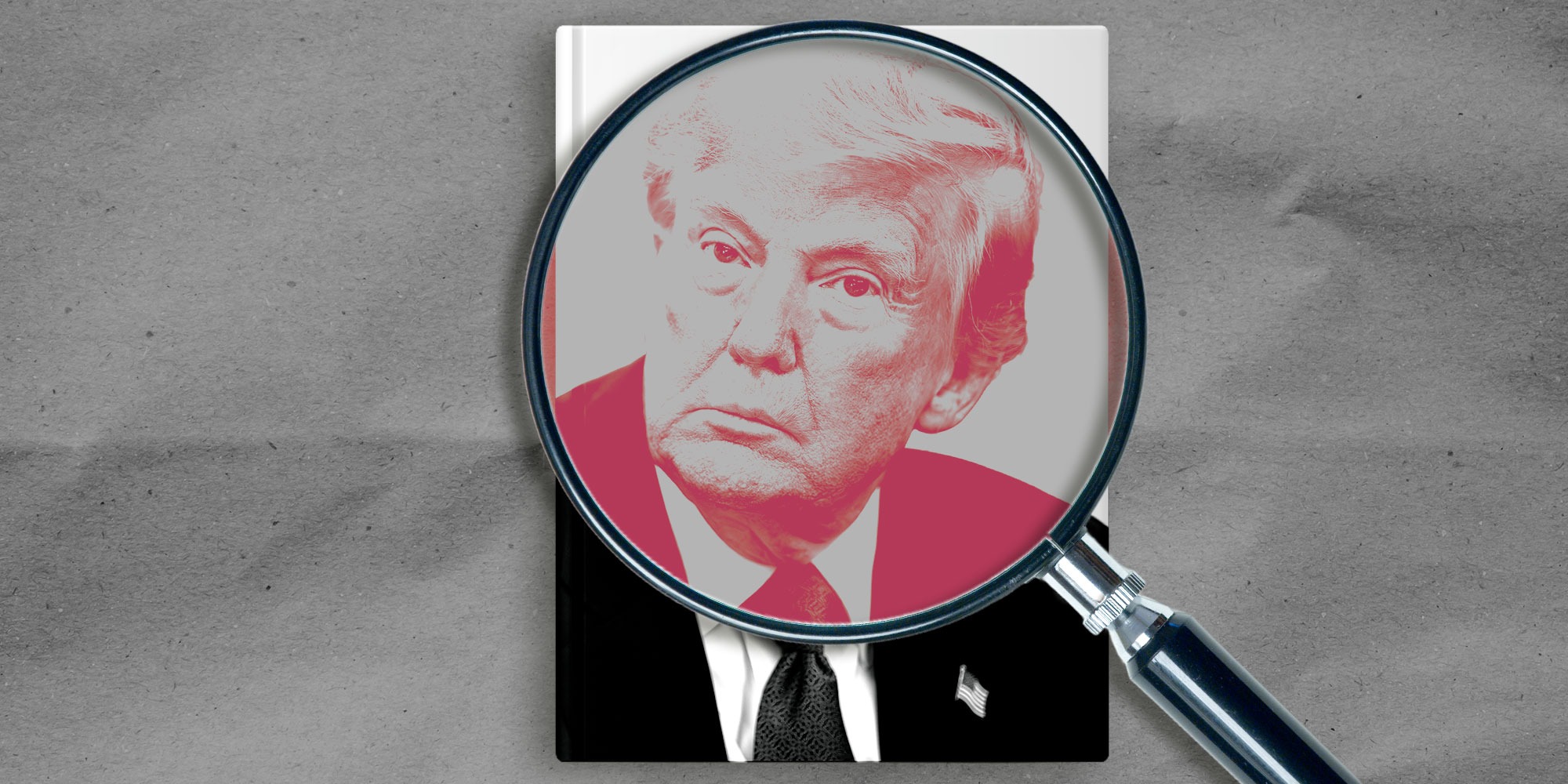
 Illustrative Image: US President Donald Trump. (Photo: EPA / AL Drago / Pool) | Book. (Image: Magnific) | Magnifying glass. (Image: Istock) | (By Daniella Lee Ming Yesca)
 Most political memoirs or books about a leader’s time in office take one of several well-trod pathways. A newly retired president or foreign minister will write about their struggles to achieve their goals, the fascinating or horrible people they were forced to deal with, the challenges they successfully confronted, or, ruefully, those that proved insurmountable.
One such example was Barack Obama’s weighty, but very readable volume about his first term of office.
Another style is the senior aide who uses the pages of their memoir to settle scores with the others whom he or she served with, and why they ultimately were right about almost everything. As someone once remarked, a memoir is where the writer gets all the best answers and snappy comebacks to deal with the inevitable slings and arrows that came their way. John Bolton’s volume The Room Where It Happened is a good example of this, as in an earlier era, might also be Richard Nixon’s Six Crises.
A third version of such writing is the non-fictional bildungsroman, where a wise, almost omniscient veteran journalist describes in great detail – and with an overflowing notebook – how the president or prime minister got to their high office. How the writers got all that inside information usually seems something of a mystery.
Popular and insightful versions of this approach is the shelf’s worth of Theodore H White’s books in his The Making of the President, covering two decades of electoral cycles. One fascinating variant on this was Joe McGinniss’ The Selling of the President that revealed the applied advertising techniques used to create the simulacrum of a thoughtful, wise, experienced, even compassionate politician otherwise known as Richard Nixon during the 1968 election.
There are dozens more in this style, such as the continuing sequence of Bob Woodward of Watergate fame’s books on various presidents, and Martin Wolff’s more wink, wink, nudge, nudge style of writing.
/file/dailymaverick/wp-content/uploads/dm-epa-05-09-2018_03-12-56.jpg "Meetings at Trump Tower")
And, of course, there have been thinly disguised novels based on real political figures such as Robert Penn Warren’s All the King’s Men, offering a fictional version of the larger than life Louisiana governor, Huey Long, and Joe Klein’s use of the same structure to offer a lightly fictionalised version of Bill Clinton in his novel, Primary Colors. Both were turned into laudable films.
Regime Change
With the publication of Donald Trump’s political journey, it is fair to say Maggie Haberman and Jonathan Swan’s new book Regime Change joins this pantheon. The co-writers are veteran New York Times reporters with a fine eye for detail, a keen ear for the nuances of language, and the antenna to pick up on the unspoken moments.
It has become clear they have got under the notoriously thin skin of the incumbent president with both revelations in this volume, as well as Haberman’s even more recent reporting regarding Trump’s decision to forego attending this year’s 9/11 commemoration in New York City.

In her reporting, Trump’s fit of pique led to his boycotting the event because organisers had informed him he would not be asked to speak at it, meaning there would not be one of his usual rants about the sins of Joe Biden and how he, by contrast, has made the country “hot, hot, hot”. His intemperate response was calling her Maggot Haberman, accusing her of writing fake news in a failing newspaper — and that she was ugly inside and outside. It is more than a little frightening that we’ve got so used to Trump’s juvenile nastiness that it is now almost seen as normal.
Yes, of course previous presidents often came to resent how they were portrayed in the media. Early presidents like John Adams and Thomas Jefferson had furious squabbles with a very partisan press; Abraham Lincoln often took it on the chin over his manners and decisions and was the subject of cruel political cartoons that made him ape-like.
Pilloried
More recently, Richard Nixon and Lyndon Johnson were pilloried by their respective media tormentors. But at least in public, the various presidents usually chose to maintain a sense of dignity about it for themselves and for their office.
But, no, not the current president. In fact, a key theme of this book is that now that Trump is in his second term of office and thus faces no further electoral moments personally, he has decided to let it all hang out: no limits, no restraints on his language, temperament, judgement and decisions. In so many words, for example, the country has gone to war with Iran over his gut instinct.
/file/dailymaverick/wp-content/uploads/h_56333005.jpg "US President Donald J. Trump holds a news briefing in the James Brady Press Briefing Room of the White House")
In his second term of office, with the experience garnered from his first battering as president and his deeper experience of the national political level, unlike Abraham Lincoln and his justly lauded “team of rivals” in picking his most senior leaders, Trump assembled a team of sycophants and “yes men” and women. Many of them offer dubious judgemental qualities, experience or expertise.
Instead, their primary qualification has been to demonstrate total, unflinching loyalty, plus a deep reluctance to speak up or challenge the president’s rasher impulses, even in close quarters with the president on complex or difficult issues and choices. Haberman and Swan lay out all of this in graphic detail. The reporting is so granular it is easy to imagine that among Trump’s team there is an ongoing effort to identify who spilled the bitchy, backbiting beans.
Beautifully written
While the book will appeal most viscerally to readers who love to learn about the inner workings – including all the messy bits – of a presidential administration, it is so beautifully written it can be savoured simply for its clean prose. Once I began reading it, I found it impossible to put down. It kept its hold on me until late into the evening, even though we already had a pretty clear idea where things were headed.
This book basically concludes as the Trump administration enters its Iranian “excursion”. But from what the co-authors describe it is clear how wrong-headed the decisions will be, given the off-handedness of the president’s decision-making and his reluctance to think things through to a logical conclusion.
If the co-authors haven’t totally burned their bridges with the senior officials cited in this book, a sequel in two or three years time should be eagerly anticipated. But then it is also clear that if things go downhill from here, there actually will be no end of senior officials all desperate to make their cases as to how they tried to avert the disasters that occurred. That’s how Washington works. DM
Regime Change by Maggie Haberman and Jonathan Swan is published by Simon and Schuster.
Comments
Scroll down to load comments...