




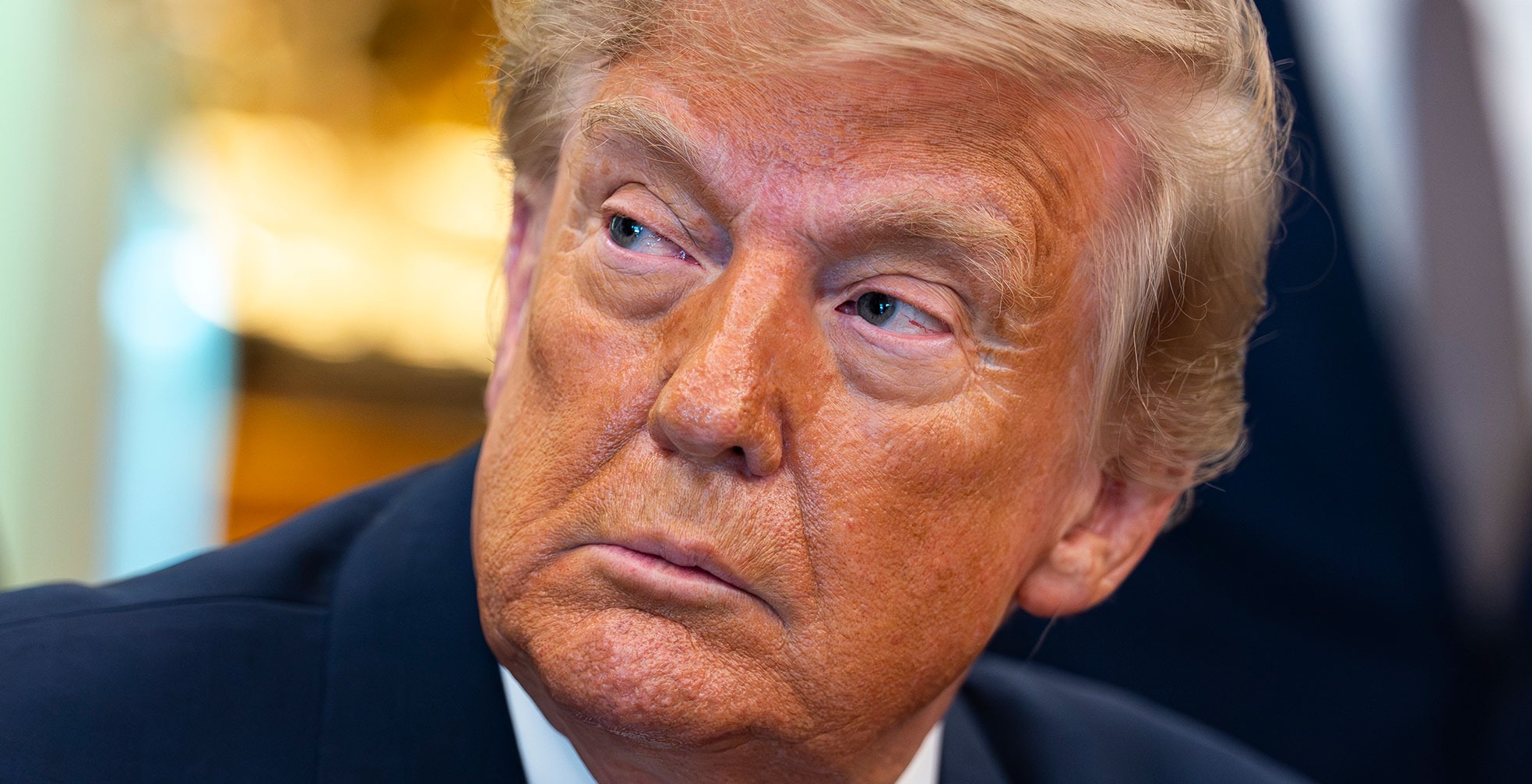
 US President Donald Trump believes that everything revolves around him and that politics is a zero-sum game. (Photo: Al Drago / EPA)
More than a decade ago, before Donald Trump was elected president, I was fascinated – and more than slightly terrified – by what his presidency could mean for the US and the world.
To gain insights into what made him tick, I consulted psychologists to get a clearer fix on his personality, his skills and his flaws.
In three articles (see here, here and here) published before and just after the first Trump presidency began, I put the Republican candidate (and as he became, the new president) on the psychiatrist’s couch.
In the first story, I noted that we “…contacted a real mental health professional, with the assurance of total, strict confidentiality, in order to solicit an opinion about Donald Trump’s emotional stability. Particularly important in this regard would be any circumstances that might well make him entirely unsuitable for the presidency, beyond the obvious.”
The consultant “explained that Trump almost certainly suffers from Narcissistic Personality Disorder (NPD). Classical scholars will recall the original Narcissus of Greek mythology was so enamoured of his physiognomy that he spent his days gazing into the waters of lakes in order to observe his countenance, until, on one fateful day, he looked so long and hard and so admiringly at his own face that he fell headlong into the deep waters of the lake [and] drowned. NPD is not, obviously, a key to a long and entirely happy life.
“The consultant’s observation was that there remains a big debate in the field as to ‘whether people suffering from NPD are thus [that way] through nature or nurture. They are regarded as having extremely fragile egos and therefore rigid defence mechanisms. So very quick to respond, usually aggressively, to comments perceived as critical.’ So far at least, that sounds rather alarmingly like The Donald’s public presence, now doesn’t it?”
Eerily predictive
After six years of Trump in government and four years with him outside it, glaring at his enemies, we can see this profile was eerily predictive of his behaviour as the US’s commander-in-chief with a destructive hand on the levers of government. Time to take stock.
As president, Trump has exhaustively demonstrated narcissistic tendencies – but married to a capricious governing style, an inattention to detail and planning, and a willingness to deflect blame for mistakes generated by his decisions. Further, he demands obsessive loyalty from subordinates, especially those professionally or personally unsuited for the tasks they have been asked to fulfil. Loyalty, to him, is a one-way street.
In the current mid-term electoral process, while Trump is not on the ballot, he has been urging Republican-leaning voters to believe the election is all about him. Given dissatisfaction by voters with the Trump presidency – his approval rating is hovering between 33 and 36% – this may be a really bad strategy.
(The House of Representatives is likely to swing Democratic, while the party could also gain control of the Senate if it defends all its incumbents and captures at least four seats currently up for grabs. Such an outcome could put the president’s policies at risk of near-constant examination by congressional subpoenas for documents and testimony as well as a full, adversarial roster of hearings. However, an impeachment and conviction appear virtually impossible without a massive Democratic wave in vulnerable Senate seats.)
Trump’s guiding of the nation’s foreign affairs has been personality-driven (such as those “love letters” with the North Korean ruler or ugly personal attacks on the Canadian prime minister). It has also been misguided by his deep misunderstanding of economics, foreign policy, history, global strategic considerations, and – increasingly importantly – military affairs, such as the ill-conceived conflict with Iran.
/file/attachments/orphans/14090758_993063.jpg "A photo released by the official North Korean Central News Agency (KCNA) shows North Korean leader Kim Jong Un (C) speaking during the Second Plenary Meeting of the Ninth Central Committee of the Workers' Party of Korea (WPK) held from 20-22 June 2026 in Pyongyang, North Korea (issued 23 June 2026). According to KCNA the three-day political gathering concluded with a resolution to accelerate the development of the country's nuclear technologies and strengthen its defense capabilities. (Photo: EPA / KCNA EDITORIAL USE ONLY)")
The reflexes of his behavioural patterns have drawn on a lifetime’s lessons from his real estate dealings (his winnings and losses) – coupled with a belief the world is a tapestry of zero-sum games. That is a transactional, implacable “I win, you lose” mentality that makes long-running relationships with allies irrelevant.
Instead, his approach has been one of “What have you done for me lately?” harnessed with “How far can I push you to do what I want?” The idea that relationships evolve from common historical, economic, cultural and societal understandings and goals is seen as largely irrelevant – unless they take on a distinctly racial tinge. We have seen this as he turned the US’s refugee policies on their head, with white Afrikaners almost the only beneficiaries.
Ultimately, his statecraft revolves around the gravitational pull of his own persona and personal ties. While his summitry with North Korean leader Kim Jong-un captured headlines, far more consequential is his persistent fawning over Vladimir Putin – a striking departure from his strained, combative relations with leaders from Canada, the United Kingdom, France, Germany, Italy, South Africa, Ukraine and a slew of multinational institutions.
/file/attachments/orphans/14247749_180642.jpg "Russian President Vladimir Putin attends a meeting with Belarusian President Alexander Lukashenko (not pictured) at the Novo-Ogaryovo state residence outside Moscow, Russia, 29 August 2026. (Photo: EPA / ANASTASIA BARASHKOVA / REUTERS / POOL)")
Perverse sense
Seen through that lens, his continuing browbeating and denigrating of Nato allies, his demands for Denmark to cede Greenland, his frequent insistence that Canada should surrender its sovereignty or sign the latest version of his proffered trade deal, his sudden decision that South Korea’s security should be sacrificed because of that heart-to-heart with the authoritarian ruler of North Korea, and his equally bizarre insistence that Ukraine should be given just enough rope to hang itself so he can continue his obeisance toward Putin all make perverse sense.
But it only makes sense if everything revolves around and is subservient to Trump’s self-image as a master of deal-making.
And, of course, the Trump administration’s increasingly mercurial decisions in the Middle East are the logical outcomes of the deeply flawed, personalised decision-making that typifies the Trump administration.
The Trump administration’s original sin, vis-à-vis the Middle East, came in its first term, when it abrogated the Joint Comprehensive Plan of Action. That plan – achieved by the Obama administration after several years of arduous, detailed negotiations – had linked the US and other major nations, together with the EU, in an agreement with Iran that strictly constrained the latter’s potential to develop nuclear weapons.
Though the agreement included rigorous inspections by the International Atomic Energy Agency, the Trump administration insisted it was far too narrow. Washington argued the deal failed to curb Iran’s missile programme, halt its support for the Assad regime in Syria, or rein in proxy groups like Hezbollah, the Houthis and Hamas. Trump was also viscerally resistant to his predecessor gaining any credit for that earlier diplomatic achievement.
Coupled with a deep-seated distrust of Iran and a conviction that Tehran would never honour an agreement, intense pressure from Israeli Prime Minister Benjamin Netanyahu pushed the US president toward a much more aggressive stance – setting the stage for what came next.
/file/dailymaverick/wp-content/uploads/2025/10/13386064.jpg "US President Trump and Israeli Prime Minister Netanyahu press conference at the White House")
By Trump’s second term of office, his and his team’s lazy thinking was that a mix of threats and blandishments would be sufficient to restrain any impulses by Iran towards nuclearisation. But eventually this gave way to the decision that military force would become the chosen path.
After bombing Iran’s nuclear installations in 2025, the Trump team declared they had “obliterated” these facilities, but the Iranians refused to roll over and play dead. Accordingly, a second, more devastating range of joint US-Israeli aerial attacks triggered Iranian missile attacks on neighbouring Persian Gulf states hosting US military facilities – plus a broader strategic response.
Iran effectively closed the Strait of Hormuz, cutting off a key artery responsible for nearly 20% of global oil shipments and leaving a hastily cobbled-together US-Iran Memorandum of Understanding completely stillborn.
The possibility the Iranians would close off the strait had apparently caught the Americans unprepared, even if a glance at a map and the history of the “tanker war” during the Iraq-Iran war of the 1980s presaged just such a manoeuvre. The situation remains highly volatile. The conflict threatens to escalate further due to a fragile military balance and its worsening strain on global supply chains.
However, the latest round of US sanctions against Iran is unlikely to lead to Iran’s surrender. Instead, it may further antagonise major trading partners such as China, whose petroleum imports significantly come from the Persian Gulf/Strait of Hormuz. The US and China, meanwhile, are already enmeshed in a swath of bilateral trade conflicts.
Blunt instrument
Such possibilities, in tandem with the Trump administration’s determination to use tariffs (or the threat of them) as a blunt instrument to cure every perceived economic ill, have helped turn long-time trading partners, allies and neighbours increasingly hostile towards US ideals, goals and interests.
In the ill-tempered negotiations with Canada (of all places), Trumpian insouciance and amateurism have soured a crucial, longstanding bilateral relationship. This has not been helped by periodic threats to annex the nation. This bilateral relationship hasn’t been this ugly since 1814 – before Canada even existed as a nation.
/file/attachments/2997/14243773_372870.jpg "A poster shows the name change from Lake Ontario to Lake America, as US President Donald Trump signs an executive order on the renaming, amid a recent trade war, in the Oval Office of the White House in Washington, DC, USA, 27 August 2026. EPA/AL DRAGO / POOL")
Now all of this may be coming to a head. In a few weeks, Trump will be hosting Chinese leader Xi Jinping on a state visit to the US, where all the economic and geopolitical tensions may be on the table.
Simultaneously, the Ukraine-Russia conflict may be entering an unstable, critical phase as Ukraine is increasingly desperate to ward off Russian missile attacks, even as Russia’s economy is taking growing strain without major tangible gains on the map.
And, of course, the Middle East conflict remains unresolved. Against this backdrop, Israel will hold national elections on 27 October – a vote widely seen as a referendum on Netanyahu’s political future that could also send ripples through the US elections.
How these issues – compounded by a domestic cost-of-living crisis and rising inflation – will affect the midterms remains to be seen. The campaign for Congress effectively kicks off after Labor Day on 7 September.
The joker in this deck is how Trump responds to these issues and to the outcome of the election. Will he be chastened and seek to reach out to bring in more advice and support? Or, true to his psychological make-up, will he respond ever more aggressively and erratically, as in his first inaugural address, where he snarled, “I alone can fix things”? DM
Comments
Scroll down to load comments...