




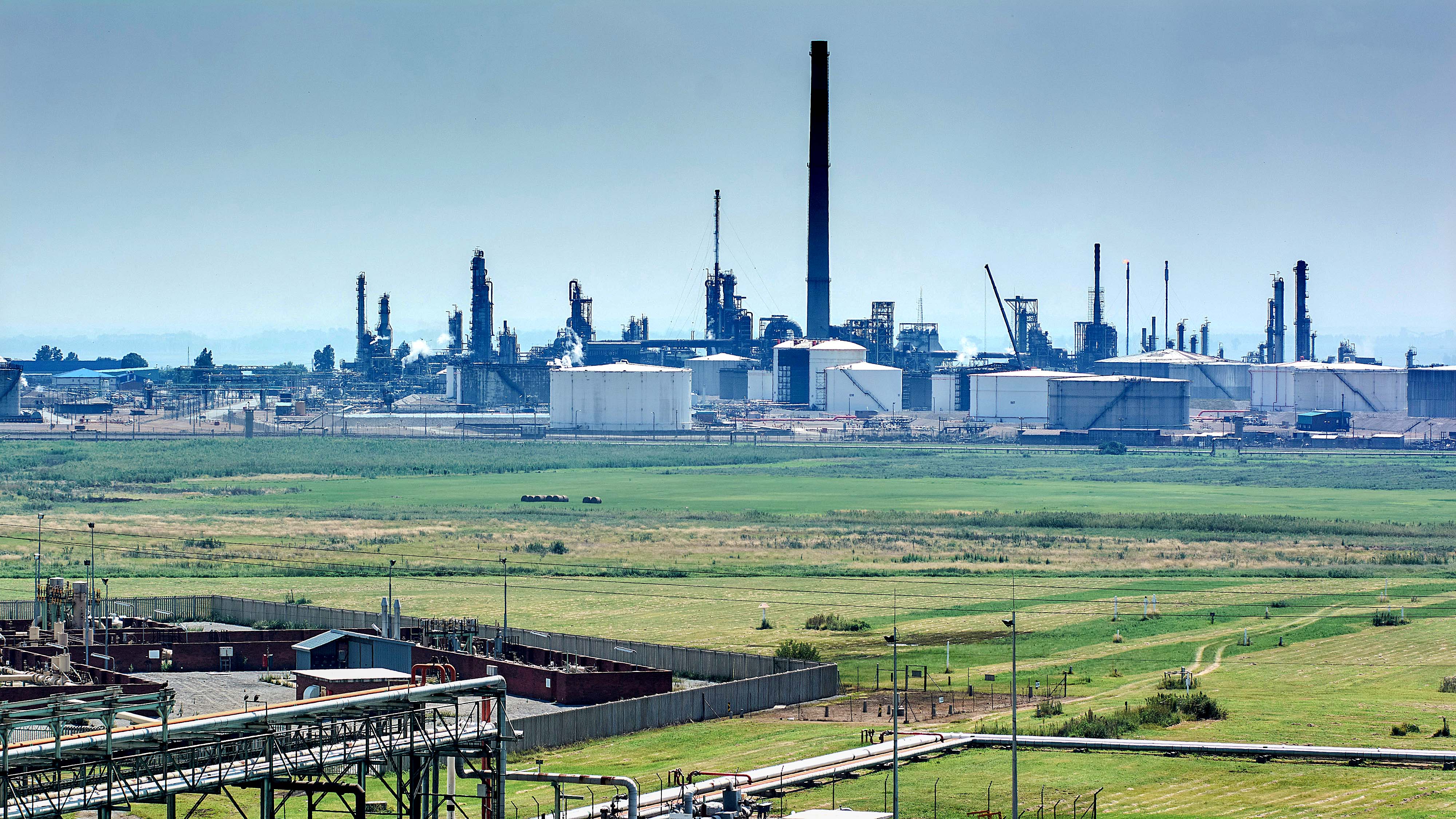
 The Natref crude oil refinery, viewed from the Sasol One liquid fuels facility in Sasolburg, on 24 February 2023. (Photo: Waldo Swiegers / Bloomberg via Getty Images)
“Everyone wants it until they have to pay for it,” Sasol CFO Walt Bruns explained about the sustainable aviation fuel (SAF) that Daily Maverick became a little obsessed with in Brazil.
While Sasol’s presentations highlight its technological capabilities in sustainable fuels, the CFO’s comments reveal a major strategic retreat. The key sustainable aviation fuel joint venture, Zaffra BV (a partnership with Topsoe), is being “operationally unwound”. Behind this unwinding is a hard commercial bottleneck: the aviation industry’s reluctance to fund green premiums.
“Zaffra BV was premised on the sustainable aviation fuel industry, especially her projects in the US, being advanced to final investment decision,” he says.
“That hasn’t happened as yet... We felt that when we looked out the window and at the time required before a project would get to the point that you make a financial investment decision, it would just take a long time. The sustainable aviation fuel makes sense intuitively, but it needs to make sense economically. We didn’t see enough industry offtake agreements being signed at a volume and a price that would justify building a new plant somewhere in Europe, in particular.”
Another green pivot turned unprofitable
Instead of building dedicated new greenfield SAF facilities abroad, Sasol is shifting to a defensive, asset-sweating strategy. It intends to leverage existing facilities at Natref and Secunda to produce SAF, aiming to market it independently while looking to potentially partner with firms in China or the Far East to license their feedstock-agnostic Fischer-Tropsch technology.
Bruns describes this as a “speed bump but not a roadblock”.
Sasol has positioned itself as a champion of the green hydrogen economy in South Africa, celebrating its proof-of-concept projects. However, Bruns admitted that these projects face the identical demand-side headwinds as SAF, coupled with a total lack of public infrastructure.
“We spent R16-billion over the last 10 years on environmental compliance programmes... We built a green hydrogen kind of proof of concept in Sasolburg, but people came, they said they wanted it, and then they’re not willing to pay the price.”
“We’re still working with the Northern Cape on it [Boegoebaai green hydrogen project]... The challenge for us just there is there’s just no infrastructure there,” he explained.
“You need green hydrogen to work, but if it has to fund a port, a whole rebuildout, infrastructure, all of that, the cost just becomes prohibitive. We think that green hydrogen will come, just not now.”

By the numbers
Sasol recorded R16.8-billion in non-cash impairments in FY26. What the high-level slides downplay is that the Secunda Liquid Fuels refinery cash-generating unit (CGU) remains “fully impaired”.
This has a devastating structural consequence: every rand of capital expenditure deployed to maintain or improve the refinery is instantly written off as an impairment in the period it is spent.
The company was also forced to take a few costly Ls on its balance sheet.
A R3.8-billion impairment on its Mozambican Production Sharing Agreement (PSA) development due to production profile revisions and delayed monetisation.
A full R462-million write-off of its equity investment in the Central Térmica de Temane (CTT) gas-to-power project in Mozambique due to project schedule deferrals and a significant increase in end-of-job costs.
Bruns defended the underlying economic value of Secunda, but admitted that Sasol was stuck in an impairment cycle, heavily driven by macro assumptions dictated by auditors.
Ironically, a stronger rand (usually a positive sign for South Africa) drives these write-offs by lowering the rand-denominated value of Sasol’s US dollar-based revenues.
“The accounting treatment and value [of Secunda] is not a fair reflection of the economic value ... but that’s not to say we happily impair stuff. We are working hard to stop it, but unfortunately we’ve gotten into a bit of a cycle at the moment just because of the negative value-in-use that we have.”
Gremlins in the IT systems
Although Sasol took corrective action for two material weaknesses relating to IT general controls and a German ERP rollout, four major material weaknesses in Internal Control over Financial Reporting (ICFR) remain open as of 30 June 2026.
These are not trivial IT glitches; they go to the core of financial reporting precision:
Inadequate risk assessment processes to determine material entities.
A lack of resources and understanding of ICFR across South African operations, leading to ineffective controls over the “level of precision and evidence of review”.
Inadequate design and execution of controls over revenue recognition in South African operations.
Insufficient precision in calculating the completeness and accuracy of information used in southern African impairment processes.
Bruns predictably tried to minimise the finding, framing it as a resource deficit and timing issue under “onerous” US SEC S-Ox rules, rather than a threat to the integrity of the numbers.
The CFO maintains that “the numbers are all good”, but the open material weakness regarding insufficient precision in southern African impairment processes directly overlaps with the R16.8-billion in impairments reported this year.
This raises a major governance concern: How can the board or the market have total confidence in the precision of Sasol’s massive non-cash write-offs?
To be fair, Sasol is shielding South Africa from fuel shortages because of the situation in the Middle East, and the share price will keep riding that wave, but the ride can only last so long. DM
Comments
Scroll down to load comments...