




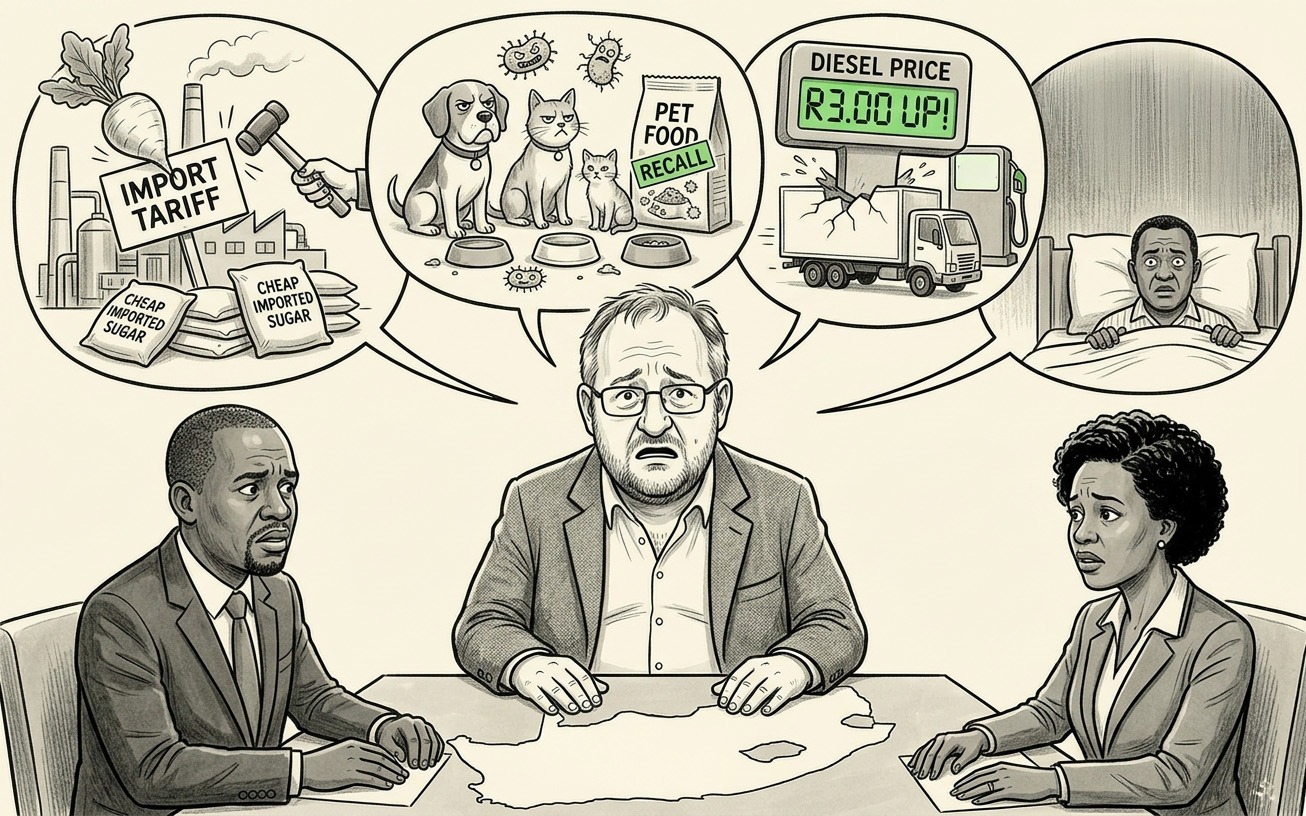
 This morning, the Department of Mineral and Petroleum Resources confirmed that diesel is going up by about R3 a litre, and petrol by about R1.30 a litre. | Illustrative image: (Generated wth Google Gemini Flash Image 2.5)
There is something about being on holiday for a week, about being reminded of the amazing wildlife that we have, of how wonderful (and funny and interesting) our teenagers are, that makes you think of all the best things in life.
For a moment, perhaps just a brief moment, all is well in the world, the sun is shining, the birds are singing and the Boks are back on top.
But to spend five minutes on the Stock Exchange News Service is to be reminded how tough life must be if you run one of our companies.
I always wonder what is the one thing that keeps our top CEOs awake at night. Which is the one shock they fear the most? And how do they plan for it?
This morning, RCL Foods released its results, which were, on the whole, not great.
There were two main reasons, which for a change had nothing to do with higher power prices.
The first was the sheer impact of cheaper imported sugar. Our sugar industry has gritting its tough-but-not-decaying teeth about this.
The amount of imported sugar has grown dramatically. To the point where government has now acted.
It’s now raising tariffs against imported sugar.
The other problem was, I’m afraid, probably entirely self-created.
RCL’s pet food line suffered an outbreak of salmonella. Which meant they had to stop production. As a result their revenue from pet food was down by 20%.
I can’t tell you the distress this has caused to five members of my family.
Usually the two dogs and three cats have differing views on matters as diverse as barking at night or who is allowed on the bed and who isn’t (fathers and daughters have been known to differ on this too).
But on this they are united. And hungry.
As you might know, pets in our middle-class homes are getting posher. And that means the market is getting more and more competitive.
You can imagine the longer-term costs of a problem like this.
Pets get used to a particular type of food, and when you don’t produce it anymore your customers don’t just stop buying pet food. They find something else.
And because this has taken so long it might be difficult to get our posher pets back to what they were used to before.
But, as RCL notes in its documents today, it has “a level of business interruption cover in place which caters for these situations, and we are currently working with insurers to finalise the claim”.
Obviously, most other businesses of any scale will have similar policies. And while I’m sure in most cases you wouldn’t be insured for the full loss and you probably can’t insure for lost market share, you will at least have enough money to get going again.
But I have no idea how you prepare for what is happening with fuel prices.
This morning, the Department of Mineral and Petroleum Resources confirmed that diesel is going up by about R3 a litre, and petrol by about R1.30 a litre.
I didn’t know this until about three weeks ago, but it turns out that while we used a lot more petrol that diesel 20 years ago, over time the amount of diesel we use has risen. Now about half of our fuel consumption is diesel and half is petrol.
This means, for anyone running a business, fuel prices must be one of your major risks.
This morning, Business Day ran a story showing that since the start of the problems around the Strait of Hormuz, our fuel importers have paid R54-billion more to bring the stuff in.
If you consider that is R54-billion going out for which we receive nothing extra, it is enough to make you weep.
That cost is obviously spread around all of us, but it must be hurting some companies really quite hard.
Of course, some have been moving towards electricity as quickly as they can.
Chains with capital, like Woolies and others, will probably say on their product packaging that more and more of their fleet is being fuelled by electricity.
But the cost of keeping your diesel-driven fleet going must run deep.
And we must be at a point where, in real terms, accounting for inflation and all the rest, we are at record prices for diesel.
That’s money you can’t account for, a loss you can’t plan for and something you can’t avoid.
All you can do as a CEO is try to plan as best you can.
And make sure that, somehow, you still get some sleep. DM
Comments
Scroll down to load comments...