




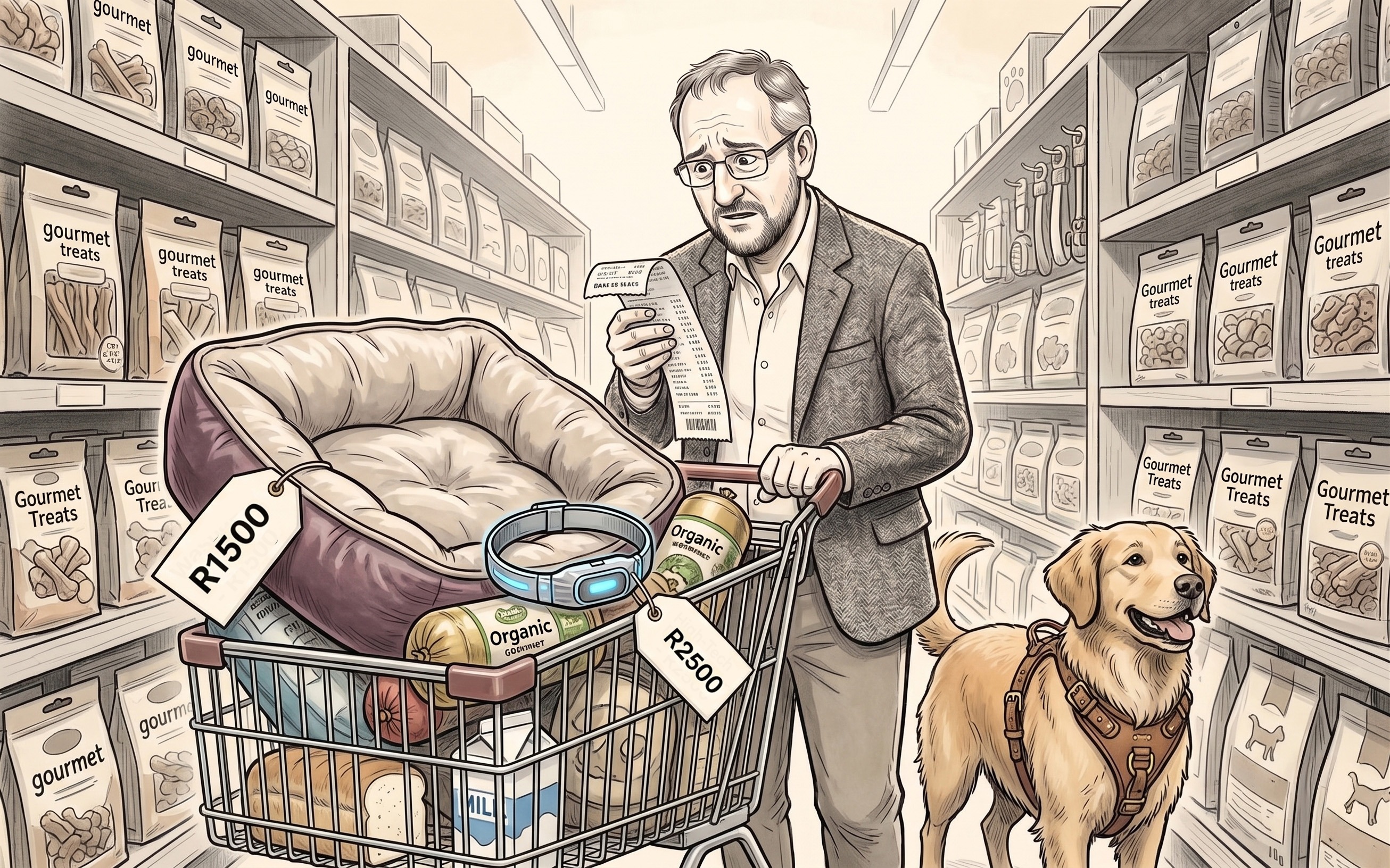
 Illustrative image: Generated with Google Gemini Flash Image 2.5
I wonder, when you get home tonight, who will be there to greet you. And who will greet you in the warmest way.
If you’ve been married for a long time, the chances are that a “Oh, hi Love” is the most you’ll get. If there are teenagers around, they will either say “the Wi-Fi’s down” or not really notice you at all.
But there are probably one or two members of the family you can rely on.
They don’t look like you. They’re not biologically related to you. But they love you the most.
They have four legs, a wet nose and a tail that is far too active. And they, at least, will probably give you the attention you deserve.
It is amazing to think how important pets can be to people. And how differently we grow up with them and without them.
Around the world being owned by a pet is a largely middle-class phenomenon. And about half of the humans currently living have a pet of some kind.
Here, Stats SA says under 24% of households report having pets. That means about three-quarters of homes don’t. And while it’s not a perfect overlap, it comes close to representing our economy in some ways.
But that doesn’t mean three-quarters of people don’t have a relationship with an animal of some kind. Many will have a dog that lives in the neighbourhood and may even sometimes sleep in their yard.
They’ll feed it from time to time, or try to keep it around as a guard dog.
Others will have grown up with a dog that has no fixed abode in the area, that would share their lunch and just be around.
Very few will have a family like mine, where humans are outnumbered by animals.
Two of those animals are excited to see me when I get home, three don’t notice.
Which probably explains why there are about seven million dogs kept as pets but only two million cats.
The amount of money that we spend on our pets has now gone past R10-billion. A report from Trade Intelligence spells out where exactly we are spending this money.
But that’s not what staggered me. What really surprised me is that this economy is growing by 15%.
You read that right. A sector worth more than R10-billion is growing at 15%.
That makes it possibly the fastest-growing consumer sector. With the obvious exception of online gambling.
It’s obvious why we are spending so much on our animals. Since Covid the tendency to treat our pets as another member of our family, as a “person”, has grown.
It hasn’t just happened here. It’s happened in Europe and particularly in China.
It’s easy to understand why – pets are playing some of the roles in our lives humans do.
They’re “somebody” to care for, to love, to treat us nicely and to live with.
And more importantly, they often show that they’re pleased we’re home.
There are plenty of cases where animals have made our lives better. For some people, they are literally the only thing between them and a life of extreme loneliness.
They often force older people to keep leaving the house regularly. If they don’t get their walk, they’re unplayable (the dog, not the person). And while we often joke about who takes who for a walk, for many people having an incredibly enthusiastic partner to walk with keeps them exercising much longer.
That in turn means you remain part of a community, since you bump into the same people walking their dogs at the same time.
Some people have even claimed that animals had saved their lives.
No less a person than Dolly Parton has suggested that her dog prevented her from doing what she was thinking of doing with the gun sitting on her bed. And without her we might not even have a proper Covid vaccine.
We are now seeing our retail chains paying serious attention to this – they are all investing in shops focusing on goods for pets.
And the mind boggles at what you can buy. It’s not just “ordinary” food, or food for immature big dogs or mature little ones.
You can buy fancy dog beds (washable nogal!), or spend about R2,500 on a pet tracker. And would your life be complete without spending more than R2,000 on an “adjustable leather dog harness”?
I do worry about some of this.
I can’t imagine what it might feel like to be a car guard, right at the end of the day and having not eaten yet, helping someone to load very expensive dog food into their car.
You might realise that what you’re lifting and struggling with is worth more than you’re able to spend on food for your children every month.
But the middle classes won’t change now, they’ll keep spending money on their beloved pets.
If only just to watch that tail move when they get home. DM
Comments
Scroll down to load comments...