




 Minister of Higher Education and Training, Buti Manamela. (Photo: Gallo Images / Frennie Shivambu)
The Department of Higher Education and Training (DHET) has admitted that it lacks a longitudinal administrative tracking system to link specific university degrees to post-graduation employment outcomes, leaving the state unable to identify qualifications that consistently contribute to high graduate unemployment rates.
/file/dailymaverick/wp-content/uploads/2025/10/ED_487135-1.jpg "Rise Mzansi leader Songezo Zibi. (Photo: Gallo Images / Darren Stewart)")
This follows parliamentary questioning by Rise Mzansi leader and Scopa chairperson Songezo Zibi to Minister Buti Manamela. Zibi asked whether Manamela’s department tracks university qualifications with five-year graduate unemployment rates above the national average, and what collaborative measures are being implemented to improve the market responsiveness of these degrees.
In response, Manamela conceded that the department lacked a five-year longitudinal record tracking individual qualifications to subsequent employment status.
“The department’s higher education information systems record enrolments, qualifications and completions at public universities. They do not, however, routinely capture the subsequent labour-market status of individual graduates. Reliable qualification-level employment outcomes require the linking of higher education records with labour-market, tax and other administrative data, subject to the applicable data-protection requirements,” said Manamela.
He said his department was participating in the development of the National Graduate Destination Study (NGDS) being undertaken by the Human Sciences Research Council (HSRC) in partnership with Universities South Africa (USAf). “The project is tracking the economic absorption and career pathways of graduates across all 26 public South African universities,” said Manamela, noting that they seek to improve labour-market responsiveness across the university system, including in qualifications whose graduates already experience comparatively favourable employment outcomes.
Daily Maverick has reported that the reality of finding a job as a graduate is difficult, especially now that there is no tracking of what qualifications lead to job employability.
/file/attachments/orphans/graduate_unemployment_sa_2021_2026_319451.jpg "Graduate unemployment rate in South Africa, 2021–2026, overall vs. young graduates (under 35). Source: Statistics South Africa (StatsSA), Quarterly Labour Force Survey (QLFS).
<br>(Source: Claude AI)")
Critical governance gap
Zibi told Daily Maverick that reports from labour analysts, business leaders and young people show many degree programmes are disconnected from industry needs, leaving graduates without sustainable employment.
“Operating without real-time tracking means the government lacks basic visibility into the return on investment of higher education subsidies. Deciding funding allocations and enrolment targets without tracking degree performance leaves policy planning reliant on delayed, periodic surveys rather than live labour-market evidence,” said Zibi.
Zibi told Daily Maverick that relying on delayed tracking created a major structural disconnection. He noted that the state faced fiscal pressure by paying to fund unmonitored university seats and then paying social safety net costs for unemployed graduates.
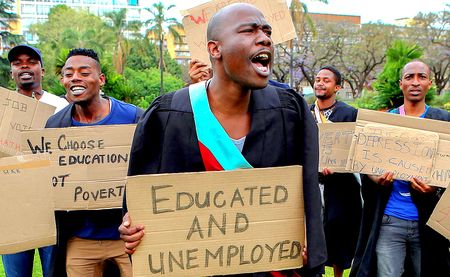
/file/attachments/orphans/ED_570437_417389_512949.jpg "Mokhale Poghiso (26) stands at a traffic light with his degree certificate in one hand and a poster in the other hand looking for work on August 25, 2025 in Bloemfontein, South Africa. Poghiso obtained a Bachelor Of Arts (BA) Degree in Humanities from the University of Free State in 2019 but has been unable to find a job. (Photo: Gallo Images / Volksblad / Mlungisi Louw)")
“Taxpayer funds and state bursaries (such as NSFAS) risk financing qualifications that do not align with economic demand. This structural disconnect severely harms the economy by misallocating capital into training sectors with structural labour surpluses instead of filling critical national skill shortages, which depresses productivity as industries suffer from persistent skill gaps while qualified youth remain economically inactive.”

HSRC on the tracking plan
Speaking to Daily Maverick about the progress of the NGDS, director of impact and research development Shirin Motala said the study was finalised in March 2026, and the project work officially began on 1 April 2026.
“Because the project has recently completed its inception phase and is currently in the operational setup phase (including methodological design and data governance frameworks), no primary empirical findings have been generated. As such, we are not in a position to speak to early data patterns or interim findings at this stage. Updates regarding project milestones, data collection timelines and planned public releases will be communicated as the research progresses through its standard lifecycle and will be managed by the project owners, namely USAf,” said Motala.
USaf’s director of operations and sector support Mahlubi Mabizela said, “South Africa currently lacks a comprehensive national dataset capable of systematically tracking graduates across all universities over time... Until such evidence has been generated and validated, it would be premature to draw conclusions regarding relative labour-market absorption or saturation across disciplines,” said Mabizela.
Unemployed people
/file/attachments/orphans/Siya-DHET-Trackingsystem_801156.png "Stats SA Q2 2026 Not in Employment, Education or Training statistics. Graphic credit: Outlier and GroundUp")
Stats SA data shows graduate absorption shifted from Community, Finance, and Trade in Q3 2025 to Community Services, Private Households, and Trade in Q4, alongside sharp declines in Finance and Transport.
By 2026, slowing corporate and public hiring shifted gains toward Wholesale, Retail Trade, and Construction, while Community and Social Services contracted. This ongoing volatility highlights the persistent labour market instability facing tertiary-educated jobseekers.
Treasury on linking the system
Daily Maverick spoke to the National Treasury, which explained what technical or legal hurdles are preventing the establishment of an administrative link to track graduate employment outcomes.
“From a legal and governance perspective, the use and linking of personal information must have an appropriate legal basis and comply with applicable data-protection requirements and institutional processes... Administrative datasets are collected for different operational purposes and can differ in structure, definitions, quality and documentation. Securely linking records requires appropriate technical infrastructure and specialist expertise in data linkage and data governance,” the Treasury said.
Speaking on the impact of not having this link, little qualification and field-level employment information was available, it said.
“Absence of comprehensive, nationally integrated and regularly updated graduate employment data constrains the ability of departments such as the Department of Employment and Labour to identify skills mismatches, track graduate labour market outcomes and effectively target active labour market interventions towards qualifications with higher unemployment risks,” the Treasury said.
A joint report by the World Bank and DHET found high demand for specialised skills in software engineering, data science, cybersecurity and cloud infrastructure. However, university outputs favour generalist IT management and digital design, creating a mismatch with employer demand for advanced technical and transversal capabilities.
The report emphasises that South Africa requires stronger systems to align policy, funding, education and labour needs to ensure timely skill development for better employment.
According to Manamela, DHET tracks in-demand courses by using the National List of Occupations in High Demand and labour-market data to guide enrolment planning, requiring universities to justify enrolments against national priorities, reviewing curricula relevance, strengthening industry partnerships and expanding work-integrated learning opportunities.
Update: Matshepo Seedat, the spokesperson for the minister of higher education and training, responded on 3 September:
Daily Maverick’s article by Siyabonga Goni “DHET admits it cannot track which degrees lead to graduate unemployment”, raises a legitimate question about the quality of information South Africa uses to connect higher education with the labour market. The headline, however, risks obscuring an important distinction.
The Department of Higher Education and Training did not say that South Africa has no information about graduates, qualifications, skills demand or employment outcomes. The Minister’s Parliamentary reply was considerably more precise: “South Africa does not yet have a single verified national longitudinal administrative dataset that routinely links individual qualifications to the subsequent employment status of graduates over time.”
That is a real gap. It is also one that the DHET has explicitly acknowledged and is working with its partners to close. Our higher-education information systems already provide extensive information on enrolments, fields of study, qualifications and completions across public universities. Statistics South Africa provides labour-market evidence.
Government produces information on occupations in high demand and skills needs. Universities conduct graduate destination and tracer studies. Employers, professional bodies and sector organisations generate additional evidence about demand and placement.
What South Africa has lacked is the secure integration of these different datasets into a longitudinal system capable of answering, consistently and at national scale, what happened to a particular cohort after graduation, in which sectors are they employed, how long did labour-market absorption take, and how do outcomes vary by qualification and field?
That is a fundamentally different proposition from saying that government “does not track” whether higher education responds to the economy. The article itself records that the National Graduate Destination Study, being undertaken by the HSRC in partnership with Universities South Africa, was finalised as a project in March 2026 and moved into implementation from 1 April.
Its purpose is to track the economic absorption and career pathways of graduates across all 26 public universities. There are good reasons why this work has to be done properly. Linking university records to taxation, employment and other administrative information raises legitimate questions of data protection, legal authority, common definitions, data quality, technical infrastructure and secure data governance.
National Treasury made precisely this point in its response to the Daily Maverick. None of this means that the department waits passively for a perfect dataset before making decisions. Enrolment planning already considers national development priorities and labour-market demand.
The National List of Occupations in High Demand informs planning. Universities are expected to demonstrate the relevance of programme offerings. Government is expanding work-integrated learning and industry partnerships and is strengthening the connection between programme planning and economic demand.
Nor should graduate unemployment be reduced to the simplistic proposition that an unemployed graduate necessarily studied the “wrong degree”. Economic growth, the rate of job creation, geography, work experience, employer recruitment practices, technological change and the transition from study to work all affect graduate outcomes.
As the Minister has always told the leadership of the department, a responsive PSET system must do two things simultaneously: improve the match between education and economic demand, and help expand the economy’s capacity to absorb skilled people. There is therefore an important challenge in Daily Maverick’s reporting which government accepts: South Africa requires better, faster and more integrated graduate-outcome intelligence.
Where we differ is with the suggestion that the absence of one integrated longitudinal dataset means that the state has no visibility and simply allocates billions without reference to labour-market evidence.
The task now is not to debate whether the gap exists. It is to close it. The Minister has asked the department to strengthen graduate-outcome tracking across the PSET system, while being candid about the distinction between the relatively developed university information base and the more fragmented placement and tracer information in the TVET sector.
When the emerging national evidence is sufficiently robust, it must feed directly into enrolment planning, programme design, funding decisions, work-integrated learning and our wider Skills Revolution. That is the standard to which the DHET should be held. DM
Did your degree or qualification actually help you land a job?
Comments
Scroll down to load comments...