



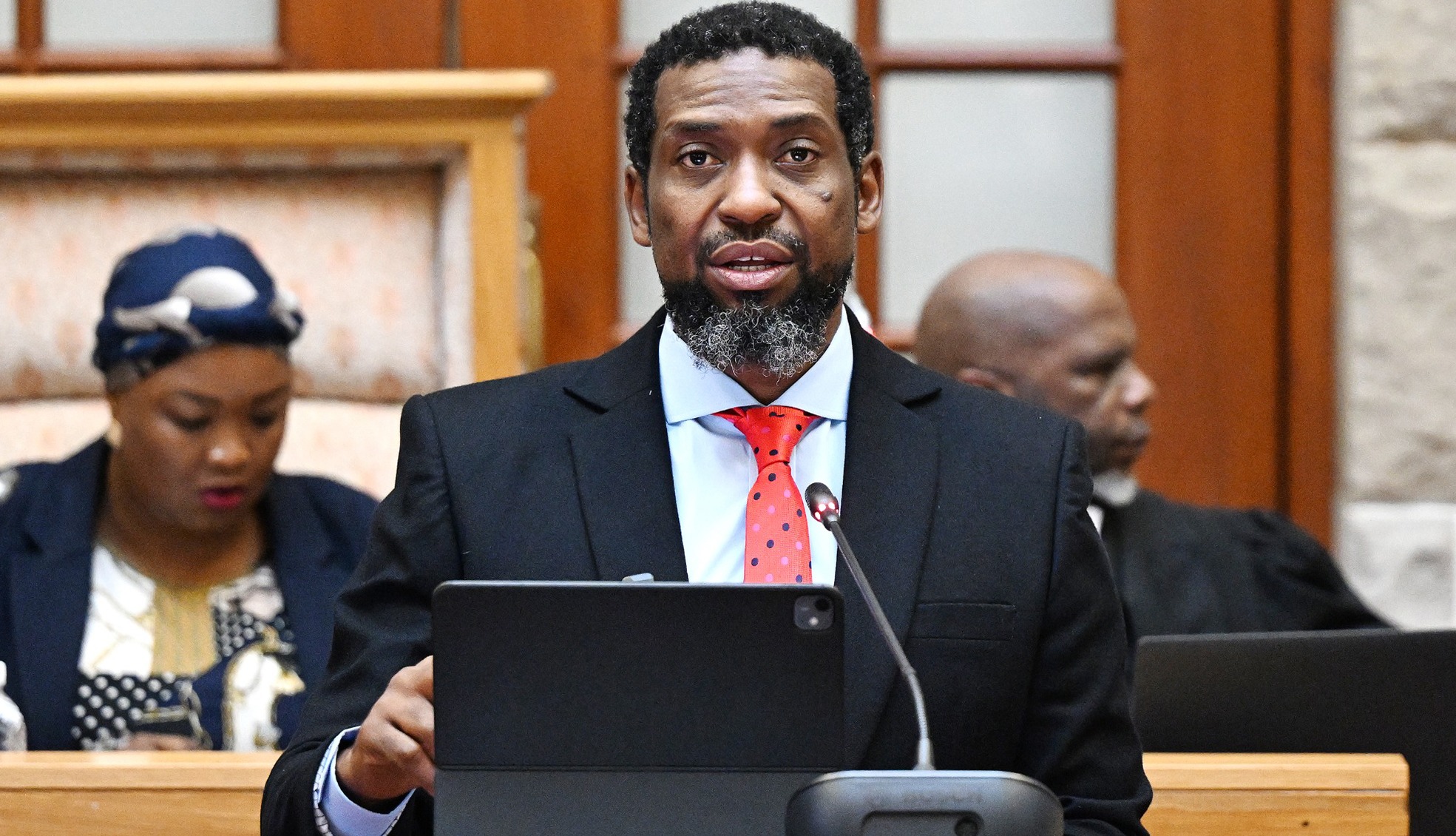
 The minister of higher education, Buti Manamela, tables his departmental budget on 26 May. (Photo: Phando Jikelo / RSA Parliament)
Parties within the Government of National Unity (GNU) on Tuesday supported Higher Education and Training Minister Buti Manamela’s R149.2-billion budget for the 2026/27 financial year, although they continued to press the minister on growing challenges within the sector.
Opposition parties outside the GNU rejected the budget, claiming the department is failing students despite its massive public funding.
Adding to the friction, Deputy Minister Mimmy Gondwe called for the eventual elimination of the National Student Financial Aid Scheme (NSFAS) and Sector Education and Training Authorities (Setas).
“The time has also come to replace Setas with a system that allows industry and the private sector to procure their skills development needs directly from accredited training institutions and providers,” said Gondwe.
“There is no longer a need for NSFAS. NSFAS has repeatedly failed, and it is time to replace it with a student funding model which sees our higher education institutions themselves select students and assess their financial needs and then apply directly to National Treasury for the necessary disbursements to fund tuition and cost of living allowances.”
/file/attachments/orphans/ED_568463_449571.jpg "Deputy Higher Education Minister Mimmy Gondwe. (Photo: Frennie Shivambu / Gallo Images)")
For the 2026 academic year, the higher education budget is distributed as follows:
- University Education: R100.1-billion;
- Technical and Vocational Education and Training (TVET) colleges: R14.7-billion; and
- Community Education and Training (CET) colleges: R3.3-billion.
Transfers and subsidies account for R134.9-billion, or 90.4% of the total allocation.
Looking ahead, NSFAS funding is projected to grow from R48.8-billion in 2025/26 to R54.6-billion by 2028/29. Similarly, skills levies are expected to rise from R27.7-billion in 2026/27 to R31.1-billion over the same period.
Manamela told Parliament that the budget seeks to improve access to education while ensuring that graduates and trainees can find employment in an evolving economy.
“TVET enrolment is far below the long-term national need. CET is structurally underfunded. Universities must remain financially sustainable while continuing to transform. NSFAS cannot be the only instrument of access,” said Manamela.
“Colleges must grow — but they must grow with quality and with relevance. The question is no longer only how large the system must become. The question is what shape it must take to meet the demands of a digital, green, industrialising and inclusive economy. That work has begun.”
Ahead of tabling the budget, Manamela admitted during a media briefing at Parliament that the higher education sector has “cracks” that require urgent intervention, mentioning the ongoing controversy surrounding the Construction Seta, where administrator Oupa Nkoane allegedly approved a remuneration package worth about R3-million without proper approval from the Department of Higher Education and Training.

GNU parties raise concerns
The African National Congress’s Tebogo Letsie defended the budget allocation, saying the party remained committed to expanding access to higher education for poor and working-class students.
“Education and skills development are not privileges of the few but are constitutional rights and instruments of economic justice for the majority of South Africans. We continue to prioritise bursaries and loans for students from the working class and the poor families earning below R350,000 annually,” said Letsie.
Inkatha Freedom Party MP Sanele Zondo also backed the budget, but warned that the government must place citizens first. “We support you because we believe in you; do not disappoint us as members of this committee when you are not showing up in meetings — make sure that the decisions that you take on our behalf as South Africans remain the priority,” said Zondo.
Democratic Alliance MP Karabo Khakhau criticised the department’s lack of measurable outcomes and accused it of failing to align skills development with economic growth.
/file/attachments/orphans/sune-DA-race3_296858.jpg "Karabo Khakhau of the DA. (Photo: Gallo Images/Jeffrey Abrahams)")
“Minister Manamela wants a R149.2-billion budget allocation without guaranteeing the sponsors of this budget, the people of South Africa, value for money in return. This is just plain nonsensical,” said Khakhau.
“We already know that this budget does not drive inclusive growth and job creation. We already know that this budget does not reduce poverty and tackle the high cost of living. Why? Because the skills development model of this department does not translate to tangible skills development, job creation and economic growth. Instead, all it does is perpetuate the misalignment of skills transferred and the needs of our economy. All while funding ANC patronage and cadre job schemes.”

Al Jama-ah and the Patriotic Alliance signalled support for the budget.
Opposition parties reject budget
Opposition parties outside the GNU used the debate to sharply criticise Manamela and his department over persistent governance failures, vacancies, graduate unemployment and instability at NSFAS. Economic Freedom Fighters MP Sihle Lonzi accused the department of failing to deliver on its promises and allowing instability to become entrenched across institutions.
/file/dailymaverick/wp-content/uploads/2025/07/WhatsApp-Image-2025-07-03-at-18.34.02.jpeg "Sihle Lonzi. (Photo: Phando Jikelo / RSA Parliament)")
“How do you explain that across universities, TVET colleges, Setas and other entities, critical vacancies remain unfilled? With so much unemployment in our country, acting principals, acting CEOs, acting directors, and acting DDGs have become permanent features under your leadership; it’s Hollywood; everyone is acting,” said Lonzi.
“You promised us a stable NSFAS, yet you have plunged us into an even greater crisis. You promised us transparency, yet oversight processes continue to be undermined by delays and missing documentation. What is even more concerning is your disregard for parliamentary accountability. When Parliament called you and sought answers from you regarding the mess that you created at NSFAS, you literally ran away.”
MK party MP Mnqobi Msezane said the budget failed to address the issue of historical student debt, which continues to prevent graduates from accessing their certificates and securing employment.
/file/attachments/orphans/WhatsAppImage2026-05-26at124608_541118.jpeg "Mnqobi Msezane. (Photo: Phando Jikelo / RSA Parliament)")
“Historical debt that has left many young people jobless because of withheld certificates. This budget says nothing about ensuring that these previously deserving graduates who ... have waited for years are able to seek employment and change the poor backgrounds of their families,” said Msezane.
ActionSA MP Malebo Kobe also rejected the budget, citing the student accommodation crisis and instability at NSFAS.
“The student housing backlog now exceeds 500,000 beds,” said Kobe. “At the start of the academic year, we see students sleeping in hallways, on floors, and even on the streets. Then there is NSFAS that is placed under administration with its board dissolved, an emblem of complete failure of the GNU and its partners… We will not support a budget vote that fundamentally and repeatedly fails students.”
The heated debate was held amid intensified scrutiny over the Department of Higher Education and Training and its entities. Manamela is expected to appear before Parliament’s portfolio committee on Friday, 29 May, to account for placing the NSFAS under administration amid allegations of political interference. DM
Comments
Scroll down to load comments...