




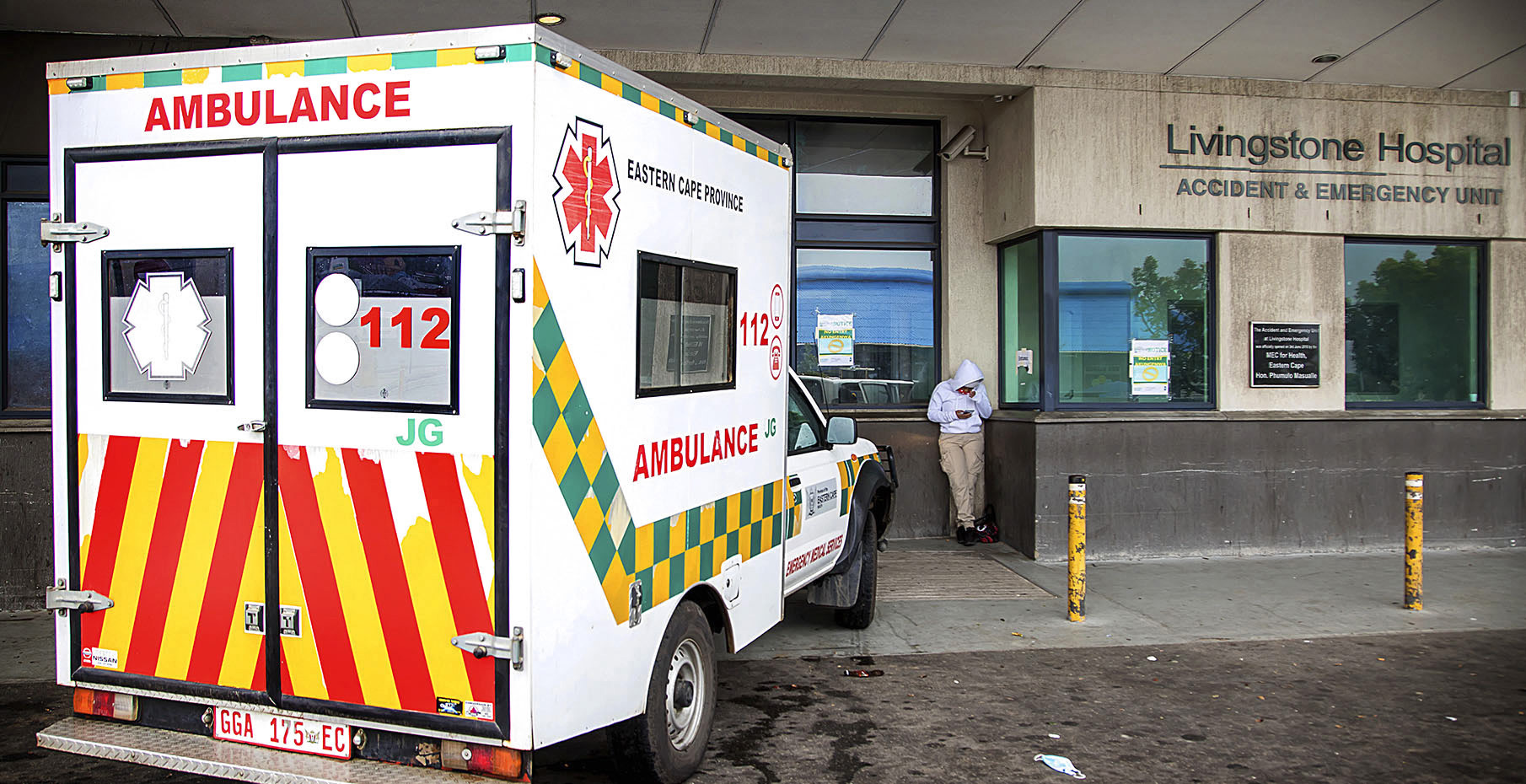
 An ambulance parked outside the emergency department at Livingstone Hospital in Gqeberha. But a Hospersa officials says ambulances are often ill-equipped. (Photo: Donna van der Watt)
 For more than 12 hours, a Nelson Mandela Bay family desperately tried to get an ambulance for a seriously ill 17-year-old boy, repeatedly calling emergency medical services without getting through.
An ambulance finally arrived at the boy’s home at about 11.15pm on Monday, 18 August — more than half a day after the family first sought emergency medical help at about 11am.
Nelson Mandela Bay resident Luzuko Gedze, a relative of the boy, has lodged a complaint with the South African Human Rights Commission over the ordeal. He said the experience exposed a much deeper failure than faulty telephone lines.
“We’re talking about an essential service. It’s a critical life-saving service that the public must – not partially, not sometimes – have access to.”
“It’s a hopeless situation. You first become frustrated, but then you kind of accept that no one is coming to your aid.
“You get to a point where you’re upset and you’re actually annoyed. But you’re calling in hope that someone would eventually pick up the phone, and you can maybe just swear, or rant, or express your frustration but it never happened,” Gedze said.
“We’re talking about an essential service. It’s a critical life-saving service that the public must – not partially, not sometimes – have access to.
“It cannot be that even that basic right to try to access healthcare is not available to citizens. We can’t have a case where people cannot get help from government services to at least get them to the doorstep of Dora Nginza Hospital or Livingstone Hospital.”
‘Dire’ and ‘disturbing’
The family’s ordeal began that weekend after a young girl visiting relatives at a traditional ceremony broke down in tears and told them about the condition of her disabled brother, Gedze said.
Concerned family members hurried to the boy’s home on Monday morning and were confronted with scenes that Gedze described as a “dire” and “disturbing”.
Gedze took the young boy’s mother to the local department of social development to seek help and intervention, where officials opened what Gedze described as a priority case.
“They insisted that the child get removed immediately and get medical attention,” he said.
The visit to social development office was just after 9am on Monday. The family returned to the house at about 11am and began trying to telephone for an ambulance.
Gedze said they called 10177, the direct Telkom number used for emergency medical services, 112 and 10111. He also contacted Dora Nginza Hospital after being given another emergency number by an official there.
“The number provided to us rings. It rings and rings and rings, so no one picks up. So it could be one of two things: it could be that there’s no one there to man the switchboard, or there’s a systems issue or an IT fault,” he said.
“While we were making calls outside at the family’s house, there was a neighbour who saw there was unusual activity at the residence. When we told her that we were trying to get an ambulance to come, she laughed and said that we are wasting our time because no one will come,” Gedze added.
In 2024, the Eastern Cape Department of Health’s emergency lines were suspended because it failed to make payments.
A service under strain
The family’s difficulty in getting through to Emergency Medical Services (EMS) comes as Nelson Mandela Bay and Eastern Cape grapple with a crippling shortage of ambulances. Frontline emergency medical services workers have warned that the essential service is on the verge of collapse and that they are increasingly expected to perform their duties with little more than the bare minimum.
The Health and Other Services Personnel Trade Union of South Africa (Hospersa) has repeatedly raised concerns about the shortage and poor availability of operational and fully equipped ambulances across the province, including in Nelson Mandela Bay.
Thembisa Witbooi, Hospersa’s Eastern Cape provincial labour relations organiser, said Nelson Mandela Bay, with a population of more than 1 million people, needed at least 150 ambulances to adequately serve its residents.
“The state of the ambulance service in Nelson Mandela Bay is laughable, and it is deliberately being collapsed,” Witbooi said.
She said ambulances parked outside the Dora Nginza Hospital EMS depot did not necessarily mean that they were operational or fit for purpose.
“People see ambulances parked there and think there are ambulances available, but that does not mean they are working or that they are fully equipped,” she said.
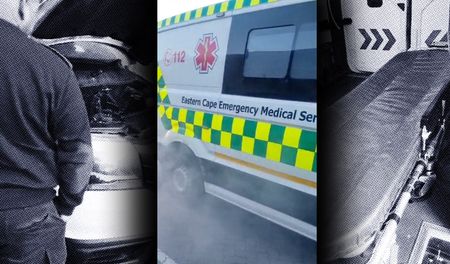
In a video provided to Daily Maverick, an ambulance is seen experiencing engine problems, with plumes of smoke surrounding it. Inside the vehicle, there are neither oxygen cylinders nor a stretcher.
/file/dailymaverick/wp-content/uploads/2023/11/ems-6-2048x1365-1.jpg "The Eastern Cape’s EMS problems are further complicated by labour disputes, with the province’s health department seeking to fire 224 EMS workers in the Amathole and King William’s Town areas. (Photo: Luvuyo Mehlwana / Spotlight)")
Witbooi said EMS personnel were desperate to do their jobs and save lives but were being hamstrung by a lack of basic resources.
“The guys want to save lives, but they do not have enough resources. They are caught between a rock and a hard place,” she said.
A source within the EMS division, who spoke on condition of anonymity, described the service in the metro as running on fumes and being on a lifeline.
The source warned that if the metro were to face a mass-casualty incident, the consequences could be dire.
“People are going to have to save themselves,” the source said.
“EMS members cannot be driving an ambulance that is not fully equipped. It’s just an empty box of an ambulance.”
Witbooi and sources within the EMS division also raised concerns about ambulances operating without critical equipment, including electrocardiogram machines, stretchers and oxygen tanks.
“EMS members cannot be driving an ambulance that is not fully equipped. It’s just an empty box of an ambulance,” Witbooi said.
She warned that forcing paramedics to work with inadequately equipped ambulances could also put their professional registrations at risk.
Witbooi said professional regulations required EMS personnel to operate with properly equipped vehicles, and that those found to be in contravention could face suspension of their registration for up to two years.
‘Intermittent disruptions’
Eastern Cape Department of Health spokesperson Siyanda Manana acknowledged that EMS telephone services have experienced intermittent disruptions, including temporary line drops as well as incidents involving cable theft and vandalism.
Manana said, however, that an interruption affecting an individual telephone line did not necessarily mean that the wider EMS communication and dispatch system was unavailable.
“The department does not dismiss reports from residents who may have experienced difficulty reaching EMS,” Manana said.
He said there were several points in the communication chain where calls could be interrupted or delayed, including temporary telephone disruptions, technical faults, damage or theft of communication infrastructure and problems routing calls through cellular network providers.
Calls to 112, in particular, are first received by the relevant cellular network provider before being transferred to the EMS Communication Centre.
“EMS can only process and dispatch a resource once that call has successfully reached the communication centre,” Manana said.
The department said the Nelson Mandela Bay EMS Communication Centre remained operational and continued to provide call-taking and dispatch services through its computer-aided dispatch system, introduced in 2019.
It said EMS also maintained multiple communication mechanisms to reduce its reliance on a single contact point, including operational call-taking infrastructure, a WhatsApp platform for inter-facility transfers and communication channels with SAPS emergency structures.
‘Dololo. Nothing’
The family desperately trying to get the 17-year-old to medical care kept up their attempts until about 3pm before turning to the Kwazakhele police station.
Gedze said police told them they had experienced similar difficulties trying to secure ambulances for other community members. One constable attempted to escalate the matter through a WhatsApp group.
Still, there was no immediate response. “Even during this time, we still made attempts to try and get through the number, but dololo. Nothing,” Gedze said.
The family eventually had to leave the property and return to their homes.
Then, at about 11.15pm, Gedze received a call from EMS saying an ambulance was outside the boy’s residence with police.
He said EMS officials told him they had no record of the earlier calls and that the call reflected on their system only after 9pm.
/file/dailymaverick/wp-content/uploads/2023/11/ems-3-2048x1365-1.jpg "With the start of the holiday season, the provincial health department revealed that the Eastern Cape only has 439 ambulances, when it should have 650. (Photo: Luvuyo Mehlwana / Spotlight)")
Gedze believes the eventual response may have followed the police escalation.
For him, however, the episode exposed something far more serious than malfunctioning telephone lines.
“We came to the realisation that ordinary people who rely on government services can’t really rely or depend on government services, even if their life actually depends on it. The whole process was frustrating,” he said.
The department said members of the public who struggle to reach EMS through one communication channel could contact the Nelson Mandela Bay EMS Communication Centre on (041) 459-0292, (041) 459-0585 or (041) 459-0858.
It also advised residents to contact SAPS on 10111, where emergency information could be relayed to the relevant services.
Manana said the department continued to monitor its communication channels and address disruptions when they were identified.
SAHRC investigating several shortcomings
Dr Eileen Carter, provincial manager for the South African Human Rights Commission (SAHRC), said the the commission is aware of the matter and confirmed that it has “been added to a pending systemic investigation into access to Emergency Medical Services in the Eastern Cape, including concerns around emergency lines, ambulance dispatch and operational capacity”.
Carter said the commission also secured a high court order compelling the Eastern Cape Department of Health to provide two operational ambulances to serve the Xhora Mouth area.
“We continue to monitor the matter and eagerly await full implementation of that order.
“Failures in access to emergency medical services may have serious implications for the constitutional rights to healthcare, dignity and, in appropriate cases, life,” Carter said.
The Department of Health said it was not yet aware of the latest complaint lodged with the SAHRC.
Ambulance services outsourced to private security
At one point, Gedze said, he contacted a private ambulance service and was told to expect to pay at least R2,500 for a dispatch, excluding any further treatment or services.
For a family in Kwazakhele, Gedze said, that was not an option.
Manana said private ambulance providers were used as “supplementary capacity” when operational demand exceeded immediately available EMS capacity, when specialised clinical capability was required, or in certain urgent or specialised cases.
Where a private ambulance was officially activated by the department under its contractual arrangements, Manana said, the department paid the provider and patients were not required to pay directly.
Witbooi, however, said funds spent on private ambulance partnerships could instead be directed towards addressing the province’s shortage of ambulances and putting more fully equipped vehicles on the road.
‘Not just a telephone issue’
“This is not just a telephone issue,” Gedze said. “The issue can never be that the lines are faulty. The issue could be why are the lines faulty, how long were they faulty, and who did something to actually try and get the lines to be working again.”
The department said it recognised that sporadic communication challenges had occurred, but maintained that its EMS Communication Centre and dispatch infrastructure were operational.
“The department acknowledges the concerns raised regarding access to emergency medical services and remains committed to ensuring that residents of Nelson Mandela Bay can access EMS when they need it,” Manana said.
“Our priority remains clear: when a member of the public requires emergency medical assistance, the system must be accessible, responsive and capable of mobilising the appropriate assistance as quickly as possible.” DM
Comments
Scroll down to load comments...