




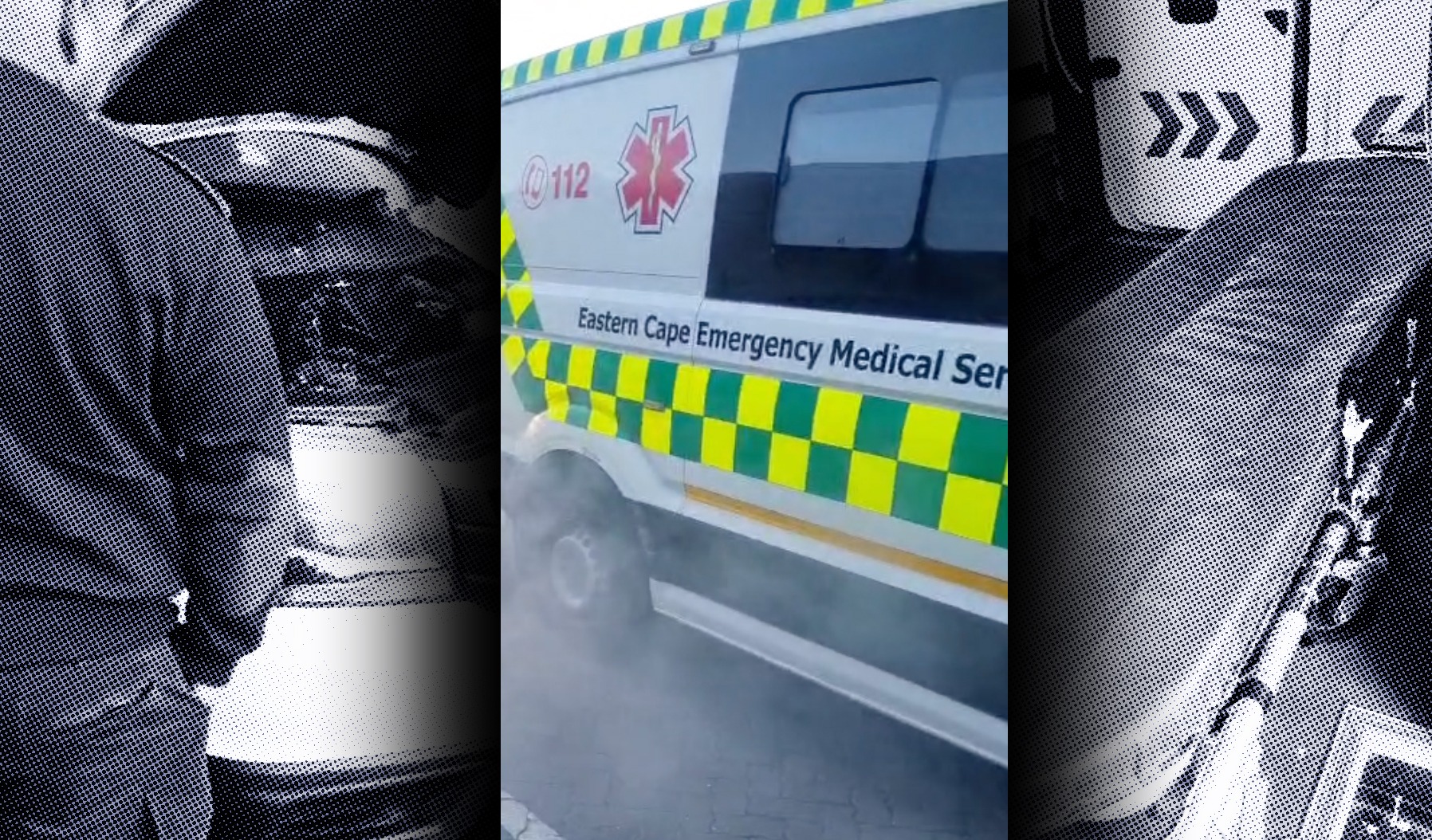
 Illustrative image | Paramedics have complained that numerous ambulances are experiencing engine trouble. | An Eastern Cape department of health ambulance with smoke billowing out of it. | An ambulance that is missing oxygen tanks. (Photos / Supplied Source )
Kyran-Ambulances
Illustrative image | Paramedics have complained that numerous ambulances are experiencing engine trouble. | An Eastern Cape department of health ambulance with smoke billowing out of it. | An ambulance that is missing oxygen tanks. (Photos / Supplied Source )
Kyran-Ambulances
The Eastern Cape’s ambulance crisis is far worse on the ground than official fleet figures suggest. Emergency medical services (EMS) workers in Nelson Mandela Bay describe a system on life support, with only a handful of properly equipped ambulances available to respond to emergencies on some shifts.
One experienced EMS source, who this week spoke to Daily Maverick on condition of anonymity, said the hollowing out of the division had reached a point where the public had little idea how close the service was to collapse.
“It is very, very sad to see where the service is right now. And the public don’t know half of it,” the source said.
“I honestly believe that the emergency medical service in South Africa has collapsed.”
‘Impossible burden’
The source described an EMS system plagued by broken-down vehicles, missing equipment, dangerous, life-threatening working conditions and a growing sense among personnel that they are being left to carry an increasingly impossible burden.
At the Dora Nginza ambulance base, which the source said should serve a large part of Gqeberha, only one fully equipped ambulance had recently been available.
“Today they ran about four or five vehicles, but only one of them was fully equipped. All of them don’t have stretchers,” the source said.
“For the better part of the day, you’ll find that there’s only two or three ambulances in Gqeberha that can actually help with a call. If they are available.”
In a video provided to Daily Maverick, an ambulance is seen undergoing engine problems, with plumes of smoke surrounding it. Inside the vehicle, there are neither oxygen cylinders nor a stretcher.
According to figures provided by Health MEC Ntandokazi Capa in response to a written question from DA MPL Jane Cowley, the Eastern Cape has 353 ambulances, of which 161 are grounded and 192 operational. Four years ago, there were 244 operational ambulances.
Problem ‘continues to worsen’
Cowley, however, said that following the response to the written questions, later reports indicated that the problem had worsened.
“Recently reported figures from the Eastern Cape Department of Health paint an even more alarming picture. The Department now says that, of a provincial fleet of approximately 350 ambulances, 211 are grounded, leaving just 139 ambulances operational and available for emergency calls.
“This means that 60% of the province’s entire ambulance fleet is currently off the road,” Cowley said.
She confirmed that just 44 of the grounded ambulances had been out of service for less than 30 days. The remaining 167 ambulances have been grounded for periods ranging from more than 30 to 120 days, Cowley said.
/file/dailymaverick/wp-content/uploads/2024/06/capa-6.jpg "Eastern Cape MEC for Health Thandokazi Capa. (Photo: Luvuyo Mehlwana / Spotlight)")
In Nelson Mandela Bay, Capa said nine of the metro’s 40 ambulances were non-operational, leaving 31 classified as operational.
A history of failure
But EMS workers and the Health and Other Services Personnel Trade Union of South Africa (Hospersa) have disputed those figures, saying the number of vehicles that can actually be dispatched to emergencies is substantially lower.
Thembisa Witbooi, Hospersa’s Eastern Cape provincial labour relations organiser, said an ambulance sitting at a depot should not automatically be regarded as operational.
“People might see ambulances parked at ambulance depots such as Dora Nginza Hospital, but that does not necessarily mean they are operational,” Witbooi said.
“Some are parked because they lack the basic equipment needed to operate.”
Daily Maverick and other publications have in recent years frequently reported on the province’s ongoing ambulance shortages, compelling some patients to resort to private transport in emergencies.
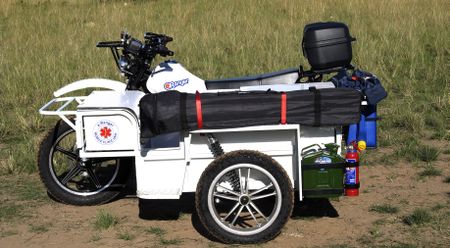
In May 2021, a controversial scooter ambulance tender in the province was set aside.
In November 2023, the provincial Health Department acknowledged it had only 439 ambulances against a required fleet of 650, with 190 of those vehicles out of service because of mechanical faults.
In August 2025, the department confirmed that staff shortages meant Nelson Mandela Bay could keep only 15 ambulances on the road despite having 36 vehicles available, forcing it to rely on private operators.
The province’s EMS crisis stretches back further still: In 2015, the South African Human Rights Commission ordered that the problem be addressed. At the time, the Nelson Mandela Bay metro was ranked as the worst off in the province.
“While the Nelson Mandela Metropolitan Municipality hosts the second-biggest population in the province, it has the smallest number of operational ambulances,” said the SAHRC report at the time.
But the latest figures raise another difficult question: what exactly does the department mean when it calls an ambulance “operational”?
The accounts from EMS sources share a glimpse into what this means on the ground.
“It’s not just about having the vehicle,” a source said.
“You need the stretcher. You need the equipment. You need the electrocardiogram (ECG) machines. You need the jump bags. You need the medication.”
‘If a plane fell this morning...’
Our source paints a grim picture of an EMS system operating with virtually no room for error, where even a single major incident could quickly overwhelm the limited number of ambulances available.
“If there was a plane that fell this morning in PE (Gqeberha), those people were going to have to save themselves.
“All it takes is one big accident on the N2 and a gang fight in the northern areas … and then you still have people that get sick.
“Now, if that should happen, PE will be under stress, and the emergency department will fall apart,” said the source.
The concern is that the public may already be adapting to the deterioration of the service, with people increasingly making alternative arrangements to transport sick or injured relatives to hospital.
“People are so used to it that they take their cars and they rather take their people to the hospital because they can’t depend on the ambulance services,” the source said.
“You can pull up a poll and ask anyone if they’ve got full, 100% trust in EMS. They’re going to say ‘no’.”
‘An unequipped ambulance is an empty box’
Hospersa has similarly warned that the crisis cannot be measured simply by counting vehicles parked at government depots.
Witbooi told Daily Maverick that ambulances lacking basic equipment should not be regarded as operational.
“EMS members cannot be driving an ambulance that is not fully equipped. It’s just an empty box of an ambulance,” she said.
She said some vehicles lacked essential equipment such as stretchers, oxygen cylinders and ECG machines.
In some cases, practitioners had allegedly been forced to physically carry patients into ambulances.
“In some situations, you would find practitioners having to carry a patient into an ambulance, and an incident can happen,” Witbooi said.
“These are the things that are increasing the litigation against the department on the basis that they are failing to actually provide what needs to be there in order to protect the human dignity of a person.”
The source said EMS workers were also struggling to receive the basic equipment and protective gear needed to perform their duties, with supplies allegedly being issued sporadically and often only after prolonged delays.
/file/dailymaverick/wp-content/uploads/MC-Ambulances-Estelle.jpg)
“We’re not even getting uniforms like we’re supposed to. We’re getting our uniform in dribs and drabs. Two pants a year; maybe the next year you’re going to get the boots.
“The guys are all CPG trained, they’re not getting the drugs that they’re supposed to get. They’re not getting the jump bags they’re supposed to get,” the source said
Promises made, but…
The department has announced an ambitious programme to replenish the province’s ageing ambulance fleet.
Health spokesperson Siyanda Manana said the department was working with Government Fleet Management Services (GFMS) and the Eastern Cape Department of Transport to strengthen the fleet.
The department said 14 new ambulances had recently been distributed in the Sarah Baartman District, along with seven patient transport vehicles and nine response vehicles.
It also announced a schedule for additional ambulances, with 20 due by 21 August, 26 by 4 September, 35 by the end of October, 74 by February 2027 and a further 40 by March 2027.
But EMS sources say promises of new vehicles have done little to reassure frontline staff.
“The news goes out that the ambulance department is going to get so many vehicles. The public hears, reads these things. Promises were made that they were going to deliver more vehicles,” the source said.
“But when I came on shift recently, I came to find out not only did they not deliver the vehicles, but we’re more short than what we were before we left four days ago.”
“Nothing came. Fokol came.”
‘Our morale is down’
Behind the failing fleet is a workforce that the source said was increasingly demoralised.
“EMS teams get treated like a stepchild,” the source said.
“The morale is down. The guys are at their wits’ end.”
Hospersa has also repeatedly raised concerns about the deteriorating operational capacity of EMS, shortages of ambulances and essential equipment, occupational safety risks and staffing challenges.
Witbooi said EMS practitioners were expected to perform their duties without the resources to do so safely.
The source also highlighted remuneration and the loss of experienced personnel, with some either seeking employment in the private sector or abroad.
“EMS gets paid so shit, that is why people are leaving to go work overseas, because they get paid what they are supposed to pay.”
The source said opportunities in the private sector were also becoming increasingly uncertain, while leaving the country was not an option for everyone.
Call for an investigation
The Eastern Cape’s vast geography compounds the crisis, with more than seven million people scattered across a largely rural province, while Nelson Mandela Bay alone is home to more than a million residents.
The national norm commonly referenced by the department is about one ambulance per 10,000 people.
Even measured against that norm, the Eastern Cape faces a substantial shortfall.
But the real concern is about the number of ambulances on paper that does not necessarily translate into the number of fully equipped vehicles available to respond.
“We’re failing the people,” the source said.
“And the managers and whoever is in charge of the EMS is going to get us killed.”
Cowley has called for an investigation into the failures surrounding the repair and maintenance of the provincial ambulance fleet.
/file/dailymaverick/wp-content/uploads/2022/08/MC-Hospital-Collapse.jpg "An ambulance outside Livingstone Hospital in Nelson Mandela Bay. (Photo: Shiraaz Mohamed)")
She has written to Capa, seeking urgent intervention, and to Eastern Cape Premier Oscar Mabuyane, asking him to prioritise the crisis.
“The failure does not lie with EMS personnel. Paramedics and frontline managers continue to work under extraordinarily difficult conditions, often in vehicles that lack essential equipment or fail to meet occupational health and safety requirements.
“The problem is financial. Medico-legal claims against the Eastern Cape Health Department have left it factually bankrupt, and while measures have been put in place to address these claims, all programmes within the department suffer the fiscal fallout,” Cowley said.
She said the department needed to fast-track repairs, address systemic maintenance failures, fill critical EMS vacancies and ensure ambulances were properly equipped and safe to operate.
The department’s response
Health spokesperson Manana said the department was addressing the challenges through its fleet replacement programme and other measures.
He said the province’s rural nature, ageing fleet, frequent breakdowns and the time required to repair and maintain vehicles had contributed to the difficulties.
The department said it could also draw on the Transport Department’s fleet for short-term replacement vehicles and had arrangements with private service providers to supplement the government fleet where necessary.
“The provincial government remains committed to strengthening ambulance services and ensuring that people across the Eastern Cape, particularly those in rural communities, can access emergency medical care when they need it most,” Manana said. DM
Comments
Scroll down to load comments...