



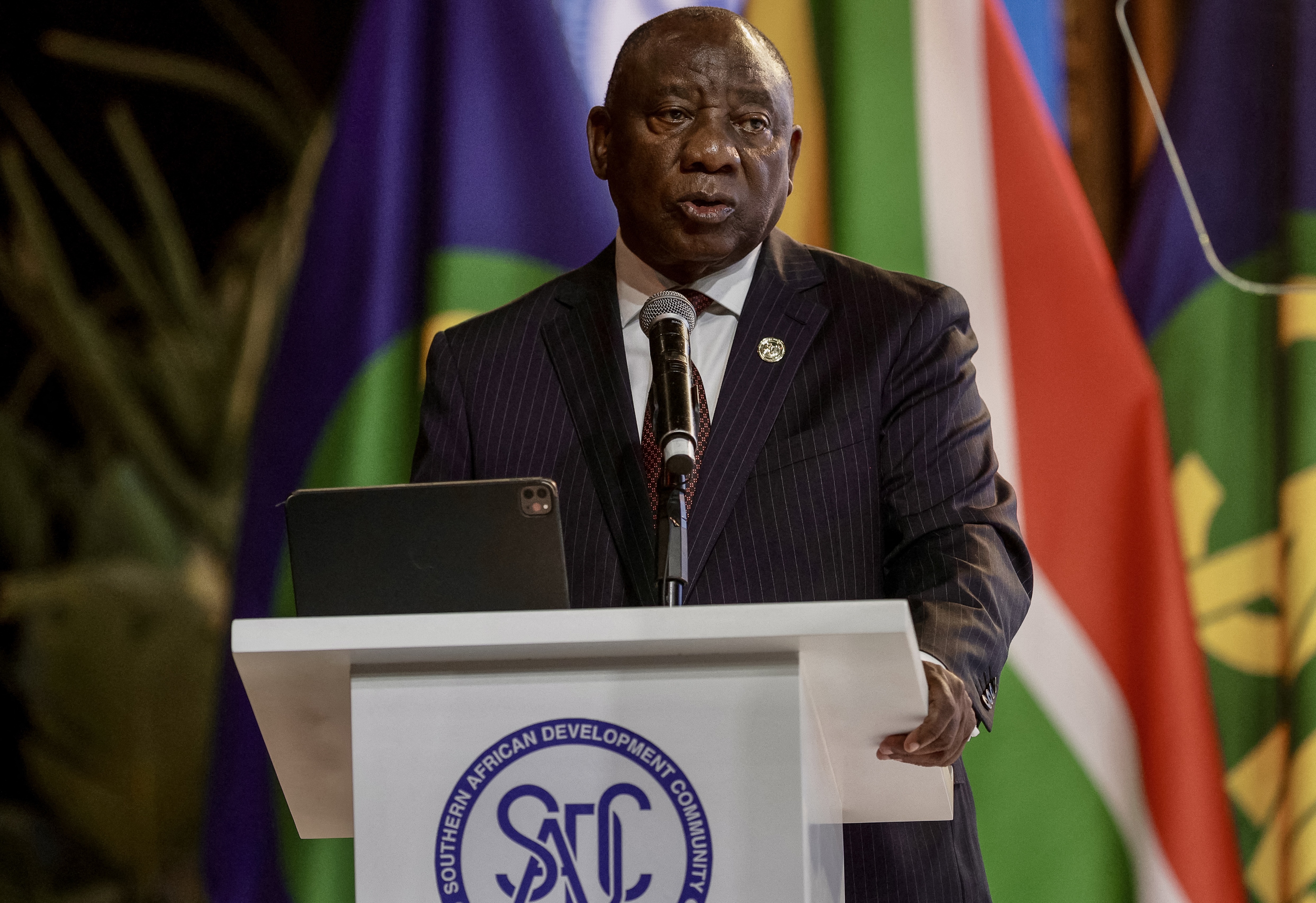
 President Cyril Ramaphosa delivers the welcome statement at the SADC Summit in Durban on 17 August. (Photo: Rajesh Jantilal / AFP)
President Cyril Ramaphosa has given the assurance that the perpetrators of violence against foreign nationals will be arrested and charged. He has also insisted that South Africa has not been snubbed or isolated by other African leaders because of the recent xenophobic violence.
He was replying in Parliament on Tuesday to questions from EFF leader Julius Malema, who asked why these perpetrators had not been arrested and prosecuted when, “We know who the instigators and the perpetrators of this violence are. They have a face.
“In certain instances, we have seen perpetrators unleashing their violence against African immigrants in the presence of the police. And yet not one of these perpetrators is arrested.
“This gives an impression that this violence is, in fact, state-sanctioned violence against African nationals,” the EFF leader said. “This hardens the attitude of our sister nations in the continent, because to them and to many of us, these are not isolated actions of vigilante groups, but rather actions aided by the state.”
Malema added that two of the perpetrators had even gone to meet Ramaphosa – apparently referring to the meeting the President had in June with Insizwa Nobunsizwa leaders Ngizwe Mchunu and Nkosikhona Ndabandaba. “You should have locked them up that day,” said Malema.
/file/dailymaverick/wp-content/uploads/2021/07/Ngizwe-Mchunu-.jpg "Ngizwe Mchunu")
Ramaphosa insisted that some perpetrators of violence had already been arrested and that there would be further arrests and prosecutions when the police had gathered enough evidence. He emphasised that action would be taken, especially against those who had caused injury or death.
“And of course those others who were seen to be leading these processes are also people who are of direct interest to the police, and that is a process that is going to be followed up,” he added.
Malema demanded what concrete steps the government was taking to ensure prosecution of perpetrators to protect foreign nationals “and to reassure the continent that this government does not condone xenophobia”.
Commitment
Ramaphosa replied, “The commitment I can make is that those who are perpetrating and have perpetrated acts of violence against foreign nationals are going to be dealt with.”
He said he was aware that other African leaders and their people were watching how South Africa managed the process. “And ... they will be able to see our seriousness in terms of dealing with the issue of migration.”
He added that other African leaders understood the complexity of the issue. According to him, some leaders suggested to the South African government that the violence against foreigners was being driven by unnamed outside forces aiming to destabilise the nation and strain its regional relationships.
Malema told Ramaphosa that the xenophobic violence – driven by March and March and other groups – had damaged South Africa’s standing on the continent. As evidence, he highlighted how Nigerian President Bola Tinubu snubbed International Relations Minister Ronald Lamola when he attempted to explain South Africa’s position.
/file/dailymaverick/wp-content/uploads/2024/06/11507856.jpg "Nigerian President Asiwaju Bola Ahmed Tinubu. (Photo: EPA-EFE)")
Malema asked Ramaphosa what he was doing “to restore the credibility of the republic as an honest pan-African voice in the continent and the diaspora”.
Ramaphosa insisted that “South Africa remains a respected member of the African community of nations and a principled pan-African actor. We continue to participate actively in continental as well as regional bodies and processes.”
While some African countries had raised concerns about anti-migrant actions, “As a government, we have firmly and publicly rejected xenophobia, Afrophobia, vigilantism and all forms of discrimination against people from other countries.”
He said his government had recently had direct engagements with other African leaders – mainly through his special envoy Lamola – to explain its position and approach. And last week at the SADC Summit in Durban, SA had briefed other leaders on the migration issue without being asked.
Multidimensional dialogue
In its communique, the summit “called for a coordinated and multidimensional dialogue at the regional level to address the underlying drivers of migration and develop comprehensive, sustainable and effective responses”.
He said South Africa continued to advocate for collective African solutions to the drivers of migration and that Lamola and he himself had been well received – even by Ghana – when they presented this view.
Ghana has demanded that the issue of xenophobic violence in South Africa be put on the agenda of the next ordinary summit of the African Union in February.
South Africa has instead called for a special AU summit dedicated to a discussion about migration as a continental problem. This summit would also address the drivers of migration, including poor economic and political governance and insecurity.
Ramaphosa denied that other African leaders had snubbed him or Lamola during their diplomatic engagement on migration. On the contrary, he said, the leaders had “articulated their deep understanding for what has been happening here and they have wished us well and they have said that they are willing and able to support South Africa as it deals with this difficult problem”.
Democratic Alliance MP Ryan Smith, his party’s spokesperson on foreign affairs, said South Africa could not keep using “respect for state sovereignty as a convenient excuse not to address brutal dictatorships next door”, which were propelling the people of those countries to flee to SA.
Ramaphosa said his government recognised why so many people from neighbouring countries flock to South Africa, noting it is widely viewed as an economic oasis. He added that others flee out of necessity – seeking refuge in South Africa because their lives are in danger.
But he said that the governance of these countries was for the citizens of those countries to determine – “and we respect the sovereignty of those countries”. Where there were challenges in the region, such as in Lesotho, Mozambique, Zimbabwe or Democratic Republic of the Congo, “it is the regional bodies that will take a firm view of what needs to be done. We are not lone rangers. We must act in unison with our region.” DM
Comments
Scroll down to load comments...