



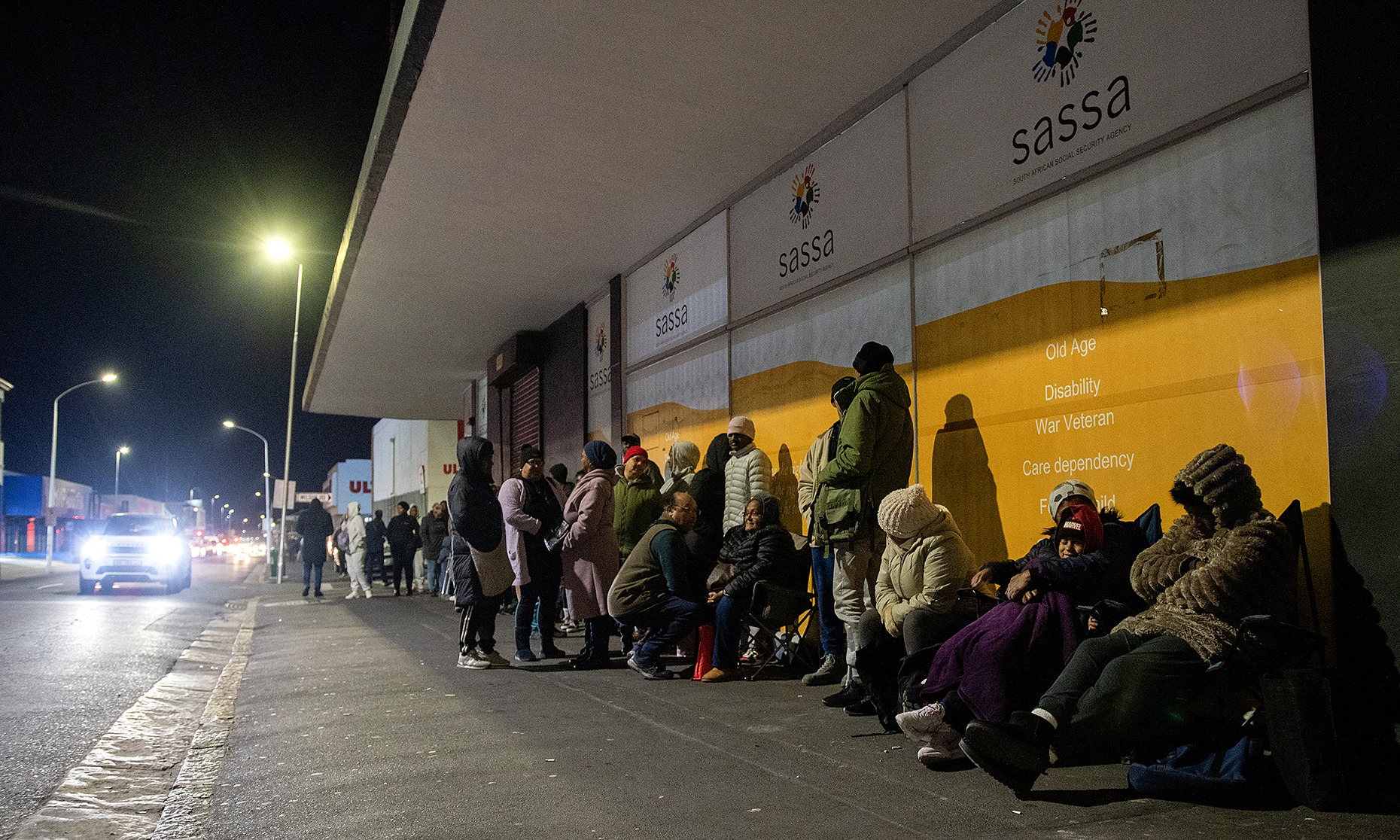
 An early-morning queue outside the Sassa office in Wynberg, Cape Town, on 22 July. (Photo: David Harrison)
An intensified grant review process by the South African Social Security Agency (Sassa) has turned into a nightmare for South Africa’s most vulnerable. Launched to weed out fraud, the nationwide audit has instead trapped lawful beneficiaries of various grants in bureaucratic chaos – suspending vital payouts without warning and forcing thousands into endless, pre-dawn queues at overcrowded offices to undergo verification processes and biometric registration.
Concerns around the grant review process come at a time when Sassa, the Department of Social Development and the National Treasury are preparing to appeal a landmark 2025 high court ruling that found critical aspects of the Social Relief of Distress Grant system, including its review system, unlawfully excluded millions of otherwise eligible applicants. The case was brought by the Institute for Economic Justice and #PayTheGrants, represented by the Socio-Economic Rights Institute.
The state’s appeal will be heard by the Supreme Court of Appeal on Tuesday, 25 August.
According to Sassa, the driving force behind the reviews is to strengthen the ability to detect and prevent fraud, eliminate irregular payments and ensure that social grants are paid only to those who qualify.
However, the experience for many vulnerable beneficiaries with legitimate claims to social grants has been gruelling. For some, the first time they become aware their grants are under review is when payments are suspended, cutting them off from vital income support and requiring repeated visits to overcrowded Sassa offices.
/file/attachments/orphans/SASSAELDOS5_231385.jpg "SASSA beneficiaries are forced to sit in queues during cold, windy and dark mornings to ensure they are near the front of the line when the office opens in Eldorado Park. Some told Daily Maverick they had nearly been robbed while making their way to the office in the early hours. (Photo:Leon Sadiki)")
Beneficiaries who receive and respond to review notices still face weeks – or even months – of delays as Sassa sites struggle to clear a growing backlog.
Daily Maverick travelled across South Africa and spoke with beneficiaries.
Polokwane, Limpopo
Florah Magagane (42) had been waiting outside Sassa’s Mankweng office since 6.30am. When Daily Maverick reached her in the afternoon, an all-day system outage had completely paralysed operations and stalled the line.
/file/attachments/orphans/FlorahMagagane1_428222.jpg "Florah Magagane waits for her turn at the Mankweng SASSA local office, Limpopo. (Photo: Leon Sadiki)")
Magagane spends roughly R80 per round trip to the office. She was there to reinstate three lapsed grants for her children: a Care Dependency Grant for her 16-year-old child living with a mental disability, and Child Support Grants for her 14-year-old and two-year-old.
In April, she was notified that her grants were up for review. She travelled to the Sassa office and submitted supporting documentation for verification. However, despite her efforts to comply, all three grants were suspended in July.
/file/attachments/orphans/Mankweng8_501343.jpg "Mankweng SASSA local office, Limpopo. (Photo: Leon Sadiki)")
Magagane spends about R1,000 a month on school transport for her children. Her 16-year-old recently changed schools, and without the support of the Care Dependency Grant, Magagane could barely afford the new school uniform.
“The problem is not us being needy – it’s them not knowing what they come to work to do,” she said of her experience at the Sassa office.
Magagane noted that she had been coming to the office since April, and constant system outages had derailed her efforts to sort out the grants. Sitting outside the facility, with her two-year-old child by her side, she said that if she could not receive help that day, she would have to return on another date – making yet another costly journey.
Sassa beneficiaries typically have 30 days to respond to a formal review notice, sent via SMS, though Sassa has said that beneficiaries are given up to 90 days to complete the review before a grant lapses.
Joburg, Gauteng
Sharolese Zovetski, a 33-year-old mother from Eldorado Park in Johannesburg, has seven children, six of whom are under 18. In January, the Child Support Grants she was receiving for her children were halted.
/file/attachments/orphans/SharoleseZovetski2_482815.jpg "Sharolese Zovetski helped by Elizabeth Raiters. Raiters helps beneficiaries dealing with grant suspensions and related issues at the SASSA Eldorado Park office, highlighting the struggles many face when trying to access the support. (Photo:Leon Sadiki)")
Because her cellphone number changed, she didn’t receive a notification from Sassa that her grants were under review. The first time she became aware of the situation was when she visited the local Sassa office to find out why her monthly payment hadn’t come through.
“They said I had to reapply [for the grants] because they thought that I’m working, but I’m not working. I’m unemployed. They want the termination [of employment] letter, and I must reapply,” said Zovetski.
“I’m a single parent. I’m staying with my mother – she’s a pensioner. It’s affecting me and my kids, and my mother even.”
/file/attachments/orphans/DSC_8020copy_578305.jpg "SASSA beneficiaries are forced to sit in queues during cold, windy and dark mornings to ensure they are near the front of the line when the office opens in Eldorado Park. Some told Daily Maverick they had nearly been robbed while making their way to the office in the early hours. (Photo: Leon Sadiki)")
Zovetski hasn’t worked since a temporary job three years ago, making it extremely challenging to obtain a formal termination letter.
She still receives the R370 Social Relief of Distress Grant, which she points out should have been cut too, if it was true that she were receiving income from elsewhere.
Despite three visits to the Eldorado Park Sassa office, her issue remains unresolved. Zovetski walks there at 5am, knowing any later arrival leaves her too far back in the queue to be seen.
/file/attachments/orphans/SASSAELDOS4_377157.jpg "SASSA beneficiaries wait in a dark office, using their cellphones to light up the room. They are forced to sit in queues during cold, windy and dark mornings to ensure they are near the front of the line when the office opens in Eldorado Park. Some told Daily Maverick they had nearly been robbed while making their way to the office in the early hours. (Photo:Leon Sadiki)")
/file/attachments/orphans/SASSAELDOS12_800804.jpg "SASSA beneficiaries are forced to sit in queues during cold, windy and dark mornings to ensure they are near the front of the line when the office opens in Eldorado Park. Some told Daily Maverick they had nearly been robbed while making their way to the office in the early hours. (Photo:Leon Sadiki)")
The long queues move slowly and grind to a halt when the system goes offline, said Zovetski.
“Sassa is putting a lot of caregivers under review, but as the people that are working at Sassa … how can they help 50 people out of 150 people that are queuing? It doesn’t make sense. And then the following day, the people go for the next queue and it’s the same story,” she said.
As the months without grant support drag on, Zovetski has struggled to cover expenses such as food and toiletries for her children.
“It’s affecting me emotionally … most of the time, seeing my kids suffering like this. I’m alone with my kids,” she said.
Daily Maverick spoke with Jakkie Botha, a 63-year-old grandmother living in Heavenly Valley informal settlement in Eldorado Park, who shares her home with two of her adult children and three young grandchildren.
/file/attachments/orphans/DSC_6740copy_932287.jpg "Jakkie Botha at her two-room corrugated-iron home in Eldorado Park, Soweto. She is a SASSA beneficiary and also collects grants on behalf of her grandchildren. (Photo..Leon Sadiki)")
In June, after her R2,400 Older Persons Grant was not paid into her bank account, she visited the bank to query the situation and was redirected to the local Sassa office.
Because she doesn’t own a phone, Botha was unaware her grant was under review. She has since made multiple 30-minute walks to the local Sassa office, attempting to submit documents and get her payments reinstated.
/file/attachments/orphans/JAKKIEBOTHA4_130087.jpg "Jakkie Botha at her two-room corrugated-iron home in Eldorado Park, Soweto. She is a SASSA beneficiary and also collects grants on behalf of her grandchildren. (Photo:Leon Sadiki)")
/file/attachments/orphans/JAKKIEBOTHA16_843052.jpg "Jakkie Botha at her two-room corrugated-iron home in Eldorado Park, Soweto. She is a SASSA beneficiary and also collects grants on behalf of her grandchildren. (Photo:Leon Sadiki)")
The grant suspension has hit Botha’s family hard. With her adult children unable to find stable work, Botha relied on the funds to buy R1,500 in monthly groceries and cover transport and crèche costs for three grandchildren, aged one, two and 14. Her eldest grandchild requires special needs schooling. The financial margin has always been razor-thin: even before the suspension, Botha often had to sacrifice her own clinic visits just to keep food on the table.
Botha is hoping that her grant will be reinstated this month. She said she would like to see Sassa taking better care of the elderly who are supporting families.
/file/attachments/orphans/Eldos3_715101.jpg "Eldorado Park residents rely on social grants to make ends meet, but payment delays and rising living costs continue to put pressure on vulnerable households.
<br>(Photo: Leon Sadiki)")
Cape Town, Western Cape
Outside the Bellville Sassa office in Cape Town, a 52-year-old mother, who requested anonymity, told Daily Maverick that she had arrived at the site at 3.50am with her young daughter to find out why her Child Support Grant had been suspended. She said Sassa never notified her about the suspension.
The mother said she had visited the Sassa office in Elsies River, where she lived, but was sent to the Bellville office. Reaching the site meant taking three taxis each way, costing her roughly R350 across three frustrating, unsuccessful trips.
/file/attachments/orphans/SASSAOfficeBelvilleDH6551copy_424897.jpg "A queue outside the SASSA office in Belville Cape Town, 22 July 2026. (Photo: David Harrison)")
She explained that she had already sat through the queue once for her own disability grant application, only to be told she needed to return on another date. She was then sent to the back of the queue to wait for assistance with the suspended child grant.
Her daughter, who has epilepsy and attends a special needs school, was missing classes to be at the Sassa office. Unlike others, she had not queued outside the office from the night before, fearing for her daughter’s health and being targeted by criminals.
/file/attachments/orphans/SASSAOfficeWynbergEarlyMorningQueueDH0198copy_473245.jpg "Queues start early in the morning outside the SASSA office on Wynberg Main Road, 30 July 2026. (Photo: David Harrison)")
When Daily Maverick visited the Wynberg Sassa office, the system was still offline in the afternoon, after going down earlier that morning.
A mother waiting in the queue with her toddler said that she had arrived at the office before 6am to seek assistance with getting three suspended Child Support Grants reinstated. Sassa had messaged her that she needed to update her details, but when she tried to call the office to get more information, she got no answer.
She said she did not know what had triggered the suspension.
Phuthaditjhaba, Free State
In July, Meisi Mofokeng, a resident of Tseki in Phuthaditjhaba, found out that the Child Support Grant she received for her 14-year-old son had been suspended. When she approached the Phuthaditjhaba Sassa office, she was told she had not received a review notice as her number had changed.
/file/attachments/orphans/MeisiMofokeng2_115561.jpg "Meisi Mofokeng got her grant suspendent at the Phuthaditjhaba SASSA office. (Photo: Leon Sadiki)")
It took her two visits to the Sassa office to complete the verification process for reinstatement, as officials informed her that assistance for individuals living in her area was only available on specific dates. She is still waiting to find out whether her grant will be issued in August.
“When they don’t help you [at the Sassa office], you must come next week. The problem is … when I go there, I leave home at 5.45am … but they help me at 3.45pm,” said Mofokeng.
“They said the system was offline twice. But we sit there. And if it’s not the system, they say it’s the electricity.”
The area experiences frequent electricity outages, which reportedly affect the provision of services at government institutions like Sassa.
Challenges in the grant review process
Thandi Henkeman, the Black Sash’s Western Cape regional manager, observed that many grant beneficiaries had been unaware their grant was under review, let alone the reasons they had been flagged for verification or the documents required at Sassa offices.
/file/attachments/orphans/BlackSashOfficeHoodahAbrahams-FaykerandThandiHenkemanandThandiHenkemanDH9470copy_496689.jpg "\"Making Human Rights Real\": Black Sash Advocacy Manager Hoodah Abrahams-Fayker (left) & Western Cape Regional Manager Thandi Henkeman & at their Cape Town head-office. The prominent human rights organisation marked it's 70th anniversary in 2025. (Photo: David Harrison)")
“It has a real knock-on effect that we can’t ignore. When communication lags in a process like this, it means that beneficiaries have to run from pillar to post in order to get the required documentation, at their own cost, and sometimes sleeping over [at Sassa offices] and then being turned away, because there’s not enough capacity to see to them,” she noted.
“When grants are disrupted, sometimes for weeks and even months at a time, it places that household in a crisis. And so, for administrative fairness purposes, but also in general, communication needs to be definitely looked at and improved, and reach every single beneficiary.”
She highlighted the barriers preventing beneficiaries from easily accessing Sassa’s services, including:
Digital barriers, particularly in rural areas with poor infrastructure, network coverage and Wi-Fi access, that make it difficult to use online tools such as Sassa’s e-Life Certification Portal;
Administrative barriers, in the form of long queues and understaffed offices;
Unreliable Sassa systems, including its website, call centres and biometric system; and
Geographic barriers, where beneficiaries face long distances and high transport costs to access Sassa sites.
Henkeman emphasised the importance of strengthening the communication strategy around the reviews to better inform beneficiaries on the ground how to proceed. She also highlighted the power of partnerships with civil society organisations, including community advice offices, to bridge the gap between Sassa and grant recipients.
“We always encourage Sassa to lean into those sorts of organisations who want to lend a helping hand and who are able to bring services, as much as they can, into the community,” she said.
Reports from grant benificiaries, community activists and even Sassa officials across different areas have indicated that the increased traffic at Sassa offices due to the grant review process has placed additional pressure on a system that is already overburdened and understaffed.
‘This is very urgent’
Elizabeth Raiters, a community activist in Eldorado Park who helps grant beneficiaries navigate challenges, described the frustration of accompanying people to the Sassa office before dawn, again and again, only to leave without assistance.
/file/attachments/orphans/ElizabethRaiters1_941489.jpg "Elizabeth Raiters helps beneficiaries dealing with grant suspensions and related issues at the SASSA Eldorado Park office, highlighting the struggles many face when trying to access the support. (Photo:Leon Sadiki)")
“This is very urgent because it’s not right that children have to suffer because of the incompetence... I’ve been speaking to [Sassa] since I started with the review story. I told them, ‘You guys know that your Sassa offices ... are understaffed already, so you are implementing all these new changes without thinking of how is it affecting the beneficiaries and the people; the poor who need that money,’” she said.
Sassa responds
Sassa said it had conducted 105,600 of 352,000 targeted grant reviews during the first quarter of the 2026/27 financial year. The process has resulted in estimated savings of R450-million.
“Sassa has identified 169 cases of suspected fraud during the 2026/27 financial year. All identified cases are subjected to further investigations,” said Sassa.
The agency noted that one of the main challenges in communicating review notices was that beneficiary contact information was not always up to date, and encouraged beneficiaries to update their personal and contact details to ensure they receive important notifications.
“It is important to note that beneficiaries identified for review are not immediately removed from the social assistance system. Grants generally remain active during the review process to allow beneficiaries an opportunity to comply with the review requirements. To facilitate the necessary verification activities, payments may be released later in the payment cycle rather than on the normal grant payment date,” said Sassa.
/file/attachments/orphans/SASSA02-BRITS-06AUG26_645692.jpg "South African Social Security Agency (SASSA) beneficiaries stand in a queue as they await assistance from officials in Brits, North West, on Aug 6, 2026. The beneficiaries gathered to seek assistance with social grant-related services, with some seeking clarification after their grants were placed under review or suspended, while others sought help with general queries. (Photo: Leon Sadiki)")
Asked about the frequent system outages at its offices, Sassa said it relies on multiple integrated systems and interfaces to process grant applications and reviews.
“Intermittent technical disruptions may occasionally affect service delivery. The agency works closely with its ICT partners and service providers to identify root causes, restore services promptly and implement measures to improve overall system reliability,” said Sassa.
“The biometric enrolment process relies on integrations with other government systems for verification purposes. While intermittent connectivity challenges may occur from time to time, Sassa and its partners continuously engage to minimise disruptions and ensure that services are restored as quickly as possible.”
/file/attachments/orphans/SASSAOfficeBelvilleDH6519copy_240899.jpg "A queue outside the SASSA office in Belville Cape Town, 22 July 2026. (Photo: David Harrison)")
On 21 July, the minister of social development, Dina Pule, announced that more than 1,000 contract workers had been recruited countrywide to provide additional frontline support at Sassa offices.
Sassa noted that it had introduced several digital initiatives to improve the efficiency of the review and life certification processes, and reduce “unnecessary visits to local offices”. This included a WhatsApp channel that enabled beneficiaries to check whether they are required to undergo a grant review or complete a life certification.
“Sassa acknowledges that some beneficiaries have experienced delays during the review process and continues to implement measures aimed at improving service delivery and client convenience,” said the agency.
“Going forward, Sassa intends to expand its range of digital services to provide beneficiaries with more opportunities to access services through self-service channels. This will help reduce queues at local offices, improve turnaround times, and enhance the overall client experience. Many of the beneficiaries served by Sassa already have access to mobile devices and digital platforms, creating opportunities to increase the uptake of these services.” DM
/file/attachments/orphans/ChildrensReporterV2_187851.jpg "Tamsin-DG-Murray-Trust")
Comments
Scroll down to load comments...