




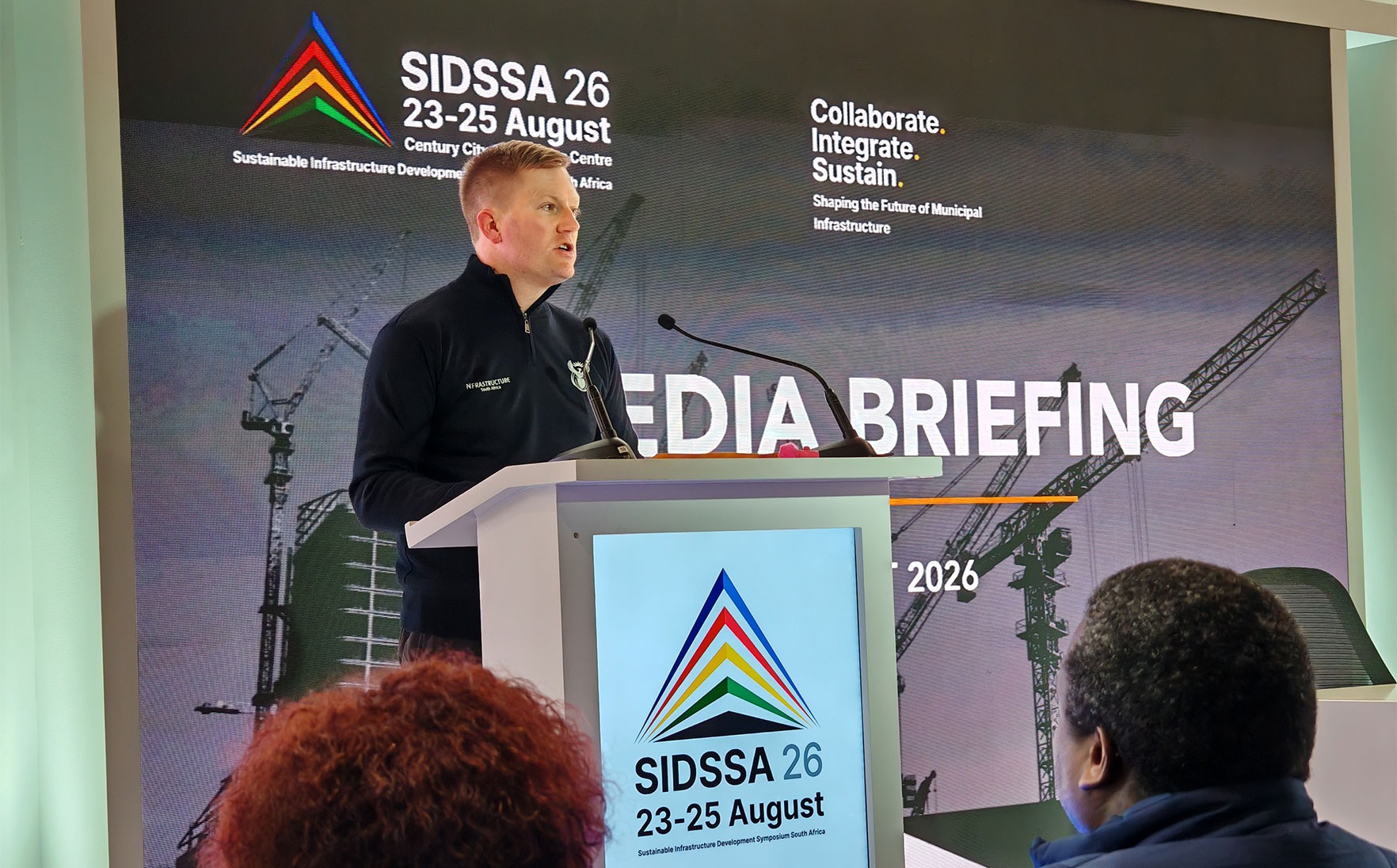
 The minister of public works and infrastructure, Dean Macpherson, welcomes mayors and investment partners to Sidssa 2026. (Photo: Lindsey Schutters)
Unveiling a strategic pivot at the sixth annual Sustainable Infrastructure Development Symposium South Africa (Sidssa), Public Works Minister Dean Macpherson and Infrastructure South Africa (ISA) head Mameetse Masemola refocused priority from national mega-projects to local-scale development and structural integrity.
Macpherson described Sidssa as the country’s “second-most important investment conference” – an accurate assessment, considering the monumental task ahead.
Reaching the National Development Plan (NDP) 2030 target of boosting gross fixed capital investment to 30% of national GDP will require ISA to mobilise R1.6-trillion in extra capital. This is over and above the R1.1-trillion the Treasury has already allocated for infrastructure projects. Highlighting the scale of the challenge, Masemola pointed out that South Africa’s fixed capital investment is currently only 13.75% of GDP.
To close this massive investment gap, she explained that South Africa has to bring 16 to 20 mega infrastructure investments into procurement and construction every single year.
Taking it to the people
That’s at a national level, but Macpherson is now laser-focused on local-level visibility. He told Sidssa:
“This year’s theme is about shaping the future of municipal infrastructure. It reflects our focus on improving infrastructure delivery where South Africans and businesses experience the state most directly at a local level. Municipal infrastructure is essential to service delivery and economic growth. Reliable water, sanitation, electricity, roads, and waste services determine where the communities and businesses can function. Improving these systems requires more than additional funding.”
Macpherson and Masemola were not shy of giving the Ramaphosa administration 2.0 (aka the GNU) bouquets when merited. One such case was the Presidential Adopt-a-Municipality programme, which is designed as a targeted pilot to bypass traditional infrastructure preparation bottlenecks in smaller local authorities.
Crucially, there is a clear distinction between the municipal selection process and the broader project preparation facility, which currently supports 26 high-value projects.
The programme specifically targets, by Masemola’s definition, “municipalities that are relatively small, but structurally stable and well-run, yet lack the technical bandwidth or financial resources to package large-scale infrastructure investments”.
She highlighted a major validation of this selection methodology:
“None of the municipalities chosen for this pilot programme appeared on the National Treasury's list of 69 municipalities facing the withdrawal of their financial transfers or allocations.”
This confirms that the initial assessment dimensions used by ISA successfully identified stable municipalities that required only technical packaging support to get projects over the finish line.
Influence at municipal level
Macpherson put aside party politics and gave credit where due, saying:
“Through the Presidential Adopt-a-Municipality programme, ISA is helping a number of municipalities to prepare projects seeking to unlock approximately R7-billion in water, sanitation, energy and waste management investment. The support is intended to strengthen municipal capacity, not replace municipal responsibility.
“Over the past 18 months, Infrastructure South Africa has committed R131-million to supporting local government infrastructure... An investment of approximately R1.8-million to prepare a non-revenue water programme across a network of around 1,700km [in uMshwathi Local Municipality] helped to unlock an R800-million debt financing facility from the Development Bank of Southern Africa.”
Macpherson presented the findings on the fatal May 2024 George building collapse but declined to answer questions about the report at Sidssa. Because structural disasters represent the worst-case scenario of weak municipal oversight, Daily Maverick pressed him on what concrete steps the Department of Public Works and Infrastructure is taking to protect metros and local authorities.
As it turns out, Macpherson’s department is executing a dual-track strategy to prevent municipalities from unwittingly doing business with compromised, blacklisted or unregistered engineering firms. This involves strengthening professional regulatory powers through national legislation.
Macpherson confirmed that the Council for the Built Environment has established a central digital repository, allowing municipalities to check professional standing and avoid hiring blacklisted personnel.
Currently, regulatory info remains fragmented: municipalities hold building plans, the Department of Employment and Labour holds safety permits, and professional councils hold registration statuses. The repository aims to integrate these silos so warning signs are not missed.
/file/attachments/orphans/IMG_20260823_133307_147932.jpg "Infrastructure South Africa head Mameetse Masemola was pleased to announce that none of the 26 municipalities adopted by ISA in the pilot assistance programme appeared on Treasury's naughty list of delinquent municipalities. (Photo: Lindsey Schutters)")
Legislation is better than just blacklisting
The primary legislative mechanism is the upcoming Council for the Built Environment Amendment Bill, which will be gazetted for public consultation.
The Bill will formally empower professional councils (such as the Engineering Council of South Africa – Ecsa) to proactively police, deregister and criminally prosecute individuals who bypass safety regulations.
“Blacklisting [is not good enough]”, said Macpherson, “there must be criminal prosecutions for people that are breaking the law. So the work that Ecsa is doing is really, really important and that’s part of the reform that we’re doing on the Council for the Built Environment ... Amendment Bill that we’re going to be bringing about, giving power to our councils to actually take on [offenders].”
Macpherson is advocating for a shift where professional misconduct that leads to structural collapse and loss of life is treated under criminal law as manslaughter or murder, rather than a mere professional deregistration.
President Cyril Ramaphosa will be at Sidssa on Tuesday to unveil the third edition of the South Africa Construction Book – which, for the first time, will contain public-private partnership projects – but the frontline commanders are driving the local government infrastructure reforms he has laid out.
It looks like South Africa is moving forward and becoming a construction site. DM
Comments
Scroll down to load comments...